
10 Things Buddhism Doesn’t Actually Teach—Despite What Pop Culture Says
Mention Buddhism and a familiar picture appears almost instantly.
A smiling Buddha statue. Meditation. Mindfulness. Karma. Reincarnation. Vegetarian food. Peaceful monks who have somehow learned not to want anything.
Some of those associations have a basis in Buddhist tradition.
Others are misleading.
Buddhism has existed for roughly 2,500 years and spread across cultures ranging from India and Sri Lanka to Tibet, China, Japan, Korea, Southeast Asia, and eventually the West. Along the way, it developed an enormous variety of schools, scriptures, rituals, philosophies, and practices.
Trying to summarize all of that as “be peaceful, meditate, and collect good karma” leaves out most of the story.
Here are 10 things Buddhism doesn’t actually teach—at least not in the simple way popular culture often suggests.
1. Buddhism Doesn’t Teach That the Buddha Was a Creator God
Walk into a Buddhist temple and you may see people bowing before an image of the Buddha, lighting incense, leaving offerings, or chanting.
To someone raised around Western monotheistic religion, the conclusion can seem obvious.They’re worshipping their god.
But the historical Buddha, Siddhartha Gautama, isn’t generally understood in Buddhism as a creator deity who made the universe. He is the Buddha—the “Awakened One”—who realized the nature of suffering, its causes, and the path toward liberation.
That doesn’t mean Buddhist traditions are devoid of gods or supernatural beings. Buddhist cosmologies can contain numerous devas, heavenly beings, spirits, bodhisattvas, celestial buddhas, guardians, and other figures.
But Buddhism doesn’t organize them around an all-powerful creator God equivalent to the God of Christianity, Judaism, or Islam.
Even gods aren’t necessarily free from the cycle of existence. Being divine and being liberated are not the same thing.
2. Karma Doesn’t Mean “The Universe Will Get You”
Someone cuts you off in traffic.
“Karma will get him.”
A celebrity behaves badly and loses everything.
“That’s karma.”
The popular version of karma often sounds like a cosmic police department that watches people behave badly and arranges ironic punishments.
Buddhist karma is more complicated.
The term is closely connected with intentional action. Actions motivated by greed, hatred, or delusion have consequences, just as actions shaped by generosity, compassion, and wisdom do. But karma isn’t necessarily immediate, obvious, or designed to satisfy our sense of poetic justice.
Someone suffering today isn’t automatically being “punished” for something we can identify, and Buddhism doesn’t give outsiders permission to look at another person’s tragedy and smugly announce that they deserved it.
Karma operates within a much larger framework involving intention, causation, rebirth, and the conditions shaping experience.
It’s not “what goes around comes around” with better branding.
3. Buddhism Doesn’t Teach Reincarnation Quite the Way People Think
Here’s one of Buddhism’s strangest philosophical problems.
Buddhism teaches rebirth. It also famously teaches anatta or anatman—the absence of a permanent, unchanging self.
So what exactly gets reborn? That’s not a minor question. Buddhist philosophers have wrestled with it for centuries.
Popular descriptions often turn Buddhist rebirth into a simple idea: you possess a soul, you die, and that same soul moves into another body.
That’s much closer to the kind of reincarnation model many Westerners already imagine than to the way Buddhism traditionally frames the problem.
Buddhist traditions generally reject the idea of an eternal, independent soul passing unchanged from body to body. Instead, rebirth is explained through causal continuity.
One life conditions another without requiring an immortal self to travel between them.
Different Buddhist schools explain the process differently, and the philosophy can become extremely sophisticated.
But the central paradox remains fascinating.There is rebirth. There isn’t an eternal “you” being reborn in the simple sense most people expect.
4. Buddhism Doesn’t Say All Desire Is Bad
“Buddhism teaches that desire causes suffering.”
That’s one of the most common one-sentence summaries of the religion.
It’s also too crude.
The Buddhist analysis of suffering focuses especially on craving, grasping, and attachment. The problem isn’t that a human being ever wants anything.
Wanting to help someone isn’t equivalent to compulsively clinging to status. Wanting to understand Buddhist teachings isn’t treated the same way as an insatiable craving for wealth. Aspiration toward awakening is obviously difficult to condemn in a religion organized around awakening.
Buddhist traditions therefore make distinctions among different kinds of desire and motivation.
The problem is the kind of craving that tries to make impermanent things permanent, builds identity around what cannot last, and continually demands that reality satisfy our attachments.
That’s a much subtler idea than “stop wanting things.”
If Buddhists literally wanted nothing, nobody would ever decide to practice Buddhism.
5. Buddhism Doesn’t Require Every Buddhist to Meditate for Hours a Day
If you asked many Westerners to name the defining Buddhist practice, meditation would probably win easily.
Historically, things are much more complicated.
Buddhist laypeople across Asia have practiced their religion through generosity, ethical precepts, chanting, pilgrimage, ritual, temple support, devotional practices, festivals, merit-making, and reverence for monastic communities.
Meditation has always been important, but it hasn’t necessarily been the daily practice of every Buddhist.
In fact, Buddhist scholars Robert Buswell and Donald Lopez note in Tricycle’s discussion of common Buddhist misconceptions that throughout much of Buddhist history, meditation was particularly associated with monastic specialists rather than something routinely practiced by the majority of lay Buddhists.
The modern Western picture of Buddhism has been strongly shaped by the enormous popularity of meditation and mindfulness.
Those practices are genuinely Buddhist.
They’re just not the whole religion.
6. Buddhist Meditation Isn’t About Making Your Mind Completely Blank
“Clear your mind.”
It’s probably one of the most common meditation instructions people think they’ve heard.
Try actually doing it and you’ll discover the problem within seconds.
Thought.
Thought.
Another thought about why you’re still thinking.
Fortunately, Buddhist meditation doesn’t generally require turning the brain off.
There are many forms of Buddhist meditation. Some cultivate concentration. Some examine bodily sensations. Some develop loving-kindness and compassion. Some involve visualization. Some investigate impermanence or the nature of the self. Some use attention to breathing.
Even mindfulness isn’t simply “thinking about nothing.”
It involves particular qualities of attention and awareness.
The idea that successful meditation means producing a perfectly blank mind can actually make beginners think they’re failing whenever a thought appears.
The mind thinks.
The practice is what you do with what appears.
7. Buddhists Don’t All Have to Be Vegetarian
Buddhism’s emphasis on compassion and non-harming makes vegetarianism seem like an obvious universal rule.
It isn’t.
Attitudes toward eating meat vary dramatically among Buddhist traditions.
Vegetarianism became particularly influential in several East Asian Mahayana traditions, and many Buddhist teachers and communities strongly advocate it.
Other traditions permit meat under particular circumstances.
Early Buddhist monastics depended heavily on food offered by laypeople and weren’t necessarily expected to demand a specially prepared vegetarian meal. Traditional rules developed concerning circumstances in which meat could or couldn’t be accepted.
Tibetan Buddhist communities also developed in environments where climate and agriculture could make strict vegetarian diets historically difficult.
Today you’ll find Buddhists who are vegan, vegetarian, occasional meat eaters, and regular meat eaters.
That doesn’t mean Buddhism is indifferent to animal suffering.
It means a religious ethical principle can produce different practical rules in different communities.
8. Buddhism Doesn’t Teach That Life Is Nothing but Misery
Another famous summary goes something like this: “Buddhism says life is suffering.”
It sounds relentlessly bleak.
The actual idea is more nuanced.
The First Noble Truth concerns dukkha, a term often translated as suffering but carrying a wider range of meanings, including unsatisfactoriness, stress, instability, and the inability of conditioned experiences to provide permanent fulfillment.
Obvious suffering is part of it: sickness, grief, pain, aging, and death.
But Buddhism also points toward a subtler problem.
Pleasant things change.
People we love change. Our bodies change. Success fades. Possessions break. Experiences end. Even when life is going wonderfully, we can’t force that moment to remain exactly as it is.
The diagnosis therefore isn’t “every second of life is horrible.”
It’s that an impermanent world can’t provide the permanent security our craving keeps demanding from it.
And Buddhism doesn’t stop with the diagnosis.
The remaining Noble Truths address the cause of dukkha, its cessation, and the path toward that cessation.
Calling Buddhism pessimistic because it talks about suffering is a little like calling medicine pessimistic because doctors talk about disease.
The point is finding a way out.
9. Buddhism Doesn’t Teach That Every Buddhist Believes Exactly the Same Thing
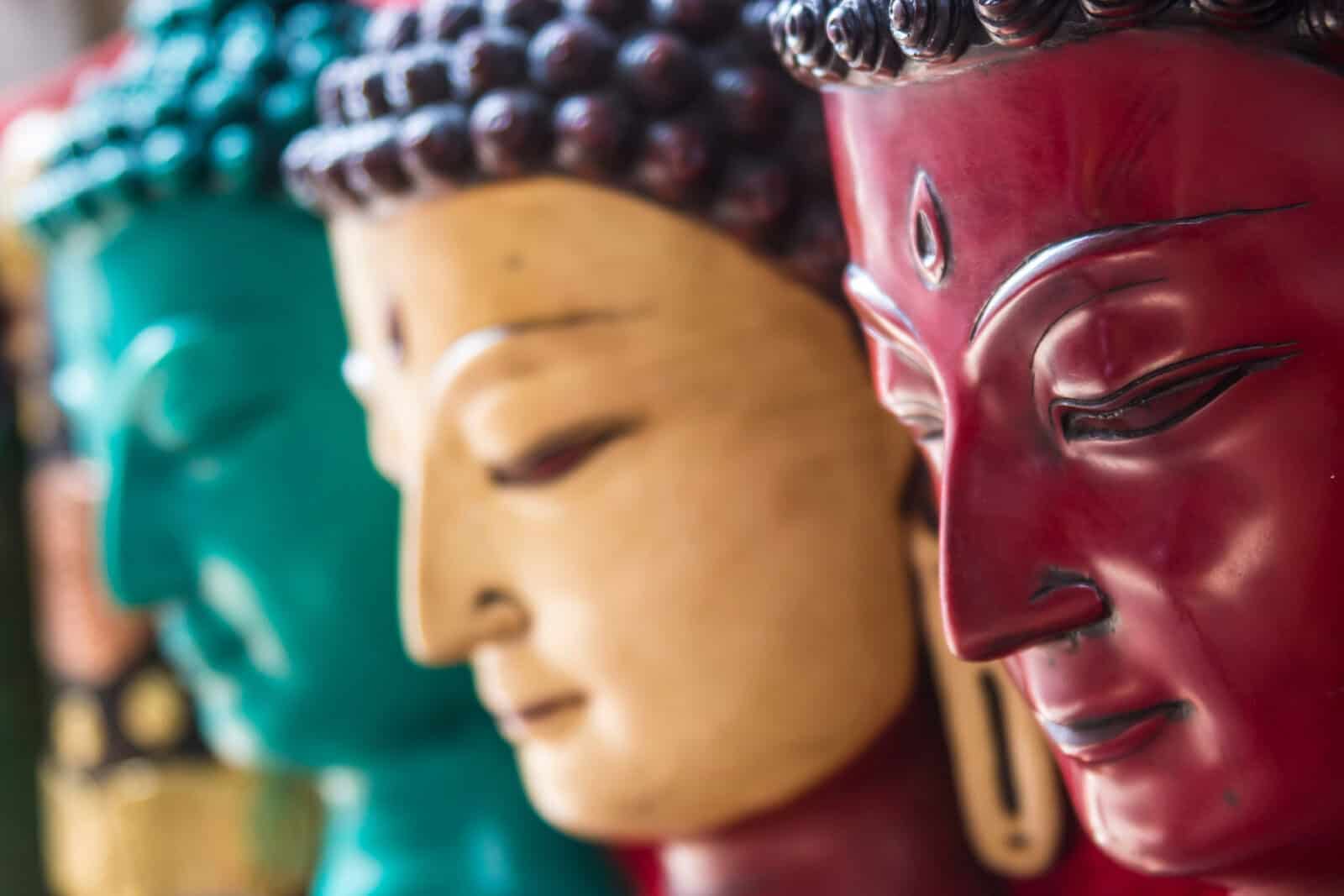
There isn’t just one Buddhism.
Theravada traditions became dominant in places including Sri Lanka, Thailand, and Myanmar. Mahayana traditions developed across China, Korea, Japan, Vietnam, and elsewhere. Tibetan Buddhism contains multiple schools of its own.
Then there are traditions such as Zen, Pure Land, Nichiren, and many others.
They share historical roots and important teachings, but they can differ dramatically in philosophy, scriptures, rituals, devotional practices, meditation techniques, monastic organization, and ideas about the path toward awakening.
Some emphasize meditation.
Some emphasize devotion.
Some contain elaborate rituals and vast pantheons of celestial figures. Others may look comparatively austere.
The Stanford Encyclopedia of Philosophy’s overview of Buddhist philosophy illustrates how even foundational Buddhist concepts involve sophisticated philosophical arguments rather than one simple body of universally interpreted doctrine.
Asking “What do Buddhists believe?” can therefore be a little like asking “What do Christians believe?”
You can give a useful answer.
But you’d better expect footnotes.
10. Nirvana Isn’t Simply the Buddhist Version of Heaven
This may be the biggest misconception of all.
If Christians want heaven, the popular assumption goes, Buddhists want nirvana.
Different word, same basic destination.
Not quite.
Buddhist cosmology can include heavenly realms. Beings can be reborn into extraordinarily pleasurable states as a result of favorable karma.
But those heavens are still part of samsara—the cycle of birth, death, and rebirth.
They don’t last forever.
Eventually, the conditions sustaining that existence end.
Nirvana is something fundamentally different.
It represents liberation from the craving, ignorance, and conditions that perpetuate samsara. It’s not simply the nicest possible place to be reborn.
It’s freedom from the cycle that makes another rebirth necessary.
That distinction completely changes the goal.
In popular Western religion, heaven is often the destination you hope finally to reach.
In Buddhism, even heaven may be somewhere you eventually have to leave.
Buddhism Is Stranger—and More Diverse—Than the Version Pop Culture Gave Us
Western culture has a habit of turning Buddhism into a personality type.
Be calm.
Live simply.
Meditate.
Don’t judge people.
Believe in karma.
Put a Buddha statue somewhere peaceful.
None of those associations came from nowhere, but together they can transform a 2,500-year-old religious tradition into something resembling a wellness philosophy.
Historical Buddhism is much bigger and stranger.
It contains heavens and hells, monastic codes, supernatural beings, relics, devotional rituals, philosophical debates, rebirth, elaborate cosmologies, meditation systems, sacred texts, pilgrimage sites, ethical rules, and radically different schools of thought.
Even mindfulness—the practice most strongly associated with Buddhism in modern Western culture—is only one part of that enormous world. As Tricycle’s overview of Buddhist misconceptions points out, Buddhist traditions contain hundreds of forms of meditation rather than one universal mindfulness technique.
That’s what makes Buddhism difficult to squeeze into a slogan.
The closer you look, the less it resembles the simplified version most of us were given.
You may want to read:
- What if the Jesus you know is not the Jesus of the Bible?
- Why Christians believe these 10 belief systems conflict with Christianity
- 10 Things People Get Wrong About Heaven, Hell and the Afterlife in Different Religions