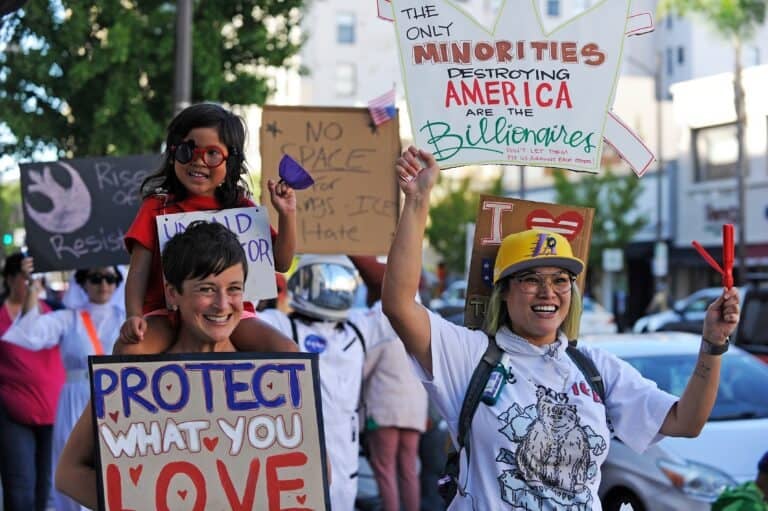
American pride falls to 25-year low, Gallup poll finds — and the online reaction reveals a deeper national split
A country can celebrate its history, wave its flags, and prepare for milestone anniversaries, yet still find itself wrestling with a far more uncomfortable question: what does it actually mean to be proud of it?
That tension sits at the center of a new Gallup poll showing American pride has fallen to its lowest level in 25 years. Just 53% of adults now say they are either “extremely” or “very” proud to be American, while only 33% say they are “extremely proud” at all. It marks a significant shift from the early 2000s, when roughly nine in 10 Americans expressed high levels of national pride.
But the numbers are only half the story. The other half is unfolding in real time online, where Americans are not just reacting to the data, they are arguing over what the data even means.
A long decline that didn’t happen overnight
Gallup’s long-running trend shows a gradual but unmistakable erosion in national pride over two decades. After peaking in the post-9/11 years, when unity and shared identity surged, pride remained high through the early 2000s before slowly slipping.
By the mid-2010s, the decline became harder to ignore. The share of Americans saying they are “extremely or very proud” dropped to the mid-70s, then into the 60s, and now sits at just over half of adults.
This is not a sudden collapse. It is a slow unwinding of consensus, one shaped by political polarization, generational change, and growing skepticism toward institutions that once anchored national identity.
The real divide is not just political — it’s emotional
The sharpest divide in the Gallup data is partisan, but it is also deeply emotional.
Republicans continue to report very high levels of pride, with 70% saying they are extremely proud. Democrats, by contrast, show dramatically lower levels, while independents fall in between.
This creates a striking imbalance: one political group largely maintains traditional expressions of patriotism, while another increasingly withholds them.
The result is not just disagreement about policy. It is a disagreement about if pride itself is appropriate, justified, or even meaningful in today’s America.
Younger Americans are rewriting the meaning of patriotism

The generational gap is just as significant as the partisan one.
Younger adults consistently report lower levels of national pride compared to older generations. Gen Z and millennials are far less likely to say they are “extremely proud,” while older Americans, especially baby boomers and the Silent Generation, remain far more likely to express strong pride in the country.
But this does not necessarily mean younger Americans feel disconnected from the country itself. Instead, it reflects a shift in how patriotism is expressed.
For many younger adults, pride is no longer automatic. It is conditional — tied to issues like economic opportunity, social justice, political accountability, and whether the country is living up to its stated ideals.
That shift changes the tone of patriotism from affirmation to evaluation.
What social media is revealing about public sentiment
While polling captures the numbers, social platforms reveal the reaction, and it is increasingly polarized in tone.
In discussions about the Gallup findings on Reddit, users questioned not just the decline in pride, but the concept itself. Some expressed surprise that the percentage of Americans still reporting pride is as high as it is, while others questioned what exactly people are still proud of.
The conversation reflects a broader cultural shift: national pride is no longer treated as a default assumption, but as a debatable position.
Instead of a shared emotional baseline, there is now a fragmented landscape of interpretation. For some, pride is tied to historical achievements, democratic ideals, and global influence. For others, it is difficult to separate pride from ongoing debates over inequality, politics, and institutional performance.
The result is not just disagreement; it is competing definitions of patriotism playing out in public view.
Trust, institutions, and the shrinking emotional center

Behind both the polling and the online reaction is a more structural issue: declining trust in institutions.
Surveys from multiple research organizations show a steady decline in confidence in government, media, and political leadership over the past two decades. Pew Research Center, for example, finds that only about 17% of Americans say they trust the federal government most of the time or always.
When institutions lose credibility at this scale, national pride often weakens as well, since it is closely tied to the belief that the system functions effectively and fairly. This helps explain why younger and politically independent Americans show lower levels of pride. Their political identity is less anchored to institutions and more shaped by skepticism toward them.
In that environment, pride becomes harder to sustain in its traditional form.
The contradiction inside the numbers
One of the most important nuances in the Gallup data is that declining pride does not mean disappearing attachment.
A majority of Americans still express at least moderate pride in the country. The shift is happening at the extremes: fewer people say they are “extremely proud,” while more are moving toward conditional or measured forms of attachment.
That distinction matters. It suggests not a rejection of the country, but a redefinition of what emotional loyalty looks like.
For some, patriotism is becoming less about celebration and more about accountability. Less about declaring pride, more about demanding improvement.
Why this moment feels different

The timing of the decline adds weight to the findings. As the United States approaches major national milestones, including its 250th anniversary, questions about identity and cohesion take on greater symbolic importance.
In earlier eras, such milestones tended to reinforce unity. Today, they arrive in a more fragmented emotional environment, where agreement on national narrative is harder to find.
The result is a country that remains deeply engaged with itself but is increasingly unsure of the story it is telling.
What comes next for American pride

The Gallup findings do not show that Americans have stopped caring about the country. They reveal something more complex: national pride is no longer automatic, especially among younger adults and voters who feel disconnected from the country’s political direction.
The biggest shift is not simply that fewer people say they are proud. It is that pride itself has become more conditional. For many Americans, love of country now comes with questions about fairness, leadership, opportunity, trust, and whether the nation is living up to its promises.
That makes this poll less of a patriotic temperature check and more of a warning sign. America is not just divided over politics. It is divided over the very meaning of patriotism.
The question moving forward is not whether Americans can still feel proud. It is whether the country can rebuild enough trust, shared purpose, and belief in the future to make that pride feel earned again.
Disclaimer – This list is solely the author’s opinion based on research and publicly available information. It is not intended to be professional advice.
Like our content? Be sure to follow us.