Some Phrases Don’t Age Well: 13 Classic Grandpa Lines That Still Catch People Off Guard
The classic grandpa lines were compressed survival strategies built for a different economic and social operating system. A world defined by scarcity, slower information flow, rigid hierarchies, and long-term stability rewarded obedience, frugality, emotional restraint, and loyalty.
Today’s environment runs on a different logic, with almost 5 generations in the labor market. Information is abundant, authority is negotiable, careers are fluid, and identity is increasingly self-defined. In that context, the same phrases can sound blunt, outdated, or even offensive, not because they were irrational, but because the conditions that made them useful have shifted.
What makes these lines interesting isn’t that they aged badly. It’s that they expose a deeper mismatch between two ways of navigating reality. Strip them of context, and they sound absurd. Restore that context, and some of them start to look less like relics and more like tools that still work, just under specific conditions.
“Because I said so.”

The definitive conversation-stopper of the 20th century has hit a sociological brick wall. In a 2024 study by the Pew Research Center, roughly 43% of modern parents now identify as gentle or responsive, prioritizing bilateral communication over the unilateral edicts of the 1950s.
In the classic text The Prophet, Kahlil Gibran noted that children dwell in the house of tomorrow, a place parents cannot visit, yet the “Because I said so” era attempted to force them to stay in the foyer of yesterday.
While military-style compliance was a survival trait in more dangerous, less regulated times, today’s child is trained to be a negotiator. However, an interesting counterargument emerges from developmental psychologist Diana Baumrind’s research on authoritative (not authoritarian) parenting.
She suggests that in urgent, high-stakes scenarios, like a child running toward a busy street, the lack of an immediate, unquestioning response can be fatal. Total democratization of the household might feel progressive, but it risks paralyzing action when time is the enemy.
“Money doesn’t grow on trees.”

When Grandpa uttered this, he was usually leaning on a scarcity mindset forged by the literal hunger of the Great Depression or by rationing in the 1940s. It was a lesson in physical limits. Today, the phrase feels strangely hollow to a generation staring at $1.75 trillion in total U.S. student loan debt.
For a Gen Z worker, money doesn’t grow on trees; it disappears into a digital void of rent that consumes, on average, 30% to 50% of their gross income. Economic historian Niall Ferguson, in The Ascent of Money, discusses how money has become increasingly abstract, from clay tablets to bits on a screen.
This abstraction makes the tree metaphor feel like a relic. Yet, the core truth of the phrase is making a comeback in the de-influencing movement. As consumer credit card debt hit a record $1.13 trillion in late 2023, the blunt reminder that resources are finite is becoming a necessary, if annoying, financial anchor.
“Back in my day…”

This phrase is the ultimate “us versus them” trigger, usually followed by a tale of manual labor or extreme weather. But here is the statistical reality: in 1970, the median house price in the U.S. was roughly $26,986, or about 2.1 times the median household income.
By 2023, that ratio jumped to nearly 5.5 times. When Grandpa says “back in my day,” he’s often factually correct about a lower barrier to entry for the American Dream. However, he’s also likely ignoring the “Day” of others, specifically, the pre-Civil Rights era or the pre-ADA (Americans with Disabilities Act) world.
To dismiss his nostalgia entirely is to lose the Lindy Effect, a concept popularized by Nassim Taleb that holds that the longer a tradition or idea has survived, the more likely it is to persist. His day contains survival hacks that a digital-only world hasn’t yet tested under pressure. It’s a friction-filled perspective in a world obsessed with seamlessness.
“Walk it off.”

There was a time when the phrase was the primary medical intervention for everything from a twisted ankle to a bruised ego. It stems from both a Stoic and a pragmatic tradition: healthcare was expensive and often inaccessible.
Today, the CDC reports that nearly 20% of U.S. adults live with chronic pain, and the shift toward early intervention has replaced the “rub some dirt on it” philosophy. The phrase now clashes with our modern understanding of concussions and micro-fractures; we know now that walking off a brain injury is a recipe for permanent deficit.
Some psychologists argue that by over-pathologizing every minor discomfort, we are creating a fragility trap. While we shouldn’t walk off a broken leg, the ability to mentally push through minor physical annoyance is a grit-building exercise that modern comfort culture has perhaps discarded too quickly.
“Boys don’t cry.”

This is perhaps the most socially radioactive line on the list. For decades, the suppression of male emotion was seen as a prerequisite for reliability and strength. The “John Wayne” archetype wasn’t just a movie trope; it was a blueprint.
However, the data reveal a grim fallout: men account for approximately 75-80% of all suicides in the U.S. and UK. The silent man is often a broken man. In her seminal work The Will to Change, bell hooks argued that the first act of violence patriarchy demands of males is that they kill off their emotional selves. The phrase doesn’t just catch people off guard today; it serves as a red flag for toxic masculinity.
Yet, even here, there is a nuance often missed in the rush to condemn. Some proponents of positive masculinity argue that emotional regulation (the ability to stay calm under pressure) is being confused with emotional suppression. The goal shouldn’t be to make men cry more, but to ensure they don’t feel they can’t.
“Respect your elders.”

In 1900, only about 4% of the population was over 65; today, that number is closer to 17%. When elders were rare, they were the community’s libraries. In a pre-Google world, age was synonymous with the monopoly on information.
Now, a 14-year-old with a smartphone has more raw data than a 70-year-old sage. This has inverted the hierarchy. Respect is now a proof-of-work concept rather than a proof-of-age one. Sociologist Max Weber’s theories on traditional authority versus legal-rational authority apply here: we have moved away from honoring the “Grey Beard” simply for having survived long enough.
Conversely, in many Eastern cultures, Filial Piety remains a cornerstone of social stability. The Western shift toward merit-based respect has led to an epidemic of loneliness among the elderly, with the U.S. Surgeon General declaring a loneliness epidemic that rivals smoking in its health risks. Maybe Grandpa wasn’t asking for an ego boost; maybe he was asking for a social tether.
“That’s not a real job.”

Grandpa worked at the mill for 40 years; you get paid to film yourself unboxing sneakers. To him, if there is no sweat, no commute, and no boss in a suit, it’s a hobby. However, the creator economy is currently valued at over $250 billion and is expected to double by 2027.
The definition of a real job has shifted from labor to leverage. YouTuber is the top career aspiration for kids, outranking Astronaut by 3-to-1. The skepticism from the older generation isn’t entirely baseless, though.
Most new jobs lack the collective bargaining and pension safety nets of the 1960s. While a TikToker might make more in a month than a plumber makes in a year, the plumber has a real skill that doesn’t disappear if an algorithm changes. Grandpa’s dismissiveness is annoying, but it’s a reminder that stability is the invisible ingredient in any career worth having.
“You’ll understand when you’re older.”

This is the ultimate intellectual keep out sign. It assumes that wisdom is a linear function of time. While neuroscience confirms that the prefrontal cortex doesn’t fully mature until age 25, implying that younger people are literally wired for impulsivity, the phrase is often used to shut down valid ideological challenges.
It’s an appeal to a future self that has been beaten down by the same compromises the elder made. This study, The Underappreciated Influence of Elisabeth Kübler-Ross on Pediatric Palliative Care, provides a deep dive into how her work changed the medical understanding of dying children, specifically referencing her 1983 book and the unique awareness that children have of their surroundings.
However, stats on affective forecasting show that young people are notoriously bad at predicting how they will feel about life decisions 20 years later. In this sense, Grandpa is statistically likely to be right, you will understand, but using it as a shield prevents the very dialogue that helps a young person grow.
“Eat everything on your plate.”
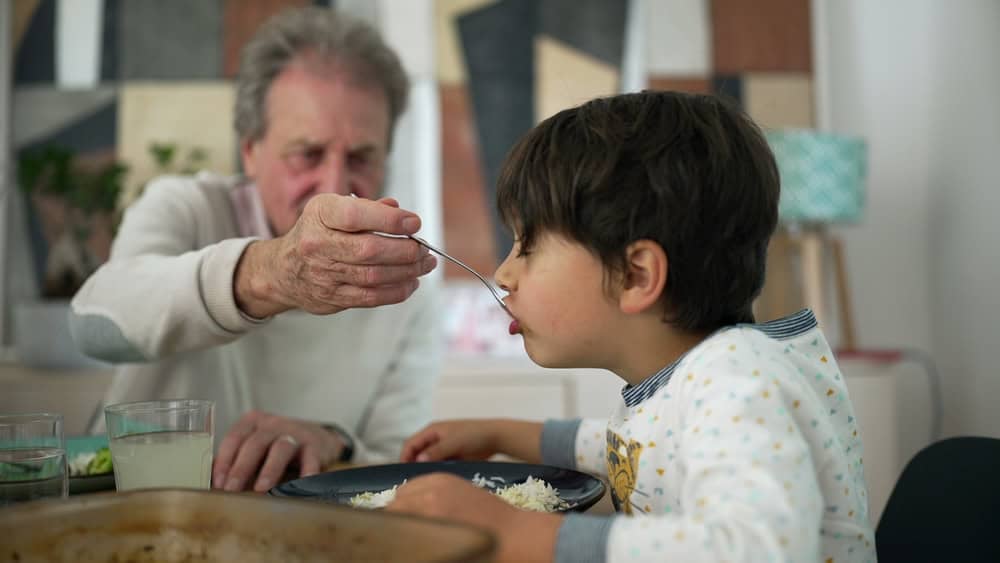
Born of the Clean Plate Club era, this phrase was a moral imperative during the Great Depression. Wasting food was seen as a sin against the starving. Fast forward to today: the U.S. obesity rate is over 40%, and nutritionists now point to forced finishing as a primary cause of children losing touch with their internal satiety cues.
We are literally teaching kids to ignore their brains and listen to the plate. Dr. Brian Wansink’s research on the same segment shows that plate size has increased by 23% since 1900, meaning a clean plate today is significantly more caloric than it was in Grandpa’s youth.
The contrary view, however, is the environmental one. Roughly 30-40% of the U.S. food supply is wasted, contributing to massive methane emissions from landfills. Grandpa’s no-waste policy was environmentally prophetic, even if his nutritional execution was a bit heavy-handed.
“Hard work always pays off.”

This is the cornerstone of the Protestant Work Ethic, but the numbers are starting to argue back. Productivity has increased by over 60% since 1979, while hourly pay has risen by only about 15-17% after inflation.
The decoupling of hard work from financial reward is the defining economic trend of the 21st century. When Grandpa says this, he is describing a world where a single income from a manual labor job could buy a home and fund a pension.
Today, many work three gig jobs and still live paycheck to paycheck. This doesn’t mean effort is useless; it means strategic and network work have replaced raw hard work in the value chain. As economist Thomas Piketty argues in Capital in the Twenty-First Century, return on capital now outstrips return on labor. Hard work is no longer the guarantee; it’s just the ante to get into the game.
“What will people think?”

To the Greatest Generation, reputation was a form of currency. In small towns, social shaming was a practical tool for maintaining order. Today, we live in an era of radical authenticity and main character energy. We are told to live our truth regardless of the audience.
But did we actually escape the judgment? Statistics on social media usage suggest we have simply traded the “Lady Next Door” for the “Anonymous Million.” A survey found that 62% of people feel pressured to post content that makes them look successful, suggesting that “What will people think?” has just moved from the front porch to the Instagram feed.
Grandpa’s version was at least local and tangible; our version is a global, 24/7 panopticon. We haven’t stopped caring what people think; we’ve just multiplied the “people” by ten thousand.
“You don’t need that, it’s a waste of money.”

Grandpa’s frugality was a survival mechanism. To him, a want was a dangerous distraction from a need. But in a consumer-driven economy, wants are what keep the lights on. We are experiencing a lifestyle inflation, where the average American spends roughly $18,000 a year on non-essentials.
Grandpa sees a waste, a modern consumer might see self-care or mental health support. The friction here lies between a production-based and a consumption-based mindset. However, the FIRE (Financial Independence, Retire Early) movement is a modern echo of Grandpa’s logic.
By labeling almost everything a waste, FIRE adherents are managing to retire in their 30s. Maybe Grandpa wasn’t being a killjoy; maybe he was the original practitioner of minimalism, before it became a trendy aesthetic with its own expensive coffee table books.
“Stay at one job, it shows loyalty.”

In 1960, the average job tenure was roughly 10 years. In 2024, it’s closer to 4.1 years, and for those aged 20-24, it’s a staggering 1.3 years. Loyalty used to be a two-way street backed by a defined-benefit pension. When companies moved to 401(k)s and “at-will” employment, the contract was effectively shredded.
Job hopping is now the most effective way to increase salary, with switchers seeing an average pay increase of 10% to 20%, compared to the 3% annual raise for stayers. To Grandpa, leaving a job is a character flaw; to a millennial, staying at a job with no growth is financial suicide.
The only sector where Grandpa’s advice still holds water is in high-level executive tracks or specialized trades where deep institutional knowledge is the only path to the top. For everyone else, loyalty is a luxury that their landlord doesn’t accept as payment.
Key Takeaways

The phrases explored here continue to resonate not because they are universally valid, but because they are structurally efficient; they compress complex beliefs about authority, risk, money, and identity into language that requires no negotiation. Their impact today comes from the mismatch between that efficiency and a modern environment that expects explanation, flexibility, and personalization.
As economic systems shifted from stability to volatility and social norms moved from hierarchy toward individual agency, the assumptions embedded in these lines became more visible and more contested. Still, their persistence suggests they address recurring human pressures, such as uncertainty, social judgment, and resource management.
The reality is not that these expressions are obsolete, but that they reveal how quickly context can change while language lags behind, forcing each generation to reinterpret, resist, or selectively reuse what it inherits.
Like our content? Be sure to follow us