Working from home isn’t equal: 11 ways women carry the heavier load
Women have fought from time to time to gain access to professional workspaces, challenging norms that kept them confined to the home. Yet in the wake of the COVID‑19 pandemic, remote work has reshaped how and where work happens, and women have emerged as a leading demographic in this shift. Data from the U.S. Bureau of Labor Statistics shows that women are more likely than men to work fully remotely, with about 16.4 % of women working entirely from home compared with 10.5 % of men in late 2024.
Surveys and workforce reports also consistently find that women, especially mothers and caregivers, are more likely to choose or remain in remote roles because of caregiving responsibilities and the unaffordability of childcare. Yet while being at home feels like autonomy, the reality has echoes of an earlier era: remote work can deepen inequalities in pay, representation, and leadership access.
As many organizations push for return‑to‑office, the gendered patterns of who stays at home and why reveal a stark truth: the progress of the last century may be colliding with structural expectations that assume women will absorb both paid work and domestic responsibilities, on top of each other, because we never really left home completely.
The Double Shift Becomes Simultaneous

Remote work has collapsed the once-clear boundaries between professional and domestic life, creating a simultaneous double shift that disproportionately falls on women.
When the kitchen, playroom, and home office all occupy the same space, women are more likely to juggle emails, video calls, and project deadlines alongside caregiving, meal preparation, and household organization.
A 2022 EU‑OSHA report found that female teleworkers consistently experienced longer working hours and greater time pressure due to overlapping demands, while research on mental load highlights the invisible cognitive labor involved in managing household logistics and emotional oversight.
Even when the workday technically begins, the domestic sphere demands constant attention, leaving women to perform two full-time roles at once, an invisible strain often underestimated by partners, managers, and colleagues alike.
Unpaid Labor Expands Into the Workday

The expansion of unpaid labor into paid hours is measurable, not anecdotal. Research from the United Nations shows that globally, women perform nearly 3 times as much unpaid care and domestic work as men; a gap that persists even among dual-earner households.
During the remote-work surge, a study by the Institute for Fiscal Studies found that mothers were more likely than fathers to reduce paid working hours to accommodate childcare during school closures, even when both parents were working from home.
Meanwhile, data from the U.S. Bureau of Labor Statistics time-use surveys confirm that women continue to spend significantly more daily time on household activities regardless of employment status.
Remote work does not create this imbalance, but by relocating paid work into the domestic sphere, it allows unpaid responsibilities to interrupt professional time more frequently and with fewer structural barriers.
Career Visibility Drops in Hybrid Systems
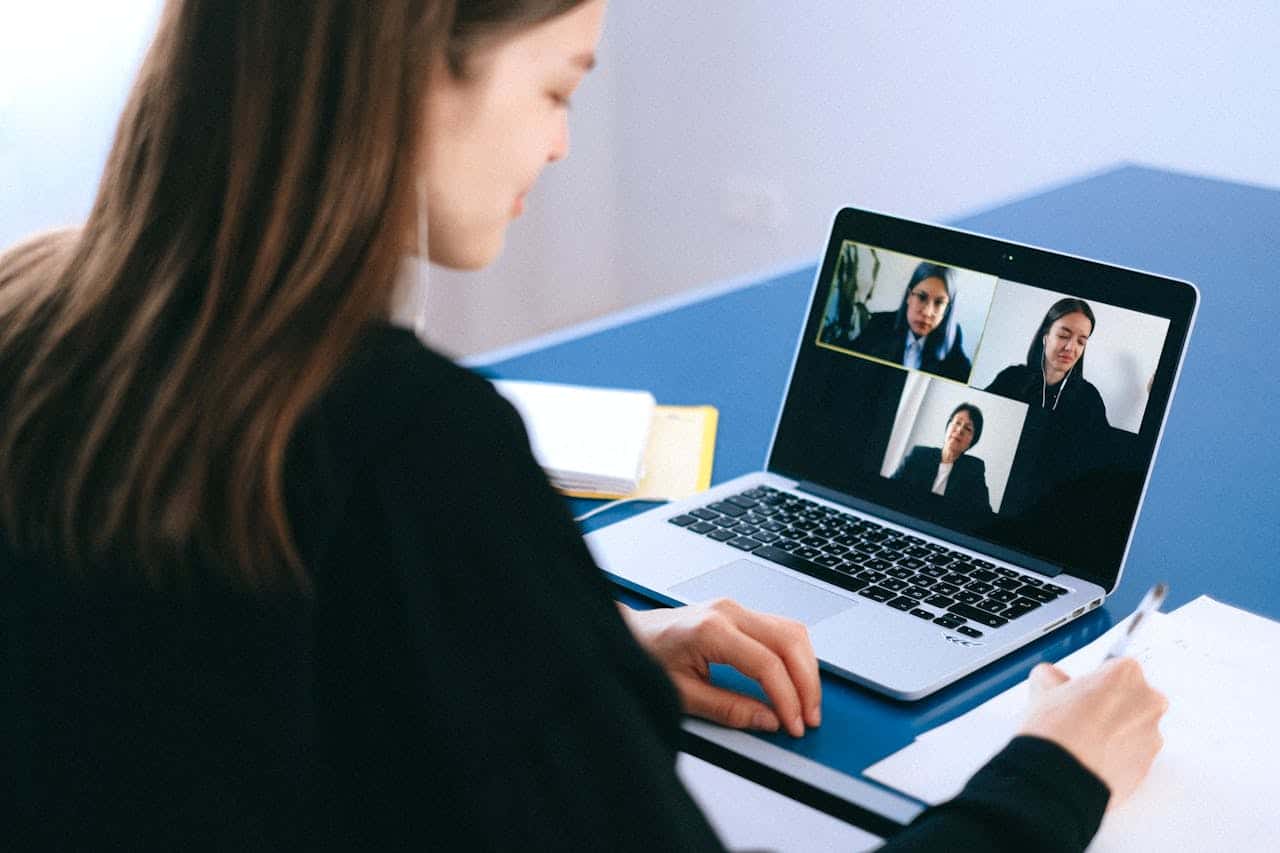
Hybrid work may offer flexibility, but the trade‑off often shows up in career visibility and advancement. Multiple studies show that physical proximity to leaders and colleagues continues to shape professional recognition.
In a UK study of nearly 1,000 managers, employees who worked fully from home were about 11 % less likely to be recommended for promotion and about 9 % less likely to receive a pay rise compared with those based entirely in the office. Hybrid workers also faced diminished prospects, though to a lesser degree.
The authors conclude that these disparities stem largely from managers’ perceptions that physical presence signals commitment and availability, and from biases that persist even when measurable performance is the same.
However, survey data from the International Workplace Group suggests a more positive pattern for some women, with many reporting that hybrid work helped level the playing field and even improved visibility with senior leadership. These mixed findings point to a complex reality: when work occurs partly outside the office, informal interactions, water‑cooler moments, and spontaneous sponsorship opportunities shrink, and unless companies design intentional visibility mechanisms, hybrid systems may inadvertently privilege those seen more often.
Social Isolation Undermines Professional Networks

Social isolation creates a feedback vacuum that is difficult to fill through a screen. In-person work allows for the subtle observation of leadership styles and the picking up of tribal knowledge that is never written down in a handbook.
Remote-working women often find themselves operating in a silo, delivering high-quality output but remaining disconnected from the strategic shifts and internal power dynamics of the organization. This lack of insider information makes it harder to align their work with the company’s changing priorities, leading to a sense of professional stagnation.
Over time, this isolation compounds; as their network withers, so does their access to the high-profile projects and cross-departmental collaborations that are essential for upward mobility. What begins as a quiet morning at a home desk can eventually evolve into a profound professional loneliness that stalls even the most promising career.
Boundary Policing Falls on Women

Remote work blurs the line between professional tasks and domestic life, but studies show that women bear the brunt of managing those blurred boundaries.
The study from Durham University Business School found that women working from home report significantly greater difficulty separating work and family time than men, often facing more frequent domestic distractions and interruptions during work hours.
They are more likely to interrupt their own work for family needs, while men maintain clearer distinctions between roles. Moreover, a recent vignette experiment by researchers at CEPR shows that simply working from home shifts social expectations about who should do household chores and childcare: survey respondents, regardless of their own work arrangements, were more likely to say that the partner working remotely should take on routine and emergency home tasks, often women. This reinforces traditional divisions of labor rather than alleviating them.
Flexibility Becomes Expectation

If a woman is expected to use her flexible hours to manage a household, she is essentially working two full-time jobs in the same 24-hour window. Remote work blurs the line between office and home, and when this overlap persists year-round, the cumulative effect of constant role-switching becomes exhausting.
Long‑term remote work intensifies role conflict because the same environment serves both work and family demands; research on work-family well-being shows that when home and workspace coincide, interruptions and overlapping responsibilities significantly heighten role conflict, especially for caregivers.
Over time, the perception of flexible hours subtly shifts from benefit to expectation, meaning women are assumed to be able to absorb domestic labor in parallel with professional obligations, a persistent, year-round dual workload that few organizational policies formally recognize.
Cognitive Load Intensifies Over Time

While physical chores are visible, the worry work of the household acts as a background processor that never truly shuts down. For women, the home office isn’t just a place to execute professional tasks; it is a command center where career KPIs are constantly interrupted by the mental inventory of domestic life.
This creates a fragmented time state, where the brain is forced to jump between a budget spreadsheet and a child’s upcoming needs or household logistics every 15 minutes. Unlike a traditional office that provides a sensory off-switch through a physical commute, the remote environment demands a state of constant hyper-vigilance.
The boundary between worker and manager of the home becomes porous, leading to a unique form of intellectual exhaustion. Over months and years, this relentless cognitive switching erodes the ability to engage in deep work, resulting in a persistent mental drain that is rarely acknowledged in standard productivity metrics but fundamentally alters a woman’s professional stamina and long-term focus.
Promotion Risk in Hybrid Models

Women often face an invisible timing penalty in their careers: the moment pregnancy or maternity leave begins, remote work or home-based arrangements are often encouraged or required.
While the need for rest is legitimate, this shift inadvertently creates openings for colleagues, often men, to occupy office space, take on high-visibility projects, or attend training and upskilling programs.
Further, the Society for Human Resource Management reports that managers often underestimate the contributions of remote workers, leaving women who return from maternity leave at a disadvantage in competitive promotion cycles.
The combined effect is a structural bias: career advancement is indirectly linked to physical presence and timing, meaning that temporary but necessary absences for maternity can translate into persistent promotional setbacks, even when performance and capability remain unchanged.
Economic Trade-Offs Persist

The flexibility of remote work is often a hidden tax, where the convenience of working from home is traded for long-term financial security. When professional and domestic responsibilities collide within the same four walls, women are far more likely than their male counterparts to informally scale back their intensity or move toward roles with less travel and fewer high-stakes demands.
This flexibility trap has a compounding effect on lifetime earnings, as even small adjustments in output or availability can lead to smaller raises, missed bonuses, and reduced retirement contributions.
High-stakes commissions and discretionary bonuses are frequently tied to the face time and handshakes that remote workers simply cannot provide. By choosing a home-based path to maintain household stability, women often inadvertently opt into a lower-earning trajectory.
This reinforces a structural wealth gap that persists even when their work quality remains high, showing that the cost of being present at home is often borne in future financial independence.
Long-Term Career Penalties Accumulate

The true cost of a flexible remote career often doesn’t appear in a single performance review, but in the slow, cumulative erosion of a woman’s professional trajectory over several years.
For women, this bias is particularly aggressive because they are often remote and managing domestic demands, managers may incorrectly assume they have reached a career plateau and no longer desire high-pressure leadership roles. Over time, being out of sight leads to being out of mind during the closed-door sessions where promotions and succession plans are decided.
This lack of visibility creates a broken rung on the corporate ladder that is nearly impossible to fix from a home office. While their output may remain high, remote-working women frequently miss out on the specialized, high-stakes assignments that have traditionally served as the proving grounds for senior management.
This creates a widening gap between their actual contributions and their perceived readiness for leadership. Eventually, the combination of stagnant growth and the relentless pressure of dual labor leads many highly qualified women to exit the workforce prematurely.
Key takeaways

- Women bear the heaviest burden in remote work: Working from home collapses professional and domestic responsibilities, creating simultaneous “double shifts” and invisible mental labor.
- Unpaid labor infiltrates the workday: Remote arrangements allow household and caregiving tasks to interrupt paid work, disproportionately impacting women’s focus, time, and productivity.
- Career visibility and advancement suffer: Women working remotely or in hybrid models are less likely to receive promotions, high-visibility projects, or sponsorship than in-office colleagues.
- Cognitive and emotional load accumulates: Continuous decision-making, boundary policing, and emotional labor increase the risk of mental fatigue, stress, and burnout for women teleworkers.
- Long-term structural inequality persists: Remote work can reinforce pay gaps, leadership disparities, and economic trade-offs, creating cumulative career penalties for women over time.
Like our content? Be sure to follow us