Why the latest deep-space findings just debunked moon life claims
Earth’s neighboring satellite just received a massive scientific reality check. For generations, sensationalized reports suggested that the Moon was teeming with life.
However, the latest deep-space observations have officially crushed any remaining hopes of lunar habitability. It turns out that the lunar surface is far more barren, dry, and hostile than previously believed.
The Great Moon Hoax of 1835 is still repeating itself

Public obsession with lunar citizens is nothing new. Back in 1835, a New York newspaper published a series of fake articles claiming that bat-winged humanoids and bipedal beavers lived on the Moon. That satirical stunt, known as the Great Moon Hoax, successfully fooled millions of readers.
Today’s viral internet rumors aren’t any different. Recent social media claims asserted that over 250 million humanoid aliens live on the Moon. Astrophysicists rated these claims “Pants on Fire” false, proving that science fiction still travels faster than facts.
Recent water ice models prove the Moon is bone dry

New simulation data has completely reshaped the understanding of lunar water. An international research study led by Paul Hayne revealed that lunar ice accumulated slowly over 3.5 billion years rather than arriving via a single cometary impact. The team’s simulations accounted for the Moon’s changing axial tilt over eons, which periodically exposed older craters and left a highly ‘patchy‘ ice distribution. While this ice sits trapped in deep, dark polar craters like Haworth, it’s incredibly sparse and patchy.
NASA’s SOFIA mission confirmed that sunlit lunar water isn’t flowing any time soon. The soil contains only 100 to 412 parts per million of H2O, which is tightly locked within impact glass. To put it in perspective, the hyper-arid Sahara Desert is literally 100 times wetter than the lunar soil.
Microbes cannot survive or grow in polar cold traps
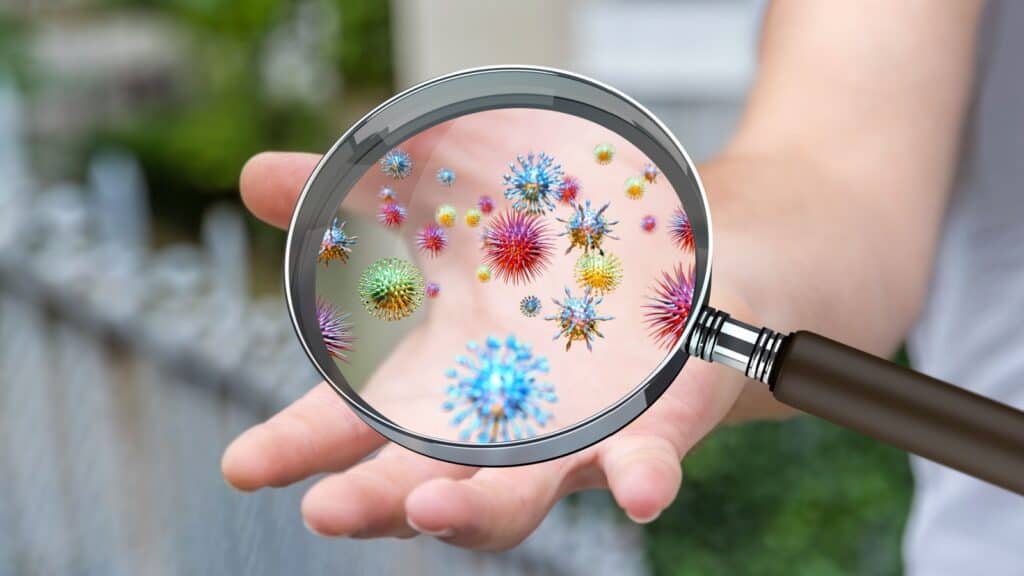
A landmark 2025 study from York University investigator John Moores has clarified the limits of lunar microbial survival. The research modeled how terrestrial bacteria survive within permanently shadowed regions such as the Shackleton and Faustini craters.
Mathematical models show it takes over 30 years in these cold traps for radiation and vacuum to drop bacterial levels by 12 logs. While this means spacecraft contaminants are preserved, the microbes are completely dormant and cannot metabolize. The extreme vacuum prevents any metabolic activity, replication, or growth. The microbes cannot colonize the Moon because they are essentially frozen in time. Thus, the idea of an active, self-sustaining microscopic ecosystem on the Moon is biologically impossible.
Historical lunar survival claims have been thoroughly debunked

Two of the most famous stories of lunar survival just received a massive reality check. For decades, some believed that Streptococcus mitis bacteria survived on the Surveyor 3 camera for 31 months. Modern analysis has shown that the positive test result was due to poor cleanroom protocols on Earth, where technicians sneezed or touched the returned parts. Furthermore, astronauts carried the camera back in a porous nylon duffel bag rather than an airtight metal container, exposing it to capsule contaminants.
Similarly, the thousands of dehydrated tardigrades that crashed on the Moon in 2019 are long dead. Laboratory tests show they likely perished from the extreme deceleration pressures of the Israeli Beresheet probe’s crash. Even if any did survive the impact, the absolute lack of liquid water makes resuscitation impossible.
Deep-space findings prompt caution across the solar system
The dramatic shift in lunar science aligns with a broader dampening of claims about habitability in deep space. In May 2025, researchers reanalyzed 14 years of Hubble Space Telescope data of Jupiter’s moon, Europa. The famous water vapor plumes, long thought to erupt from a life-friendly subsurface ocean, are now highly doubted.
Reanalyzing 14 years of Hubble Space Telescope data revealed that even a single pixel misalignment in the imaging software can create false-positive water plumes. The scientific team’s confidence in the plumes’ existence dropped from 99.9% to under 90%. Team leader Lorenz Roth noted that the original detections were likely just data noise. This cosmic reality check proves that finding active biological niches is much harder than early models predicted.
Key takeaway from the deep-space findings

Modern astronomical research has firmly established that the Moon is a sterile, radiation-blasted desert. While future astronauts can extract microscopic traces of ice for rocket fuel, the Moon has no active biology.
Earth remains the solar system’s lonely oasis, as space probes continuously confirm that the lunar surface is completely lifeless.
Disclaimer – This list is solely the author’s opinion based on research and publicly available information. It is not intended to be professional advice.
Like our content? Be sure to follow us