
10 Religious Ideas That Changed Dramatically Over the Centuries
Religions often present themselves as guardians of ancient truth. That can make it easy to imagine that a Christian living in the year 200, a Jewish community living 2,000 years ago, a Buddhist monk in ancient India, and their modern counterparts would immediately recognize everything their religion teaches today.
History is messier. Religions preserve traditions, but they also interpret them. New questions appear. Political circumstances change. Philosophers introduce new language. Communities encounter rival religions. Scriptures are debated, legal traditions expand, and ideas that once seemed peripheral can move toward the center.
That doesn’t necessarily mean believers simply “invented” new teachings. Religious communities often understand development as clarification: later generations finding more precise language for beliefs they see as rooted in much older revelation or tradition. Historians may describe the same process differently. Either way, the result can be surprising. Here are 10 religious ideas whose meanings, importance, or formal definitions changed dramatically over time.
1. The Christian Idea of the Trinity Took Centuries to Define Precisely
The New Testament speaks about the Father, Jesus, and the Holy Spirit, but it doesn’t hand readers the later theological formula most Christians now associate with the Trinity. Early Christians had to answer an extraordinarily difficult question: if there is one God, how should they understand Jesus and the Holy Spirit without either abandoning monotheism or reducing Jesus to an ordinary human being?
Different Christians proposed different answers. Some emphasized Jesus’ divinity in ways critics thought compromised the distinction between Father and Son. Others, including followers associated with Arius, argued that the Son wasn’t eternal in exactly the same way as the Father. The controversies helped produce the Council of Nicaea in 325 and later debates culminating in the creed associated with Constantinople in 381.
Terms such as ousia and hypostasis became crucial as theologians tried to express how God could be one while Father, Son, and Holy Spirit remained distinct. Modern Christians can recite Trinitarian language in seconds, but getting to that language took generations of argument.
2. Jewish Ideas About the Afterlife Became Far More Elaborate Over Time
Read some of the earliest material in the Hebrew Bible and you won’t necessarily find the detailed heaven-and-hell system modern readers expect. Early biblical texts speak of Sheol, a shadowy destination associated with the dead. It isn’t simply the Christian hell, nor is it a fully developed paradise. The dead go there, and descriptions can be remarkably subdued compared with later religious imagery.
Over time, Jewish thought became much more diverse and elaborate. Texts from the Second Temple period show developing ideas about resurrection, judgment, reward, punishment, angels, cosmic conflict, and the fate of the righteous and wicked. By the first century, Jewish groups could disagree sharply about these questions; the New Testament itself notes that Pharisees and Sadducees differed over resurrection.
Later rabbinic and mystical traditions added still more concepts, including Olam Ha-Ba, Gan Eden, Gehinnom, resurrection of the dead, and—in some Jewish mystical traditions—forms of reincarnation. There was never one moment when “the Jewish afterlife” changed. It developed through centuries of argument, interpretation, and speculation.
3. Christianity’s Picture of Hell Became Much More Detailed Than the Bible’s
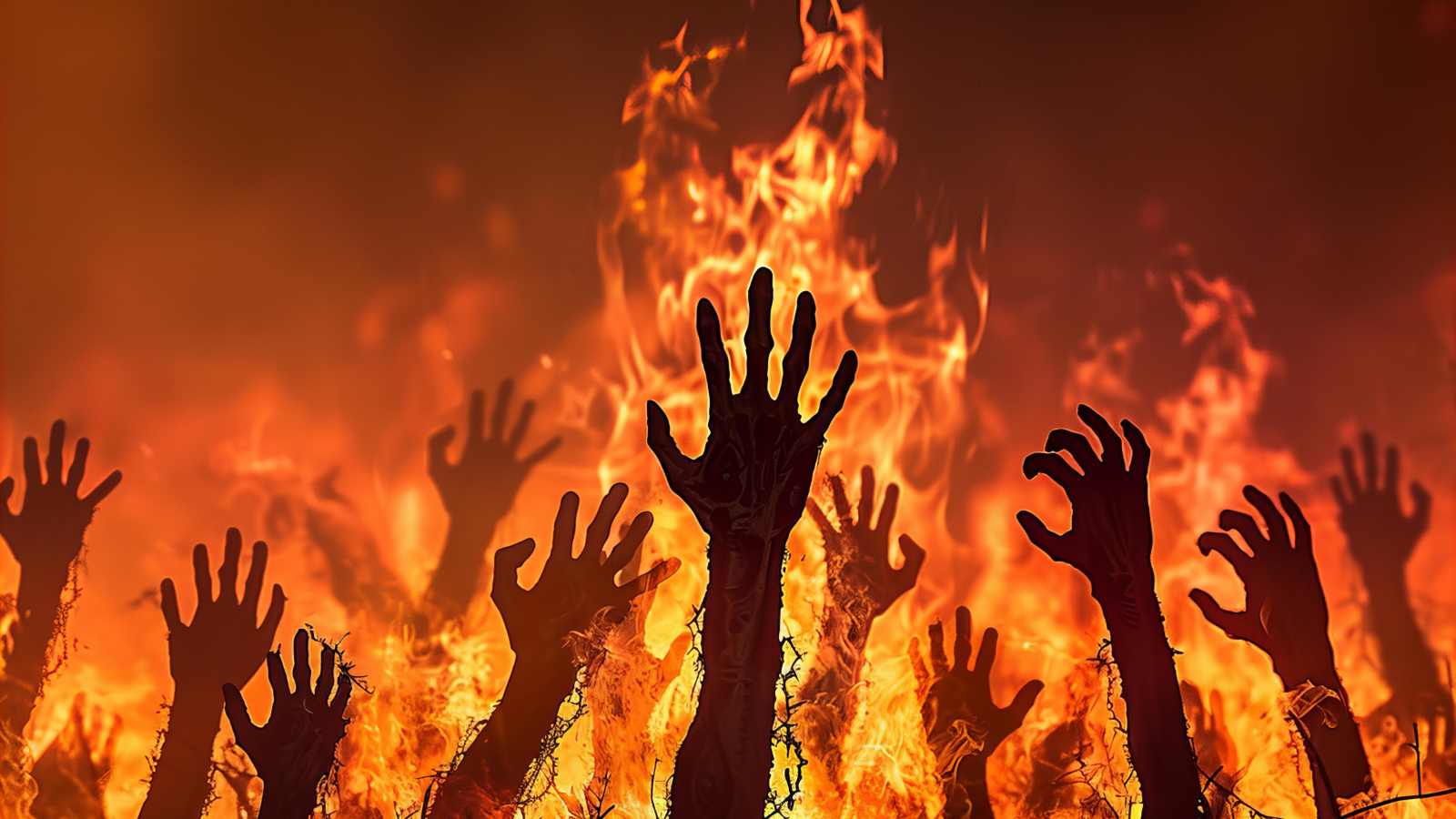
Ask someone to picture hell and they may imagine flames, demons torturing sinners, underground caverns, and carefully organized punishments. Some of that imagery has biblical roots, but much of the hell people picture today is more detailed than any single biblical description.
Biblical texts use several different terms that English translations have sometimes flattened into the single word “hell,” including Sheol, Hades, Gehenna, and Tartarus. They don’t all mean precisely the same thing. Later Christian writers developed increasingly elaborate descriptions of postmortem punishment, while apocalyptic literature imagined journeys through realms of reward and torment. Medieval preaching and art expanded the imagery further.
Then Dante arrived. The Divine Comedy, written in the 14th century, didn’t create Christian belief in hell, but its extraordinarily vivid architecture of the afterlife had an enormous cultural influence. Dante’s circles, punishments, demons, and memorable sinners helped shape Western imagination far beyond formal theology. Many people today can picture Dante’s hell more easily than they can explain the biblical terms behind Christian teaching.
4. Satan Changed From a Role Into the Ultimate Enemy
Modern Christianity often presents Satan as the great cosmic enemy of God: the fallen angel who rebelled, tempted humanity, commands demonic forces, and will ultimately be defeated. Open some of the Hebrew Bible’s earlier material and the picture is much less developed.
The Hebrew word satan can mean adversary or accuser. In the Book of Job, “the satan” appears in God’s heavenly court and challenges Job’s righteousness. He isn’t portrayed exactly like the later Christian Devil ruling a kingdom opposed to God. Over time, Jewish literature developed more elaborate ideas about evil supernatural beings, rebellious angels, and cosmic conflict, and Christianity inherited and transformed this environment.
New Testament texts identify Satan as tempter, deceiver, and opponent, while later Christian theology increasingly connected different biblical figures and passages into a larger story of a primordial angelic rebellion. The serpent in Genesis, the satan in Job, Lucifer from a later Christian reading of Isaiah, the dragon in Revelation, and the Devil of the New Testament eventually became fused in popular Christian imagination. That familiar biography wasn’t written in one biblical chapter; it was assembled over centuries.
5. Reincarnation Became Much More Central to Indian Religions Over Time
Today, karma and reincarnation are so closely associated with Hinduism that they can seem inseparable from the religion’s earliest beginnings. The historical development is more complicated. The oldest Vedic religious texts focus heavily on sacrifice, gods, prosperity, descendants, and reaching a desirable existence after death. The increasingly elaborate concepts of samsara—the recurring cycle of rebirth—and liberation from it become especially prominent in later Vedic and Upanishadic thought.
That shift changed the religious question itself. The problem was no longer simply how to secure divine favor or reach a desirable world after death. Existence could be understood as cyclical, with beings repeatedly born and dying according to karma. The goal therefore changed too: if even a heavenly existence eventually ends, the ultimate spiritual objective can become moksha, liberation from the entire cycle.
Buddhism and Jainism emerged within the broader Indian environment in which karma, rebirth, renunciation, and liberation were being debated intensely, though they developed strikingly different explanations. Ideas that modern people sometimes treat as timeless features of “Indian religion” have histories too.
6. Christian Attitudes Toward Lending Money Changed Enormously
For centuries, Christian authorities treated usury—the taking of interest on loans—as a serious moral problem. Biblical passages condemn exploitative lending and charging interest in particular contexts, and medieval Christian theologians developed extensive arguments about why making money simply from lending money could be unjust.
Then economies changed. Commercial expansion, banking, investment, inflation, financial risk, and increasingly complex markets made the simple equation of all interest with sinful usury much harder to maintain. Christian moral thought gradually distinguished between exploitative lending and legitimate returns associated with risk, lost opportunity, inflation, business investment, and other economic realities.
Today, Christians routinely take out mortgages and business loans without assuming that every payment of interest is inherently sinful. The underlying ethical concern never completely disappeared, since predatory lending can still be condemned. What changed was the definition of the problem.
You may want to read: You’ve Seen These Religious Practices—but Do You Know What They Actually Mean?
7. Buddhist Traditions Developed Very Different Ideas About Who Could Become a Buddha
Early Buddhist traditions placed enormous emphasis on the historical Buddha’s path and on liberation from samsara. The ideal of the arhat—someone who achieves liberation through the Buddha’s teaching—became especially important. Later Mahayana traditions expanded the religious landscape dramatically.
The bodhisattva ideal became central: rather than focusing solely on one’s own liberation, practitioners could aspire toward buddhahood for the benefit of all beings. Vast numbers of bodhisattvas and celestial buddhas populated Mahayana religious imagination, while texts also developed powerful ideas about Buddha-nature, sometimes suggesting that all sentient beings possess the potential for buddhahood.
Buddhism didn’t stop with the Buddha; entire universes of buddhas emerged. That can make later Buddhism look dramatically different from the stereotypical image of a religion centered only on one historical teacher meditating beneath a tree.
8. Catholic Teaching About Religious Freedom Changed Dramatically
For much of European history, Christians generally didn’t operate with the modern assumption that every individual should have an equal civil right to practice whichever religion they choose. Catholic societies could restrict Protestant worship, Protestant societies could restrict Catholicism, Christian governments persecuted religious dissenters, and theological error could be treated as a danger to public order rather than merely a private belief.
The modern concept of religious liberty developed through long and often painful political struggles. The Catholic Church’s relationship with that idea changed significantly, especially during the 20th century. The Second Vatican Council’s 1965 declaration Dignitatis Humanae formally declared that the human person has a right to religious freedom and grounded that right in human dignity, while also presenting the teaching as a development consistent with Catholic tradition.
Catholic thinkers still debate exactly how that teaching relates to earlier church positions, with some emphasizing continuity of underlying principles and others acknowledging substantial development. Either way, a modern Catholic defense of religious liberty would sound striking in many earlier Catholic political societies. Religious traditions don’t develop in isolation from changing ideas about human rights.
9. Judaism Changed Profoundly After the Temple Was Destroyed
Imagine a religion whose sacred texts command sacrifices at a central sanctuary, and then the sanctuary disappears. That’s the crisis Judaism faced after Roman forces destroyed the Second Temple in Jerusalem in 70 CE.
The Temple had been central to Jewish religious life, with priests, sacrifices, pilgrimage festivals, and rituals tied to a physical location. Its destruction meant those practices could no longer continue in their traditional form, but Judaism didn’t disappear. Rabbinic Judaism increasingly centered religious life around Torah study, prayer, synagogue worship, commandments practiced in everyday life, and an expanding interpretive tradition preserved eventually in works such as the Mishnah and Talmud.
The transformation wasn’t instantaneous, and Judaism was already diverse before the Temple’s destruction. Synagogues, scriptural interpretation, prayer, and different Jewish movements existed beforehand. But the loss of the Temple permanently altered the center of gravity. One of history’s most remarkable religious adaptations emerged from catastrophe: a tradition deeply connected with a sacred temple learned how to survive for nearly two millennia without it.
You may want to read: 10 Religious Relics People Have Searched for—or Fought Over—for Centuries
10. The Idea of “Religion” Itself Has Changed
This may be the strangest development on the list. Modern people often imagine religion as a distinct category of life. You have your religion, your politics, your job, your nationality, and your hobbies. Ancient societies didn’t necessarily divide the world that way.
Greek and Roman religious rituals were entangled with civic identity and government. Ancient kings could perform priestly functions. Household religion was part of family life. Festivals were simultaneously religious, political, economic, and social events. Even asking an ancient person, “What religion are you?” might impose categories that don’t fit neatly into their world.
The modern concept of separate, clearly bounded “religions” developed gradually through encounters among traditions, European political change, colonial administration, academic classification, and legal systems that needed to decide what counted as religion. That doesn’t mean ancient people weren’t religious. It means they didn’t necessarily put religion inside the same conceptual box we do—and that may be the biggest change of all.
Religions Preserve the Past by Constantly Interpreting It
It’s tempting to describe every religious development as either corruption or progress, but history rarely gives us something that simple. Believers often see later teachings as faithful explanations of truths that were present from the beginning. Critics may see the same developments as evidence that religions are human institutions changing with society. Historians generally ask a different question: when did an idea appear, how did people understand it, and what caused its meaning or importance to change?
Those questions reveal religions that are neither frozen nor infinitely flexible. They carry ancient texts forward while repeatedly asking those texts new questions. They preserve rituals while changing what those rituals mean. They survive destroyed temples, collapsed empires, scientific discoveries, political revolutions, economic transformations, and encounters with other faiths.
Sometimes a belief that feels ancient turns out to have received its familiar form centuries later. Sometimes an apparently modern teaching has surprisingly old roots. Religion survives partly because it remembers, but it also survives because every generation interprets what it remembers.
You may want to read: 10 Religious Traditions That Are Much Older Than Most People Realize