

10 Sacred Books Millions of People Have Never Heard Of
Most people can name the Bible and the Quran. Plenty have heard of the Torah, and some recognize the Bhagavad Gita. But ask someone to name the sacred writings of the Sikhs, Jains, Zoroastrians, or followers of the Bahá’í Faith, and the answers become much less certain.
Some of the world’s most fascinating religious books are almost invisible to people outside the communities that treasure them. One is treated as a living spiritual teacher. Another contains teachings associated with a religion that once flourished across the ancient Persian world. Others preserve conversations about death, elaborate visions of the universe, or instructions for living without harming even the smallest creatures.
And not every sacred text works like the Bible. Some religions have enormous libraries rather than one central book. Others preserve collections that took centuries to assemble, and some place as much importance on how a text is recited or handled as on the words themselves.
Here are 10 sacred texts that reveal just how much of the world’s religious literature most of us have never encountered.
1. The Guru Granth Sahib Is Treated as a Living Guru
Imagine entering a place of worship where a book occupies the position that might otherwise belong to a religious leader. It rests beneath a canopy, is treated with extraordinary reverence, and is ceremonially opened and closed as part of daily worship.
That’s the role of the Guru Granth Sahib in Sikhism.
For Sikhs, this isn’t simply a collection of inspiring religious writings. It is the eternal Guru, the authoritative spiritual guide of the community. The scripture contains hymns and teachings associated with Sikh Gurus, along with compositions by other spiritual figures from different religious backgrounds. Its poetry emphasizes devotion to the one divine reality, ethical living, humility, and the rejection of empty religious pride.
The tenth Sikh Guru, Guru Gobind Singh, established the scripture’s continuing authority as Guru rather than appointing another human successor. That decision helped shape Sikh religious life in a way outsiders may find surprising. The community has religious teachers and institutions, but the Guru Granth Sahib holds a unique spiritual position that no ordinary human leader can replace.
The scripture is written in the Gurmukhi script and is commonly sung or recited in worship. Its treatment also explains why Sikh practices surrounding the book can look unusually ceremonial. The reverence isn’t directed toward paper and binding as ordinary objects, but toward the sacred teachings the scripture embodies.
2. The Avesta Preserves the Sacred Words of Zoroastrianism
Long before Christianity or Islam emerged, Zoroastrianism was an influential religious tradition in the Iranian world. Its teachings concern truth, moral choice, the struggle against destructive forces, and devotion to Ahura Mazda, the supreme divine being.
Its sacred writings are preserved in the Avesta.
The collection includes hymns, prayers, ritual texts, and religious instructions. Among its most important portions are the Gathas, ancient hymns traditionally attributed to Zarathustra, also known as Zoroaster. Their language is so old that understanding them requires specialized study, and scholars continue to debate aspects of their interpretation.
One of the most remarkable things about the Avesta is how much of the original religious literature may have been lost. Zoroastrian tradition remembers a much larger body of sacred knowledge, while the surviving texts reflect centuries of transmission, preservation, and historical disruption.
The Avesta remains important to Zoroastrian communities, including Parsis in India and Zoroastrians in Iran and elsewhere. It also provides a rare window into a religious world that influenced ancient civilizations but is now unfamiliar to much of the public.
The story of the Avesta is therefore partly about survival. A tradition that endured conquest, migration, and demographic decline still preserves prayers whose roots reach back into deep antiquity.
Read: 10 Ancient Religions That Once Flourished but Nearly Disappeared
3. The Tripitaka Is So Large That Calling It One Book Is Misleading
People sometimes ask what the Buddhist equivalent of the Bible is. The answer immediately becomes complicated.
In Theravada Buddhism, the Pali Canon, also known as the Tipitaka or Tripitaka, is a foundational collection of scriptures. Its name refers to three baskets or divisions: teachings attributed to the Buddha, monastic discipline, and systematic analysis of Buddhist teachings.
This isn’t a single book that someone can casually read from beginning to end over a weekend. It’s an enormous religious library.
The collection contains discourses, rules for monastic communities, philosophical discussions, stories, and practical guidance. Some passages are approachable and memorable, while others are highly technical. The texts were transmitted orally before being committed to writing, reflecting the importance of memorization and recitation in early Buddhist communities.
But Buddhism doesn’t have one universally identical scriptural canon. Mahayana and Vajrayana traditions recognize additional sutras, commentaries, and tantric literature, and Tibetan and Chinese Buddhist canons contain vast bodies of material.
That diversity challenges a familiar assumption: a major religion doesn’t necessarily organize its sacred literature around one fixed collection recognized in exactly the same way by every follower.
4. The Agamas Reveal Why Jainism Takes Nonviolence So Seriously
Jainism is known for its extraordinary emphasis on nonviolence. Many Jains follow vegetarian diets, and some religious ascetics take remarkable precautions to avoid harming even tiny living creatures.
The reasoning behind those practices becomes much clearer when you encounter Jain sacred literature.
The Agamas are especially important within the Śvetāmbara Jain tradition. They preserve teachings associated with Mahavira and the early Jain religious community, addressing conduct, discipline, karma, spiritual liberation, and the responsibilities of religious practitioners.
These texts help explain why Jain nonviolence isn’t simply an unusually strict form of kindness. It’s part of an entire understanding of how souls become bound by karma.
Jain traditions differ in their views of which early scriptures survived. Digambara Jains generally hold that the original canonical teachings were lost, and they place authority in other important philosophical and religious works. That means there is no single collection accepted in precisely the same way by all Jains.
The disagreement itself is fascinating. Sacred literature isn’t always just a matter of preserving words. Religious communities can spend centuries debating whether those words have been transmitted faithfully, which texts deserve authority, and how ancient teachings should guide modern life.
5. The Book of Mormon Tells a Sacred History Set in the Ancient Americas
Many people know that members of The Church of Jesus Christ of Latter-day Saints read the Bible. Fewer understand how central the Book of Mormon is to their religious identity.
First published by Joseph Smith in 1830, the Book of Mormon presents itself as a record of ancient peoples in the Americas and includes an account of the resurrected Jesus Christ appearing to people there.
The book makes an extraordinary religious claim: that God’s dealings with humanity included sacred events and prophetic histories outside the biblical world of the ancient Near East.
Latter-day Saints regard the Book of Mormon as scripture alongside the Bible and other texts within their tradition. Its teachings emphasize Jesus Christ, repentance, faith, and God’s relationship with humanity. The church’s name reflects its belief that the book is another testament of Jesus Christ.
The book’s claimed ancient origins are not accepted as established history by mainstream archaeology or historical scholarship. For believers, however, its spiritual authority rests on religious testimony and faith rather than scholarly consensus.
That difference between religious conviction and historical evaluation is central to understanding why the Book of Mormon inspires deep devotion among its followers while remaining controversial outside the faith.
6. The Kitáb-i-Aqdas Contains the Laws of the Bahá’í Faith
The Bahá’í Faith emerged in the 19th century, making it relatively young compared with many of the world’s major religious traditions. Yet its sacred literature is extensive and unusually international in outlook.
One of its central texts is the Kitáb-i-Aqdas, or Most Holy Book, written by Bahá’u’lláh, the founder of the Bahá’í Faith. It contains religious laws, spiritual principles, and guidance for individual and communal life.
What makes the book surprising is that it belongs to a religion built around the idea that divine revelation has appeared through multiple great religious figures across history.
Bahá’ís recognize figures such as Abraham, Moses, Buddha, Jesus, and Muhammad within a broader understanding of progressive revelation, although the Bahá’í interpretation of these figures differs from the teachings of their respective traditions.
The Kitáb-i-Aqdas is not the only important Bahá’í scripture. The writings of Bahá’u’lláh, the Báb, and other authoritative figures occupy a major place in Bahá’í religious life. The text’s laws also require interpretation within the faith’s broader teachings and institutions.
Its existence challenges the assumption that the world’s religious scriptures all emerged in remote antiquity. Some influential sacred writings were produced in an era of modern states, newspapers, and expanding global communication.
7. The Popol Vuh Preserves a Maya Story of Creation Unlike Genesis
Two divine beings attempt to create humanity. Early efforts fail. Eventually, humans are successfully made from maize, the crop that sustains life in much of Mesoamerica.
That extraordinary creation story appears in the Popol Vuh, a foundational narrative of the K’iche’ Maya.
The text also tells of the Hero Twins, who confront powerful beings in the underworld through a series of dramatic trials. Its stories combine creation, ancestry, cosmic struggle, and the origins of a people.
For readers familiar only with biblical creation, the idea that humans were formed from corn can be startling. But within the cultural world of the Maya, maize carried enormous practical and symbolic importance.
The surviving written version was recorded during the colonial period in the K’iche’ language using the Latin alphabet, preserving traditions with precolonial roots. Scholars study it as an invaluable source for Maya literature, religion, and cultural history.
It’s important not to treat the Popol Vuh as the single Bible of every Maya community. Maya peoples have diverse languages, histories, and religious practices, and the text belongs specifically to a K’iche’ tradition.
That distinction makes the work even more interesting. It is both a sacred cultural inheritance and a reminder that Indigenous American religious literature contains complex narratives that are still unfamiliar to many readers.
8. The Kojiki Preserves Stories About Japan’s Divine Origins
Japan’s religious history includes a remarkable collection of stories about divine beings, sacred places, and the origins of the islands themselves.
The Kojiki, compiled in the early eighth century, is one of the oldest surviving Japanese literary works. It preserves myths and genealogies involving the kami, the divine or sacred presences central to Shinto traditions.
Among its best-known stories are accounts involving the sun goddess Amaterasu, the storm deity Susanoo, and the divine ancestry traditionally associated with Japan’s imperial line.
The surprising part is that a text filled with religious mythology also helped preserve ideas about political authority and national origins.
But the Kojiki isn’t simply Shinto’s equivalent of the Bible. Shinto historically developed through shrine rituals, local traditions, purification practices, festivals, and relationships with kami rather than one universally binding scripture.
The text is therefore best understood as an enormously important source of Japanese myth and religious tradition, not a book that every Shinto practitioner must interpret in one prescribed way.
It also shows how closely sacred stories and political history can become intertwined. Narratives about gods can help communities explain not only the universe but also why particular places and institutions matter.
9. The Zhuangzi Contains Some of Religion’s Strangest Philosophical Stories
A man dreams he is a butterfly. When he wakes, he wonders whether he is a man who dreamed of being a butterfly or a butterfly dreaming of being a man.
That famous story comes from the Zhuangzi, a foundational work of classical Daoist thought.
The text is associated with the philosopher Zhuang Zhou, although scholars generally understand it as a collection containing material from different hands and periods. Its stories use humor, paradox, strange conversations, and unexpected reversals to challenge conventional assumptions about knowledge and reality.
Rather than giving readers a simple list of commandments, the Zhuangzi repeatedly makes them question whether their most confident judgments are reliable.
The work became influential in Daoist religious and philosophical traditions, as well as broader Chinese intellectual history. Daoism also developed a vast body of religious scriptures, rituals, and teachings beyond the Zhuangzi and the better-known Daodejing.
That’s why describing the Zhuangzi as a single universally authoritative Daoist holy book would be misleading. Its importance lies partly in its ability to unsettle the reader.
A sacred or spiritually influential text doesn’t always tell you exactly what to believe. Sometimes it asks whether you understand the world as clearly as you think you do.
10. The Ethiopian Book of Enoch Preserves a World of Fallen Angels and Cosmic Secrets
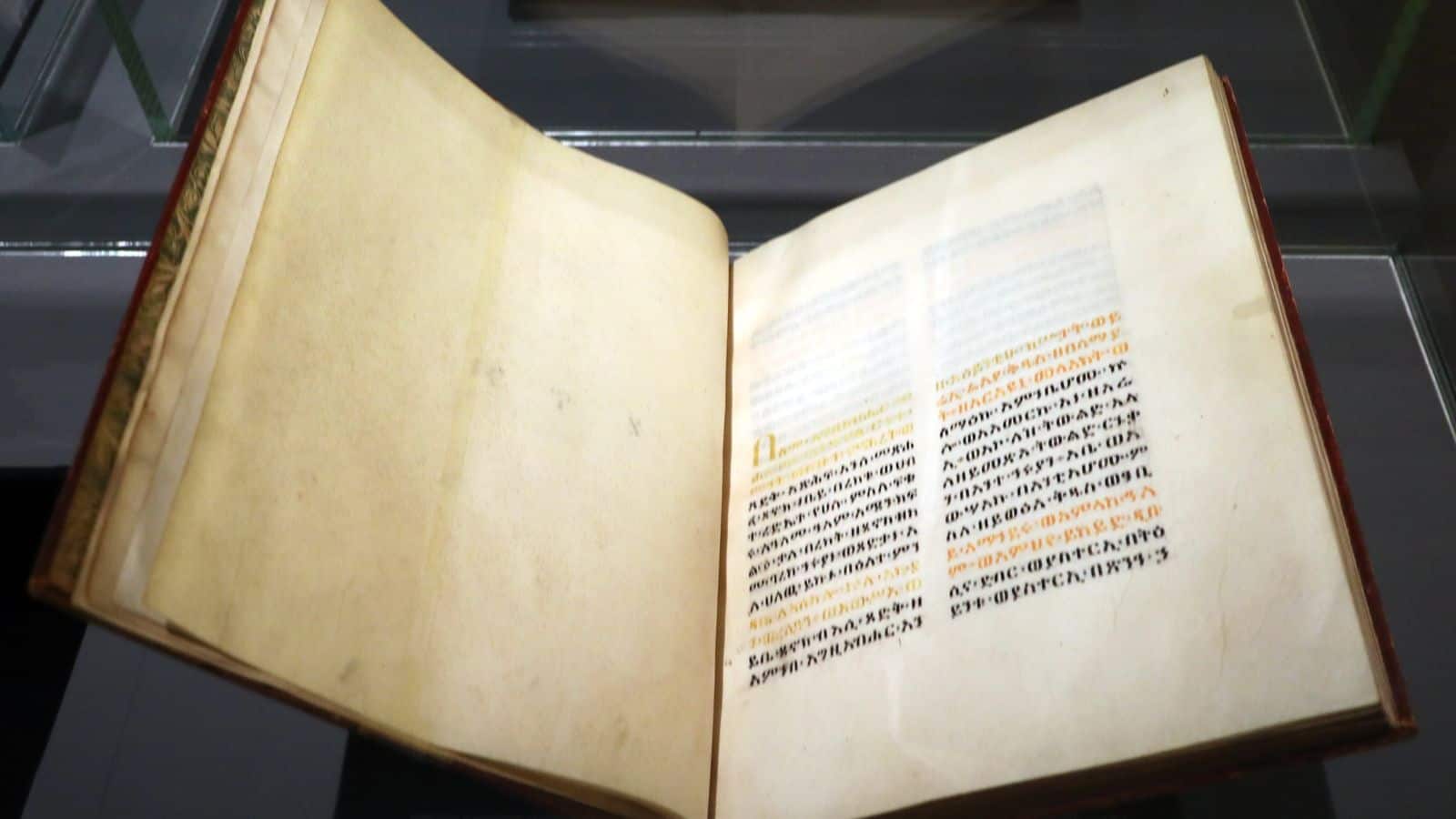
Imagine opening a religious book and finding stories about rebellious heavenly beings, forbidden knowledge, cosmic journeys, and the mysteries of divine judgment.
The Book of Enoch, also called 1 Enoch, contains precisely that kind of material.
Its ancient Jewish writings developed over several centuries and were influential in some Jewish and early Christian circles. Portions were discovered among the Dead Sea Scrolls, demonstrating that the work was known long before the medieval period.
The real surprise is that a book outside most Christian Bibles remains part of the biblical canon of the Ethiopian Orthodox Tewahedo Church.
The Book of Enoch includes accounts of the Watchers, heavenly beings who descend to earth and become involved in human corruption. Its visions expand on themes found in Genesis and other biblical literature, offering elaborate pictures of angels, judgment, and the structure of the cosmos.
The New Testament Letter of Jude also contains a passage closely connected to 1 Enoch, making the text especially interesting for readers who assume the boundaries of biblical literature were always fixed.
Its history illustrates a larger point: the books regarded as scripture can differ dramatically across religious communities, even when those communities share much of the same religious heritage.
You may also want to read: Differences between Catholic and Protestant Bibles explained
The World’s Sacred Library Is Much Bigger Than Most People Realize
It’s easy to assume that religious literature consists of a handful of famous books. The Bible, Quran, Torah, and Bhagavad Gita dominate public awareness, especially in countries where Christianity has shaped the surrounding culture.
But those titles barely begin to describe the world’s sacred writings.
The Guru Granth Sahib is treated as the eternal Guru of Sikhism. The Avesta preserves the ancient prayers of Zoroastrianism. Buddhist canons contain enormous libraries. Jain texts explain an exceptionally demanding commitment to nonviolence. The Popol Vuh preserves a Maya understanding of creation, while the Book of Enoch reveals how differently Christian communities can define scripture.
The most important discovery isn’t that unfamiliar religions have unfamiliar books. It’s that different religions understand the very idea of a sacred book differently.
Some texts are recited. Others are sung. Some contain laws, others philosophical puzzles, and still others stories about gods, ancestors, or the end of the world. A few are central to daily worship, while others preserve traditions that might otherwise have disappeared.
The next time someone refers to the world’s holy books, it’s worth remembering how many remarkable works are missing from the conversation.
You may also want to read: 10 Bible Stories Christianity, Judaism and Islam Tell Surprisingly Differently