10 Bible Stories Christianity, Judaism and Islam Tell Surprisingly Differently
Adam and Eve ate the forbidden fruit. Noah built an ark. Abraham nearly sacrificed his son. Moses confronted Pharaoh. David killed Goliath. Mary gave birth to Jesus. If you grew up around Christianity, those stories can feel unmistakably biblical.
Then you encounter Judaism and Islam, and suddenly familiar characters appear in unfamiliar stories. The Quran never names Eve. Abraham’s nearly sacrificed son isn’t named in the Quranic passage. David’s famous confrontation with Goliath appears in the Quran, but the story is dramatically shorter. Mary receives one of Islam’s most extraordinary birth narratives, including details Christians won’t find in the New Testament at all.
Even Christianity and Judaism, which share many of the same ancient scriptures, can interpret those texts through very different theological traditions. These aren’t simply three religions telling identical stories with different names. They share characters, events, and ancient traditions while frequently disagreeing about what those stories ultimately mean.
Here are 10 famous stories that look surprisingly different depending on whether you’re encountering them through Judaism, Christianity, or Islam.
1. Adam and Eve Aren’t Quite the Same Story in All Three Religions
The basic outline is familiar. The first humans live in paradise, violate God’s command, and lose the life they had known. But the differences begin almost immediately.
Genesis names the first woman Eve. The Quran repeatedly tells the story of Adam and his spouse but never actually gives her the name Hawwa, the Arabic equivalent of Eve. That name comes from later Islamic tradition.
The role of the tempter also changes. Genesis describes a serpent tempting the woman. Christian tradition later strongly associates that serpent with Satan, particularly through interpretations influenced by later biblical texts. In the Quran, Satan is directly involved in tempting Adam and his spouse, while Iblis is also portrayed as refusing God’s command to bow before Adam.
Then comes an even bigger difference. Traditional Western Christianity developed a powerful doctrine of original sin, particularly through interpretations of Paul and later theologians such as Augustine. Humanity’s fallen condition after Adam became central to Christian explanations of why people need salvation.
Judaism doesn’t generally interpret Adam’s disobedience through the same doctrine of inherited original sin. Islam doesn’t either. In the Quran, Adam sins, repents, and receives God’s forgiveness.
All three traditions know the story of humanity’s first disobedience. They don’t necessarily agree about what humanity inherited from it.
2. Noah’s Flood Includes a Son Christians and Jews Won’t Recognize
Noah, the ark, the flood, the animals—Christian and Jewish readers know the story from Genesis. The Quran knows Noah too. Nuh, as he is called in Arabic, is an important prophet who repeatedly warns his people to turn toward God.
But the Quran includes a dramatic scene absent from Genesis. As the flood arrives, Noah sees one of his sons refusing to board the ark. Noah begs him to come aboard and not remain with the unbelievers. The son thinks he can survive by climbing a mountain, but Noah warns him that nothing will protect him from God’s judgment.
Then a wave separates them, and the son drowns.
Afterward, Noah appeals to God because the young man was part of his family. God’s response makes the theological point unmistakable: biological relationship doesn’t guarantee salvation when faith and obedience are absent.
Genesis tells a very different story about Noah’s sons. Shem, Ham, and Japheth all survive aboard the ark.
Same prophet. Same catastrophic flood. A completely different family tragedy.
3. Abraham’s Nearly Sacrificed Son Isn’t Named in the Quran
This may be one of the most consequential differences among the three traditions.
Genesis is explicit. God tells Abraham to take Isaac, the son he loves, and offer him as a sacrifice. Abraham obeys, but an angel stops him before Isaac is killed.
In Judaism, the Akedah—the Binding of Isaac—became one of the Hebrew Bible’s most important stories. Christianity inherited the same account and frequently interpreted Isaac’s near-sacrifice as foreshadowing Jesus.
The Quran also tells a story in which Abraham prepares to sacrifice his son after receiving a dream. But there’s a startling difference: the son isn’t named.
The Quran describes Abraham telling his son about the dream, and the son willingly tells his father to do what he has been commanded. God stops the sacrifice and provides a great ransom.
Later Muslim tradition came overwhelmingly to identify the son as Ishmael, Abraham’s son through Hagar, although early Muslim interpretation wasn’t completely unanimous. The episode became deeply connected with the Islamic festival of Eid al-Adha and the rituals associated with the pilgrimage to Mecca.
One of the world’s most famous religious stories therefore contains a remarkable divide. Jews and Christians read Isaac’s name directly in Genesis. Muslims traditionally identify the unnamed Quranic son as Ishmael.
4. Joseph’s Story Is So Important in Islam That the Quran Devotes an Entire Chapter to It
Joseph’s story in Genesis already reads almost like a novel. His jealous brothers sell him, he is taken to Egypt, falsely accused, imprisoned, elevated to enormous power, and eventually reunited with the family that betrayed him.
The Quran tells much of the same recognizable story.
In fact, Surah Yusuf—Chapter 12—is devoted almost entirely to Joseph, making his story unusually continuous compared with many Quranic narratives that appear across multiple chapters.
But some details change.
Genesis identifies Potiphar as Joseph’s Egyptian master and describes Potiphar’s wife attempting to seduce Joseph. The Quran doesn’t name either of them. Later Islamic tradition often calls the woman Zulaikha, but that name isn’t in the Quran.
The Quran also adds an extraordinary scene involving women from the city. After they gossip about the woman’s attraction to Joseph, she invites them to a gathering, gives each of them a knife, and tells Joseph to appear. They are so overwhelmed by his appearance that they cut their own hands.
That scene isn’t in Genesis.
The Quran itself describes Joseph’s narrative as one of the “best of stories.” Christian and Jewish readers will recognize most of the plot, but some of its most memorable Islamic details come from a version they’ve probably never heard.
5. Moses Is an Enormous Figure in Islam Too
If someone asked you to name the central figures of Islam, Moses might not be the first person who comes to mind.
He should be high on the list.
Moses—Musa in Arabic—is mentioned more frequently in the Quran than any other individual by name. His confrontations with Pharaoh, miracles, leadership of the Israelites, and encounters with God appear repeatedly.
Many scenes will sound immediately familiar to Jewish and Christian readers. Moses is placed in danger as an infant. He grows up connected with Pharaoh’s household. He flees after killing a man. God calls him. He confronts Pharaoh. His staff becomes a serpent. The sea is divided.
But the Quran isn’t simply retelling Exodus word for word. It uses Moses’ story repeatedly to reinforce themes of prophecy, rejection, divine judgment, perseverance, and God’s protection of His messengers.
One particularly famous Quranic story has Moses traveling with a mysterious servant of God who performs actions Moses can’t understand, including damaging a boat and killing a young person. Only afterward are hidden reasons revealed. The story, found in Surah 18, has no direct equivalent in the Torah or Christian Old Testament.
The Moses of Judaism, Christianity, and Islam is recognizably the same great prophetic figure. But Islam gives him additional stories that many Jewish and Christian readers have never encountered.
6. David and Goliath Appear in the Quran—but David Isn’t the Main Character at First
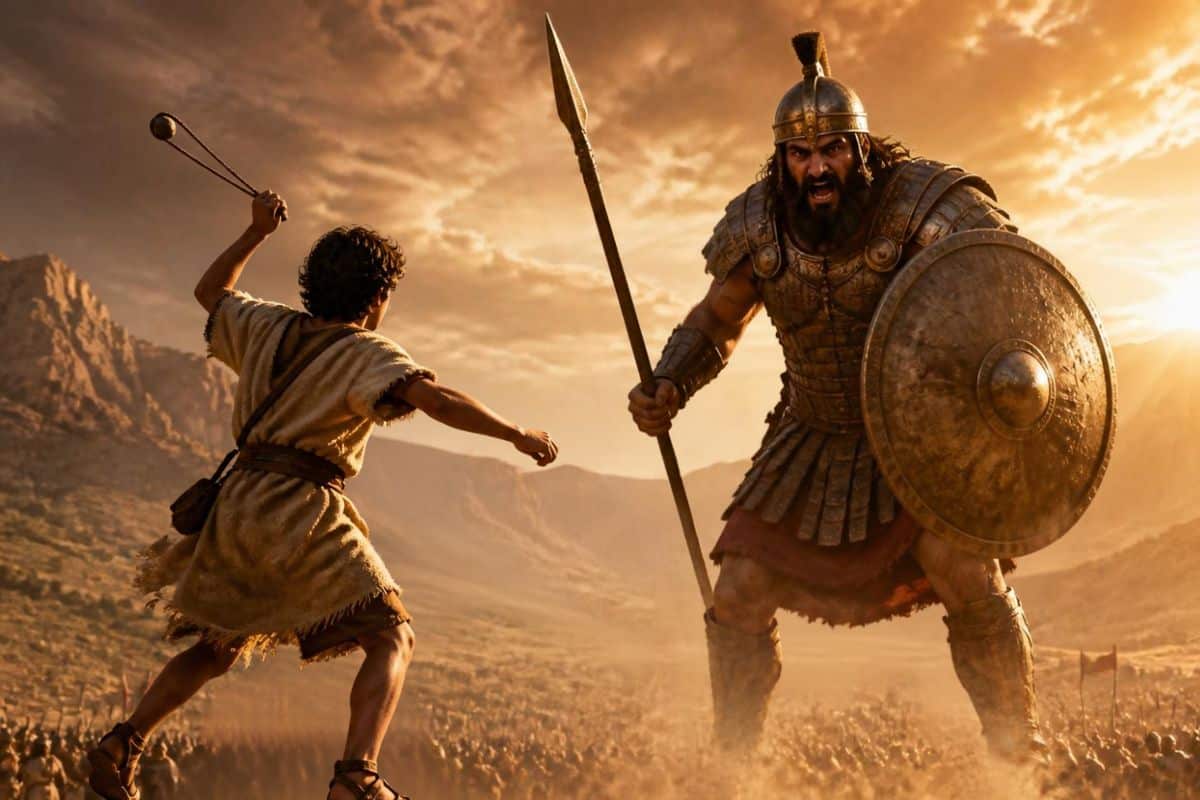
David and Goliath may be one of the world’s most recognizable underdog stories. A young shepherd faces a giant warrior with a sling and a stone and wins.
The Quran tells the story too, but it doesn’t unfold quite the way readers of 1 Samuel expect.
The Quranic account appears within a story about Talut, generally identified with the biblical Saul. Talut leads a force into battle and tests his soldiers at a river. Most fail the test, leaving a smaller faithful group to face the enemy.
Then comes Jalut—Goliath.
The Quran doesn’t give us the long description of Goliath’s armor or David’s conversation with Saul that readers find in 1 Samuel. It moves quickly to the decisive moment: David kills Goliath, and God later gives David kingship and wisdom.
The famous battle is there, but the storytelling emphasis is different. The Quran places David’s victory within a broader lesson about small faithful groups defeating larger forces by God’s permission.
For Christian and Jewish readers, David versus Goliath is primarily David’s breakout moment.
In the Quran, David enters a story already in progress.
You may want to read: 10 Biblical Villains Whose Stories Are Darker and Stranger Than Most People Remember
7. Jonah’s Fish Isn’t Just a Children’s Story in Islam
Jonah and the great fish are familiar to generations of Jewish and Christian readers.
Islam knows him too.
The Quran calls him Yunus and also refers to him as the “man of the fish.” As in the biblical story, Jonah leaves, ends up aboard a ship, is cast into the water, and is swallowed by a great sea creature. But Islamic tradition gives Jonah’s ordeal a particularly powerful spiritual emphasis.
Surah 21 records his prayer from the darkness, in which he acknowledges God’s uniqueness and his own wrongdoing. That prayer became deeply important in Muslim devotional tradition. The Quran also refers to Jonah’s people in an unusual way. They are presented as a community whose belief ultimately benefited them and spared them from punishment.
The biblical book of Jonah also famously ends with Nineveh repenting and God withholding destruction, much to Jonah’s frustration.
So this is one place where the shared story preserves a remarkably similar theological surprise. The prophet struggles. The supposedly wicked people repent. And God shows them mercy.
8. Mary Has a Birth Story in the Quran That Christians Don’t Have
Mary may be one of the most surprising points of connection between Christianity and Islam.
The Quran calls her Maryam. She is the only woman named explicitly in the Quran, and an entire chapter bears her name.
Like Christianity, Islam teaches that Mary was a virgin when she conceived Jesus. The Quran describes a divine messenger announcing that she will have a son despite having been with no man. But then the stories diverge dramatically.
Luke describes Mary traveling with Joseph to Bethlehem, where Jesus is born and laid in a manger. Shepherds visit after receiving an angelic announcement.
The Quran gives Mary a much lonelier scene. She withdraws with her pregnancy and experiences labor beside the trunk of a palm tree. In her distress, she wishes she had died and been forgotten before experiencing what is happening.
Then she is comforted. She is told to shake the palm tree so fresh dates fall down for her and to eat, drink, and be reassured.
When Mary later returns to her people carrying Jesus, they accuse her of something scandalous.
She doesn’t explain herself. She points to the baby. And the infant Jesus speaks. None of that appears in the New Testament. Islam shares Christianity’s miraculous birth of Jesus while telling a strikingly different story about what happened immediately afterward.
You may want to read: 10 Things the Quran Says About Jesus That May Surprise Christians
9. Jesus Performs Familiar Miracles in the Quran—and One Very Unfamiliar One
Christian readers encountering Jesus in the Quran may be surprised by how recognizable he initially seems.
He heals the blind. He heals people suffering from disease. He raises the dead.
But the Quran repeatedly emphasizes that these miracles happen by God’s permission, reinforcing Islam’s understanding of Jesus as an extraordinary prophet rather than God incarnate.
Then comes a miracle Christians won’t find in Matthew, Mark, Luke, or John. Jesus forms a bird from clay, breathes into it, and it becomes alive by God’s permission.
The story has parallels in ancient Christian literature outside the New Testament, particularly the Infancy Gospel of Thomas, which also portrays the young Jesus making birds from clay.
The similarity has fascinated scholars studying the religious environment of Late Antiquity and the traditions about Jesus that circulated outside the canonical Gospels. But the theological difference is even more important.
Christianity interprets Jesus’ miracles within a belief that he is the divine Son of God. Islam treats those miracles as signs God granted to one of His greatest messengers.Both traditions believe Jesus did extraordinary things.They disagree fundamentally about where his authority came from.
10. The Crucifixion Creates the Biggest Divide of All
Eventually, the similarities reach a wall.
For Christianity, Jesus’ crucifixion is not a minor detail. It stands at the center of the faith. The New Testament describes Jesus being executed under Pontius Pilate, and Christian theology connects his death and resurrection directly with salvation.
The Quran presents the event very differently. Surah 4 says Jesus’ opponents did not kill or crucify him, but that it was made to appear so to them, and then says God raised Jesus to Himself.
Traditional Islamic interpretation generally holds that Jesus wasn’t crucified, although Muslim scholars and interpreters have disagreed about precisely how the Quranic passage should be understood. A widespread later explanation holds that someone else was made to resemble Jesus, but the Quran itself doesn’t identify a substitute.
Historically, Jesus’ crucifixion under Roman authority is accepted by the overwhelming majority of modern historians who study the historical Jesus. Christianity then makes the crucifixion and resurrection the defining events of the Christian story.
Islam takes a profoundly different theological path.
That means Christianity and Islam can agree that Jesus was born miraculously, that Mary was his mother, that he was the Messiah, that he performed miracles, and that he was extraordinarily important. Then they arrive at the cross. And the stories separate.
You may want to read: 10 key reasons the first Christians broke away from Jewish tradition
Same Characters, Very Different Stories
Judaism, Christianity, and Islam are often called the Abrahamic religions because of their shared connection with Abraham.
That phrase can make them sound more alike than they actually are.
They share an extraordinary cast of characters: Adam, Noah, Abraham, Joseph, Moses, David, Jonah, and many others. Christianity and Islam also share major figures such as Mary and Jesus.
But sharing a character doesn’t mean sharing an interpretation.
For Judaism, Abraham’s binding of Isaac belongs to the foundational story of Israel and its covenantal tradition. Christianity inherits that story and frequently reads it through later beliefs about Jesus. Islam remembers Abraham as a great prophet and model of submission to God while connecting him deeply with Ishmael and Islamic sacred history.
Moses can be the great lawgiver of Judaism, a foundational biblical prophet for Christianity, and one of the most frequently discussed messengers in the Quran.
Jesus can stand at the center of Christianity as the divine Son of God while being revered in Islam as Messiah and prophet—and rejected by Judaism as the Messiah altogether.
That’s what makes comparing these traditions so revealing.The surprising question isn’t simply, “Why are their stories different?”
It’s how three religions can inherit so many of the same people and still build such different understandings of God, revelation, prophecy, salvation, and history around them. Sometimes the character is familiar. It’s the meaning of the story that has completely changed.