

Why Millions of People Pray in Languages They Don’t Speak
A child growing up in Indonesia learns to recite prayers in Arabic. A Catholic attends a Latin Mass without necessarily understanding every word. A Buddhist monk in Thailand chants in Pali, while a Zoroastrian family recites prayers in a language that hasn’t been spoken conversationally for centuries.
Why do religious communities continue using languages that many of their own followers don’t speak or fully understand? In almost every other part of life, communicating in an unfamiliar language would seem unnecessarily complicated. Religion, however, has often treated preserving particular words, sounds, and pronunciations as something worth extraordinary effort.
Sometimes believers regard a language as inseparable from divine revelation. Sometimes ancient words connect communities scattered across continents. In other traditions, the sound of a prayer or mantra carries spiritual significance beyond its literal translation.
Here are 10 languages whose survival owes an extraordinary amount to religious devotion—and the fascinating reasons people continue using them.
1. Latin: The Language Catholicism Never Completely Left Behind
For centuries, Catholics across much of the world attended Mass celebrated in Latin, regardless of whether they spoke English, French, Spanish, or another language at home. A traveler could enter a Catholic church in another country and recognize much of the worship even without understanding the local language.
Latin became the dominant liturgical language of Western Christianity during late antiquity, gradually replacing Greek in many settings. As ordinary spoken Latin evolved into languages such as Italian, French, and Spanish, the Church continued using older forms for worship, scholarship, and official communication.
The Second Vatican Council in the 1960s opened the way for much wider use of local languages in Catholic worship. However, its Constitution on the Sacred Liturgy did not abolish Latin. It explicitly called for its preservation in the Latin rites while permitting greater use of vernacular languages.
What many people assume was a language abandoned by the Catholic Church remains part of its religious inheritance. Some Catholics seek out Latin worship because they value its historical continuity, solemnity, or connection with previous generations. Others prefer worship in a language they understand immediately. The disagreement reveals a larger question about whether worship should prioritize accessibility or continuity with the past.
2. Quranic Arabic: Why Muslims Around the World Learn the Same Sacred Words
Indonesia has one of the world’s largest Muslim populations, yet Arabic is not the everyday language of most Indonesians. The same is true of Muslim communities in Pakistan, Turkey, Bangladesh, and numerous other countries. Nevertheless, Muslims across these different linguistic environments learn passages of the Quran in Arabic.
The reason concerns the distinctive Islamic understanding of revelation. Muslims traditionally regard the Quran as the word of God revealed to Muhammad in Arabic. Translations help people understand its meaning, but they are generally regarded as interpretations or translations of those meanings rather than replacements for the original Arabic Quran.
Someone can participate in the same prescribed prayers as Muslims thousands of miles away without sharing their everyday spoken language. This creates an extraordinary degree of linguistic continuity across a global religious community. Learning correct Quranic recitation, including the rules associated with tajwid, is an important religious discipline for many believers.
Arabic itself is very much a living language, spoken by hundreds of millions of people. However, the Quran’s classical language differs from the everyday regional varieties spoken across the Arab world. Its religious importance has helped preserve forms of expression that connect modern Muslims with texts dating back more than fourteen centuries.
3. Biblical Hebrew: A Sacred Language That Returned to Everyday Life
For centuries, Jewish communities lived in countries where their everyday languages included Arabic, Yiddish, Ladino, Russian, Polish, and many others. Yet Hebrew retained a central position in religious worship, scriptural study, and scholarship.
Children learned Hebrew prayers, religious scholars studied sacred texts, and Jewish communities maintained connections with an ancient linguistic inheritance despite being geographically dispersed. Hebrew also continued to be used in literature and communication beyond strictly religious settings, although it was not the ordinary native language of most Jews for many centuries.
Hebrew’s extraordinary story is that a language preserved partly through religious devotion eventually became a modern everyday language again. Beginning in the late nineteenth century, efforts to revive spoken Hebrew gained momentum, ultimately helping establish the language used by millions of people in modern Israel.
Biblical Hebrew, rabbinic Hebrew, and modern Hebrew nevertheless differ in vocabulary, pronunciation, and grammatical usage. A modern Hebrew speaker has advantages when reading ancient scripture, but understanding every passage is not automatically effortless. Hebrew’s history demonstrates how religious preservation can help sustain the foundations of a linguistic revival that would otherwise seem almost impossible.
You may also want to read: 6 ancient religions and belief systems that predate Christianity
4. Sanskrit: A Language Whose Sounds Can Be Religiously Significant
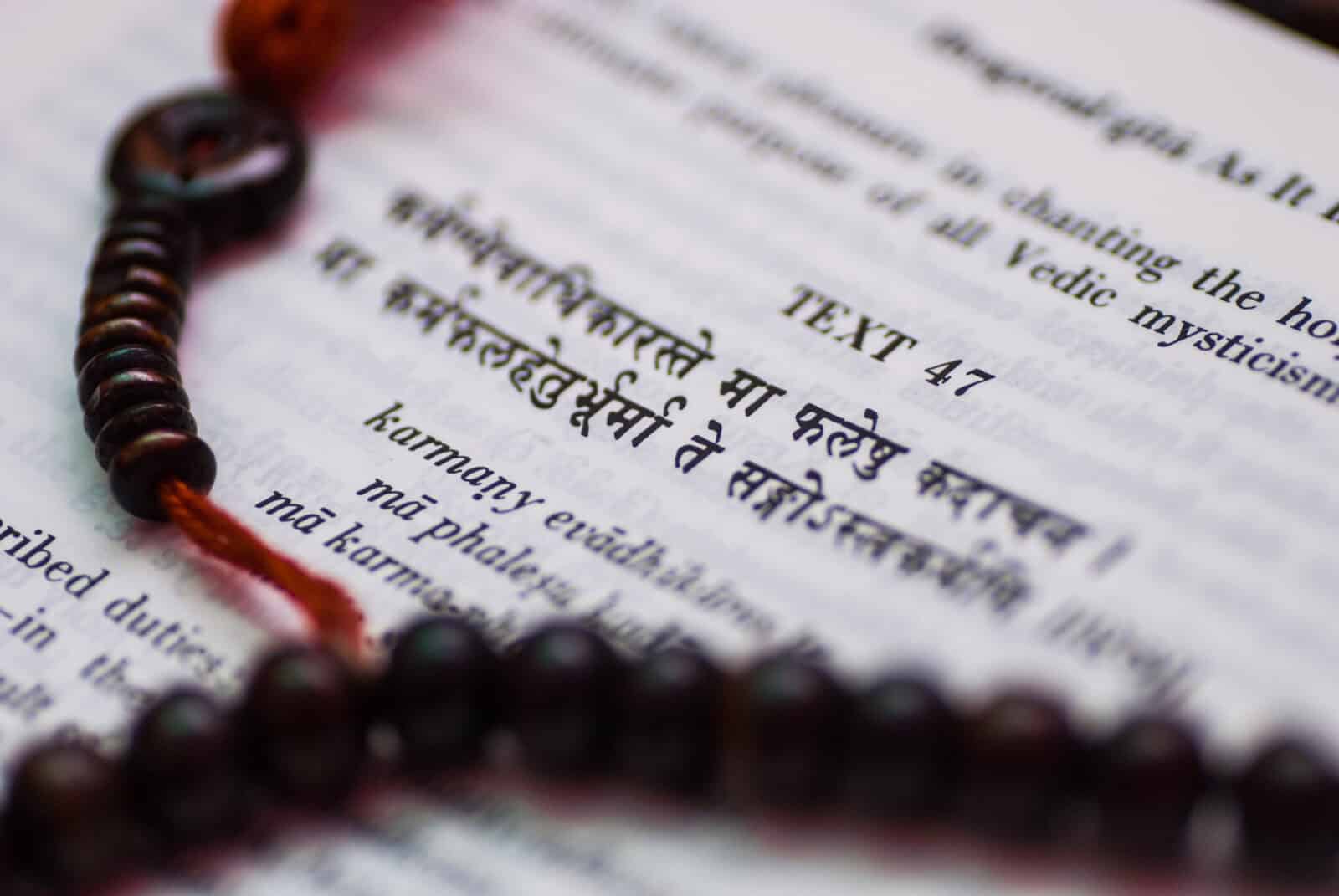
At a Hindu wedding, temple ceremony, or household ritual, participants may hear Sanskrit verses that are considerably older than many of the languages they use in everyday conversation. Sanskrit has occupied an extraordinary position in South Asian religious and intellectual life for thousands of years.
The Vedas, among Hinduism’s oldest sacred writings, were composed in an ancient form of Sanskrit and transmitted orally through remarkably sophisticated memorization techniques. Students learned not only the words but also patterns of pronunciation and recitation designed to preserve the texts with exceptional accuracy.
UNESCO has recognized the tradition of Vedic chanting as part of humanity’s intangible cultural heritage. The techniques used to transmit these compositions demonstrate how communities preserved extensive bodies of religious literature long before modern recording technologies existed.
In some Hindu traditions, correctly pronouncing sacred words is considered spiritually significant, not merely a matter of linguistic accuracy. Sanskrit remains important in religious ceremonies, philosophical study, mantras, and traditional scholarship, although Hindu worship also takes place in numerous regional languages. The language’s continued religious role connects modern worshippers with intellectual and spiritual traditions stretching back into antiquity.
5. Pali: The Buddhist Language Preserved Far From the Buddha’s Homeland
Visit a Theravada Buddhist monastery in Thailand, Sri Lanka, or Myanmar, and you may hear monks chanting in Pali. Although the language is unfamiliar to many outsiders, it occupies a central position in one of Buddhism’s major religious traditions.
Pali is the language of the Theravada Buddhist canon, an extensive collection containing discourses, monastic regulations, and systematic religious teachings. The historical Buddha probably taught in one or more ancient Middle Indo-Aryan vernaculars, but scholars cannot establish that the surviving Pali scriptures reproduce his exact everyday speech.
Pali became a shared religious language across countries whose populations speak dramatically different languages. A monk from Thailand and another from Sri Lanka may have very different native languages while recognizing many of the same sacred passages. Religious education often involves learning to interpret these texts and preserve their recitation.
Pali is not generally used as an ordinary native language today. Its continued importance comes largely from Buddhist scholarship, monastic education, chanting, and religious ceremonies. Its survival demonstrates how a religious community can maintain an ancient linguistic connection with its teachings even as those teachings spread far beyond their original geographical setting.
You may also want to read: 10 Sacred Books Millions of People Have Never Heard Of
6. Ge’ez: The Ancient Language Still Echoing Through Ethiopian Churches
Ethiopia possesses one of the world’s oldest Christian traditions, and its religious history is closely connected with a classical language called Ge’ez. Although Ge’ez is no longer generally spoken as a native everyday language, it remains important in the Ethiopian Orthodox Tewahedo Church and other religious communities in the region.
Ge’ez was historically associated with the ancient Kingdom of Aksum and became a major language of Christian literature, theology, and worship. Numerous religious works were translated into or composed in Ge’ez, creating a substantial literary inheritance that remains important to Ethiopian religious identity.
Some ancient religious writings survived in their most complete form because Ethiopian Christians preserved them in Ge’ez. The best-known example is the Book of Enoch, a work that remains part of the Ethiopian Orthodox biblical canon but is absent from most other Christian Bibles.
Modern Ethiopian worshippers may primarily speak Amharic, Tigrinya, or other languages, while encountering Ge’ez through religious services, hymns, and traditional education. Its survival is particularly remarkable because it preserves access to religious literature that might otherwise have been partially lost. Ge’ez is not simply a historical language maintained for ceremonial reasons; it is also an important repository of humanity’s religious and literary history.
7. Coptic: A Surviving Link to the Language of Ancient Egypt
When people think about the language of ancient Egypt, they often imagine hieroglyphs carved into temple walls. But the Egyptian language continued developing long after the pharaohs, eventually taking a form known as Coptic.
Coptic uses an alphabet based primarily on Greek letters, supplemented by characters derived from earlier Egyptian writing. It became an important language of Egyptian Christianity, preserving biblical translations, theological writings, monastic literature, and religious ceremonies.
As Arabic gradually became dominant in Egypt, Coptic declined as an everyday spoken language. It nevertheless survived through the liturgical traditions of the Coptic Orthodox Church and other Coptic Christian communities.
A language descended from the speech of ancient Egyptians can still be heard in Christian worship today. That doesn’t mean modern Coptic services reproduce the language spoken by the builders of the pyramids without change. Thousands of years of linguistic development separate those historical periods. The remarkable connection is that Coptic belongs to the continuing history of the Egyptian language itself, and religious devotion helped preserve its later forms long after they largely disappeared from ordinary conversation.
8. Syriac: A Sacred Language Closely Related to the Language Jesus Spoke
When Jesus lived in the eastern Mediterranean world, Aramaic was a widely used language with a long history across the Middle East. Jesus himself almost certainly spoke Aramaic, although the precise linguistic circumstances of his life were more complex than the popular claim that he spoke only one language.
Classical Syriac developed from an Aramaic dialect associated with the ancient city of Edessa, in what is now Türkiye. It became one of the great literary and liturgical languages of Eastern Christianity, carrying biblical translations, hymns, poetry, theological discussions, and religious scholarship across large parts of Asia.
Some Christian communities continue worshipping in a language belonging to the same linguistic family as the language Jesus spoke. Syriac remains important in traditions including the Syriac Orthodox Church, the Assyrian Church of the East, and several Eastern Catholic churches. Some members of these communities also speak modern Neo-Aramaic languages, which are related to but distinct from Classical Syriac.
Centuries of political upheaval, persecution, migration, and changing language use have placed considerable pressure on these traditions. Preserving Syriac therefore involves much more than maintaining an ancient vocabulary. For many communities, it protects a distinctive connection with early Christianity and a religious history that developed far beyond Western Europe.
9. Avestan: The Sacred Language Almost Nobody Uses Outside Religious Settings
Zoroastrianism preserves sacred writings in Avestan, an ancient Iranian language named for the Avesta, the religion’s collection of foundational texts. Its linguistic roots reach into the ancient Indo-Iranian world, and it shares notable historical connections with Vedic Sanskrit.
Among the most important Avestan compositions are the Gathas, hymns traditionally associated with Zarathustra. Their antiquity and linguistic complexity mean that even specialists continue debating aspects of their translation and interpretation.
Zoroastrian communities preserved a sacred language long after it ceased to function as an ordinary means of conversation. Religious specialists transmitted prayers and ritual texts across generations, helping maintain a connection with a religious world that existed before many of today’s familiar faiths emerged.
Modern Zoroastrians may speak Persian, Gujarati, English, or numerous other languages. Their use of Avestan during religious observances connects geographically scattered communities with a shared ancient inheritance. The language also presents an extraordinary example of the responsibility carried by small religious populations: when relatively few people maintain a tradition, the preservation of ancient linguistic knowledge can depend on a comparatively small number of dedicated scholars, priests, and families.
10. Church Slavonic: A Religious Language That Sounds Familiar but Isn’t Quite Russian
Visitors to certain Eastern Orthodox churches may hear a language that resembles Russian or another Slavic language without sounding exactly like ordinary modern conversation. In many cases, they are hearing Church Slavonic, a liturgical language with roots in the medieval Christianization of Slavic-speaking peoples.
Its history is connected with the ninth-century missionaries Cyril and Methodius and the development of Old Church Slavonic, which made Christian religious texts available to Slavic-speaking communities. Over subsequent centuries, different regional forms of Church Slavonic developed, preserving older linguistic features while reflecting local traditions.
A language originally developed to make Christianity more accessible eventually became a traditional sacred language that many modern worshippers find challenging to understand. That reversal is particularly interesting. Words once chosen to communicate religious teachings directly became associated with historical continuity, solemnity, and the distinctive atmosphere of worship.
Church Slavonic remains in use in several Orthodox and Eastern Catholic communities, although many churches also use modern languages. Its continued role inspires debates similar to those surrounding Latin in Catholicism: should religious services preserve the language inherited from previous generations, or should they prioritize immediate understanding among contemporary worshippers? Different communities have reached different answers, and the debate remains relevant wherever religious language and everyday speech have gradually drifted apart.
Why Understanding Every Word Isn’t Always the Point
From a practical perspective, using a language that worshippers don’t fully understand can seem counterproductive. But sacred languages often accomplish things that ordinary communication does not. They connect geographically separated communities, preserve ancient literature, maintain continuity with previous generations, and sometimes give sound itself a distinctive religious significance.
There are genuine trade-offs. Worshippers may struggle to understand prayers without translations or religious education, while preserving an ancient language requires teachers, institutions, and sustained commitment. Some religious communities respond by using both traditional and modern languages, allowing believers to remain connected with their heritage while understanding the teachings more directly.
The survival of these languages reminds us that words can carry more than information. They can carry cultural memory, religious identity, and a connection with people who lived centuries before us. A prayer spoken today may preserve the same words that someone recited before the invention of printing, before the rise of modern nations, or even before several of the world’s largest religions existed.
That continuity helps explain why some believers are reluctant to exchange ancient sacred words for modern equivalents, even when a translation would be easier to understand.
You may also want to read: 10 Religious Traditions That Are Much Older Than Most People Realize
Reader question: Would you rather hear religious prayers in their original ancient language or in a language you completely understand? What do you think might be lost—or gained—through translation?