A 9-year-old’s hand dryer experiment exposes a public noise problem adults keep ignoring
A child covering her ears in a public restroom is easy to dismiss. Maybe the dryer startled her. Maybe the room echoed. Maybe she was being sensitive.
Nora Keegan did not leave it there.
After noticing that her ears rang when she used public hand dryers, the Calgary girl began asking a question many adults had learned to ignore: how loud are these machines, really? She was 9 when she started measuring hand dryers in public washrooms. By 13, her work had been published in the Canadian journal Pediatrics & Child Health.
That is the part of the story that makes it travel so well online. A child felt pain, noticed other children covering their ears, and did what institutions often fail to do. She measured the problem.
A Child’s Complaint Became a Field Study
Keegan’s project began with something ordinary: a bathroom hand dryer that left her ears ringing. Instead of accepting that discomfort as part of public life, she treated it like evidence.
With help from her parents, she carried a decibel meter, ruler, and measuring tape into public washrooms. She checked dryers in places where children actually use them, including libraries, restaurants, schools, and shopping centers. She measured at different heights and distances, including children’s ear level, because a machine that sounds loud to an adult can be much worse for a smaller child standing closer to the airflow.
That detail matters. Public design often assumes an average adult body. Children, wheelchair users, older adults, and sensory-sensitive people are left to adapt to spaces that were never really tested for them.
Keegan’s study examined 44 hand dryers and took multiple measurements from each one. Her findings were blunt: several models were louder than manufacturer claims, and some reached levels that raise serious concern for children’s hearing.
The loudest measurement in her study was 121 dBA from a Dyson Airblade model. Xlerator units were also among the loudest, exceeding 100 dBA when hands were placed in the airstream.
For a public restroom device, that is not a small inconvenience. That is a design warning.
How Loud Is Too Loud?
Noise is tricky because people tend to treat it as a preference. One person says something is painful. Another says it is just annoying. A third says everyone should toughen up.
But hearing damage is not a personality test.
NIOSH, the U.S. workplace safety research agency, recommends limiting occupational noise exposure to 85 dBA over an eight-hour workday. It also notes that as sound rises above that level, safe exposure time drops quickly. Every 3 dB increase halves the recommended exposure time.
A hand dryer does not run for eight hours straight, of course. Most people use it for less than a minute. That is the strongest argument against treating every loud dryer as an emergency.
But the public-health concern is not just one adult drying their hands once. It is repeated bursts of loud sound in small tiled rooms. It is toddlers with ears near the machine. It is in school bathrooms where children may hear the same blasts day after day. It is people with tinnitus, migraines, autism, ADHD, sensory processing differences, or hearing vulnerability who do not experience the sound as background noise.
A normal conversation is often around 60 dB. Heavy traffic can reach roughly 80-90 dB. Some high-powered hand dryers push into the range where people instinctively raise their voices, cover their ears, or leave the room.
That instinct is worth taking seriously.
Reddit Users Recognized the Pain Immediately

The story resurfaced on Reddit’s Today I Learned forum, where the post framed Keegan as a child researcher who proved something many people had long felt.
One user, madogvelkor, pointed out a simple design issue: dryers are often louder for children because the machines sit closer to their ears than to adults’.
Another commenter, LIslander, criticized restrooms that place loud hand dryers near changing tables. The frustration was sharp, but the point was practical. A baby lying on a changing table has no way to step away, properly cover their ears, or explain that the noise hurts.
The comments quickly moved beyond hand dryers. HopelesslyHuman compared the issue to parents bringing babies and toddlers to loud sports events without hearing protection, writing that children have “brand new, fresh ears” and need adults to protect them. Another user, blackcatlover2114, described newer dryers as sounding “like a jet taking off” and said their eardrums felt like they were being stabbed.
That language may sound dramatic to someone who is not bothered by the sound. But it is familiar to people with sensory sensitivities. One commenter, Himit, said fear of hand dryers may have been an early clue that their children were on the spectrum.
That is where the conversation becomes larger than one machine. Public spaces often treat sensory distress as a personal problem. The person who cannot tolerate the sound is expected to cope, avoid the bathroom, plug their ears, rush through the task, or apologize for needing something quieter.
That is not accessibility. That is endurance.
The Bigger Public-Health Issue Hiding in Everyday Spaces

The hand dryer debate fits into a wider concern about environmental noise. The World Health Organization has described noise as a public-health issue linked to hearing impairment, sleep disturbance, cardiovascular disease, hypertension, and cognitive effects.
Most people understand loud concerts or construction sites as risky. They are less likely to think about the daily soundscape of ordinary life: school assemblies, traffic, headphones, restaurants, public toilets, gyms, airports, and shopping centers.
That is part of what makes Keegan’s work so effective. She did not pick an obscure hazard. She picked a machine that many people encounter without thinking.
The danger triangle is simple: too loud, too close, too long. A restroom hand dryer may be brief, but for small children, it can be very close. In an echoing room, the sound can feel even harsher. For workers who clean bathrooms or spend long hours near noisy facilities, exposure can be more frequent.
There is also the emotional side. A sudden loud noise can trigger stress, panic, irritability, and avoidance. Parents of young children know this routine well: the child finally agrees to use a public restroom, then a toilet flushes automatically or a dryer roars to life, and the whole trip becomes a negotiation.
The child is not being difficult. The room is difficult.
When “Eco-Friendly” Design Is Not Child-Friendly
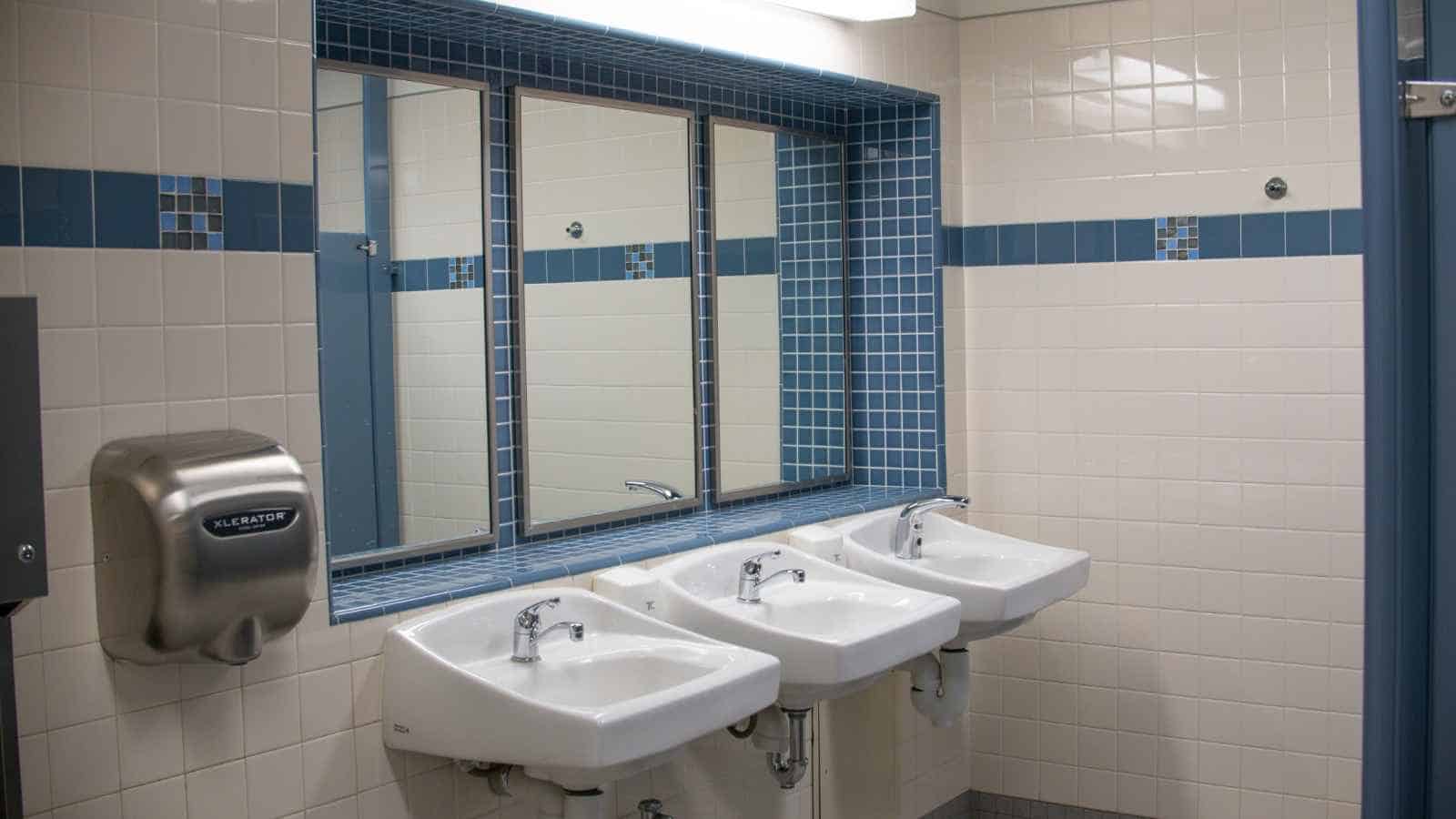
Hand dryers are often promoted as cleaner, cheaper, or more environmentally responsible than paper towels. In some buildings, they are installed as a practical cost-saving measure. In others, they become part of a green image.
That does not make the noise issue disappear.
A design can reduce paper waste and still fail to provide people with acoustics. A public bathroom can look modern and still be hostile to children, disabled people, and sensory-sensitive users. A machine can be efficient and still need redesign.
The better question is not whether every restroom should abandon hand dryers tomorrow. It is whether public spaces can offer choices.
Quieter dryers exist. Paper towels can remain available. Noise ratings can be posted. Dryers can be placed away from changing tables. Restrooms can use acoustic materials that reduce echo. Schools, hospitals, airports, and malls can think about sound the same way they think about ramps, lighting, signage, and stall size.
Accessibility is not only about whether someone can enter a room. It is also about whether they can use it without pain.
What Adults Can Learn From a 9-Year-Old With a Decibel Meter

The most striking part of this story is not just that a child did the research. It is that she believed her own discomfort enough to investigate it.
Many children are taught the opposite. Stop complaining. It is not that loud. Hurry up. Everyone else is fine.
Keegan’s work challenges that reflex. Sometimes, a child saying “that hurts” is not an overreaction. Sometimes it is the first useful data point.
Parents can help by letting children cover their ears, step away from dryers, or use paper towels when available. Caregivers can carry small ear defenders for children who are sensitive to sound. Schools and public facilities can audit their bathrooms with a basic sound meter instead of waiting for complaints to pile up.
And manufacturers can stop treating loudness as a minor tradeoff for speed.
A restroom should not require bravery from a child. It should not make a toddler cry, leave a person’s ears ringing, or force neurodivergent users to plan their day around which bathrooms they can tolerate.
Nora Keegan noticed what adults had normalized. Then she measured it.
That should be the uncomfortable part for everyone else.
Like our content? Be sure to follow us