
Hair: Sacred or Not? Why Sikhs Never Cut Their Hair but Buddhist Monks Shave Theirs
A Sikh man carefully wraps his long hair beneath a turban. A Buddhist monk shaves his head. An Orthodox Jewish man wears long curls beside his face. A Christian woman covers her hair during worship. Somewhere else, a person cuts their hair as part of a religious ceremony marking a completely new stage of life.
How can hair be so sacred that one religion says never to cut it, while another makes shaving it a sign of spiritual commitment?
Hair seems like an ordinary part of personal appearance. We cut it, color it, style it, hide it, and sometimes worry about losing it. But religious traditions have treated hair as something much more significant: a symbol of obedience, humility, identity, purity, spiritual power, or separation from the world.
The most surprising part is that the same action can carry opposite meanings. Keeping hair long may represent devotion in one community and worldly attachment in another. Shaving it can symbolize renunciation, purification, mourning, or a new beginning.
Here are 10 religious hair traditions whose meanings become much more interesting once you understand the history behind them.
1. Sikhs Keep Their Hair Uncut as a Visible Commitment to Faith
One of Sikhism’s most recognizable religious practices is kesh, the keeping of uncut hair. For initiated Sikhs, it is one of the Five Ks associated with the Khalsa, the religious community formally established by Guru Gobind Singh in 1699.
But reducing kesh to a rule against haircuts misses the larger religious idea behind it.
Uncut hair is commonly understood as an expression of accepting the body as a gift from God and living according to Sikh discipline. It also makes religious identity visible in everyday life. Many Sikhs maintain their hair beneath a turban, which carries additional associations with dignity, responsibility, and service.
The commitment can be demanding. Keeping long hair requires care, and visibly identifying as Sikh has sometimes exposed people to discrimination or harassment. For some believers, that visibility is part of the point: religious commitment shouldn’t disappear when someone leaves a place of worship.
Not all Sikhs maintain uncut hair, and individual practices vary. But within Khalsa discipline, kesh is a fundamental article of faith rather than simply a cultural hairstyle.
You may also want to read: You’ve Heard These Religious Rules. Here’s the Meaning Behind Them.
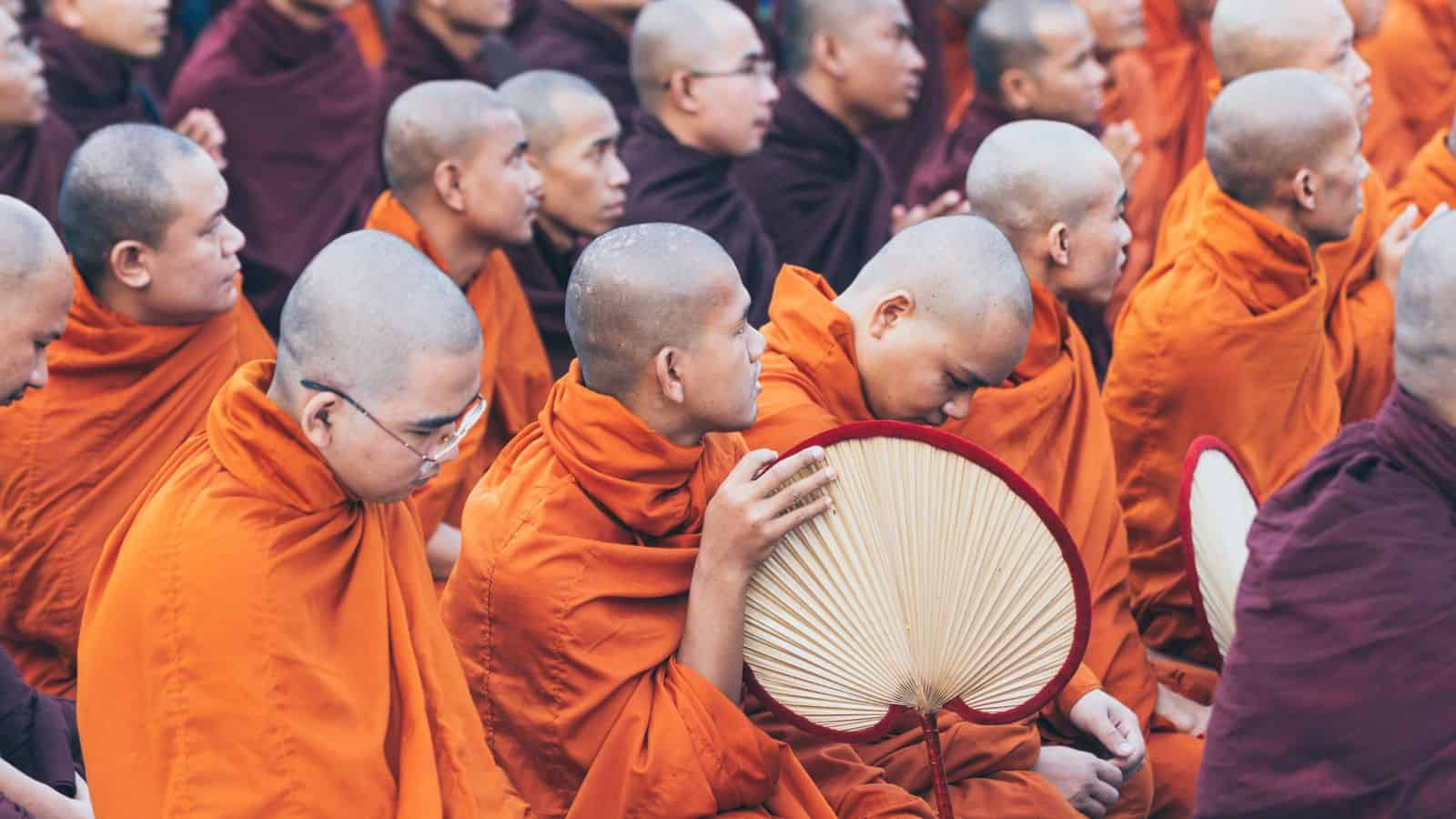
2. Buddhist Monks Often Shave Their Heads for Almost the Opposite Reason
Now consider a Buddhist monk entering a monastery. Instead of preserving every strand of hair, the new monastic may have their head shaved.
The contrast with Sikh practice is striking.
In many Buddhist traditions, removing hair represents letting go of ordinary attachments to appearance, status, and personal identity.
Hair is one of the easiest ways to express individuality. People use it to communicate beauty, fashion, age, profession, social standing, and cultural belonging. Shaving it can remove one familiar way of presenting oneself to the world.
Buddhist monastic rules include guidance about hair and grooming, and the practice became an important visible marker of renunciation. Monks and nuns may shave their heads regularly, although customs vary among Buddhist traditions and communities.
The point isn’t that hair is evil or that lay Buddhists must shave their heads. Rather, the act can help mark a transition from ordinary household life into a disciplined religious community.
What Sikh tradition may express through preserving hair, Buddhist monasticism may express through removing it: a commitment to living according to spiritual priorities rather than ordinary social expectations.
3. Orthodox Jewish Side Curls Come From a Biblical Prohibition
The long side curls worn by some Orthodox Jewish men are among the most recognizable religious hairstyles in the world.
They’re commonly called payot or pe’ot, and their origin is connected with Leviticus 19:27, a biblical passage that prohibits certain forms of cutting the hair at the sides of the head and damaging the corners of the beard.
The surprising part is that Jewish communities don’t all interpret the resulting hairstyle in the same way.
Some Hasidic and other Haredi Jewish men grow distinctive long curls or locks near their temples. Others keep the side hair relatively short while still observing the relevant religious restrictions. Interpretations depend on Jewish legal tradition and community practice.
The precise historical background of the biblical prohibition has been debated, including possible connections with ancient mourning or ritual customs. But its continuing significance in observant Jewish life comes from the authority of religious law.
For someone unfamiliar with Judaism, the curls may look like a deliberately unusual fashion choice. Within the communities that maintain them, they can express obedience to a commandment and belonging to a particular religious tradition.
The difference between the biblical rule and the many ways Jews observe it also shows how a short ancient passage can produce a remarkably varied set of modern customs.
4. Hindu Pilgrims Sometimes Shave Their Heads as an Offering
At certain Hindu pilgrimage sites, visitors may see people waiting to have their heads shaved. One of the most famous examples is the Venkateswara temple at Tirumala-Tirupati in India, where large numbers of devotees offer their hair.
To outsiders, the practice can seem puzzling. Why would someone travel to a sacred place only to give up their hair?
For many devotees, the act expresses surrender, gratitude, humility, or the fulfillment of a vow made to the deity.
The practice is often called tonsure. Worshippers may have their heads shaved as an offering connected with prayer, thanksgiving, or a significant personal commitment. Men, women, and children may participate, depending on family traditions and individual circumstances.
Hair is particularly meaningful as an offering because it is personal. It belongs to the body, can take years to grow, and often contributes strongly to a person’s appearance.
The custom also has an unexpected modern dimension: hair collected at major pilgrimage centers can enter commercial markets, including the global hair-extension industry. That economic afterlife doesn’t erase the devotional meaning of the original act, but it creates an unusual connection between ancient religious practice and contemporary beauty culture.
5. Some Hindu Renunciants Grow Their Hair Into Long, Matted Locks
Hindu religious traditions don’t all associate holiness with shaving the head.
Some sadhus, particularly ascetics devoted to Shiva, grow their hair long and allow it to form matted locks known as jata. The image of Shiva himself frequently includes long, matted hair, sometimes depicted holding the sacred river Ganga.
In one Hindu setting, shaving the head can represent devotion. In another, allowing hair to grow freely can express renunciation.
The difference reflects the enormous diversity of Hindu religious life. Ascetic communities have developed distinctive practices concerning clothing, possessions, grooming, meditation, and bodily discipline.
For some renunciants, long or matted hair symbolizes separation from ordinary social expectations. It can also express devotion to Shiva or association with particular lineages and spiritual disciplines.
But long hair alone doesn’t identify someone as a Hindu ascetic, and not all sadhus wear it in the same way. Some shave their heads, while others maintain different forms of grooming.
The larger point is that religious renunciation doesn’t always mean making the body look neat, plain, or uniform. Sometimes rejecting ordinary standards of appearance means refusing to maintain the hairstyle society expects.
6. The Bible Tells of a Man Whose Hair Was Connected to His Strength
Few religious hair stories are as famous as that of Samson.
In the biblical Book of Judges, Samson possesses extraordinary strength and is associated with a Nazirite dedication to God. His uncut hair is one of the visible signs of that special status.
When Delilah arranges for his hair to be cut, Samson loses his strength and is captured by the Philistines.
The story is often remembered as though Samson’s hair were a magical battery. The biblical narrative is more concerned with his relationship to God and the violation of his dedication.
The Nazirite vow, described in Numbers 6, includes restrictions on cutting hair, consuming grape products, and contact with the dead. The vow represents a special form of consecration rather than a universal rule for all Israelites.
Samson’s story is unusual because his dedication is connected with his life from before birth, and the narrative includes dramatic events far beyond the ordinary regulations of a temporary vow.
Hair becomes a visible sign of a deeper religious obligation. Losing it marks the collapse of that commitment and the consequences that follow.
The story also helps explain why uncut hair has sometimes carried associations with spiritual strength and sacred identity, even in traditions where ordinary followers are free to visit a barber.
7. Some Christian Women Cover Their Hair Because of a Passage Written Nearly 2,000 Years Ago
A woman wearing a lace veil during a Catholic Mass or a plain head covering in a conservative Christian community may be following a tradition connected with the New Testament.
In 1 Corinthians 11, the apostle Paul discusses men and women covering or uncovering their heads during prayer and prophecy. The passage has generated centuries of debate about worship, gender, modesty, and cultural expectations.
The surprising part is that Christians who read the same passage can reach very different conclusions about whether women should cover their hair today.
Some Anabaptist communities, including certain Mennonite and Amish groups, maintain regular head-covering practices. Some Orthodox Christian women wear scarves during worship, while some traditionalist Catholic women wear chapel veils.
Other Christians understand Paul’s instructions as reflecting particular cultural conditions in the ancient Corinthian church rather than establishing a permanent dress requirement for all Christian women.
The debate isn’t only about hair. It concerns how believers interpret ancient scripture and decide which instructions apply across cultures and centuries.
A small veil or head covering can therefore represent a much larger theological disagreement about authority, tradition, and the relationship between religious practice and social custom.
8. Some Jewish Women Cover Their Hair Only After Marriage
In some Orthodox Jewish communities, a woman who has worn her hair uncovered for years begins covering it after she marries.
She may use a scarf, hat, wig, or another covering, depending on her community’s customs and interpretation of Jewish law.
The striking feature is that the same hair can be treated differently because a person’s marital status has changed.
The practice is connected with Jewish ideas of modesty, privacy, and the particular obligations of married life. Its legal and historical development involves rabbinic interpretation, and communities differ considerably in how strictly they observe it.
Wigs, known as sheitels, can be especially surprising to outsiders. If the goal is covering natural hair, why wear a wig that resembles ordinary hair?
Within communities that permit them, wigs can fulfill the religious requirement while allowing a woman to appear conventionally dressed. Other Orthodox authorities or communities prefer scarves or hats and may object to certain wigs.
Not every Orthodox Jewish woman covers her hair in the same way, and women themselves describe their experiences differently. For some, the practice is deeply meaningful; for others, it can involve complex questions of community expectation and personal choice.
The garment may be visible, but the religious reasoning behind it is not always obvious.
9. Rastafari Dreadlocks Carry Religious Meaning Beyond Hairstyle

Dreadlocks are often associated with Rastafari, a religious and cultural movement that emerged in Jamaica during the twentieth century.
Rastafari developed through a distinctive interpretation of biblical themes, African identity, liberation, and the significance of Ethiopia. Many Rastafari adherents regard Haile Selassie I as central to their religious understanding, although interpretations differ.
For some Rastafari, dreadlocks are connected with the biblical Nazirite tradition and passages concerning uncut hair. They can also express natural living, resistance to imposed standards of appearance, and identification with African heritage.
In this context, hair can become a visible refusal to accept the cultural expectations of a society shaped by colonialism and racial hierarchy.
Not all Rastafari wear dreadlocks, and not everyone with dreadlocks is Rastafari. The hairstyle also exists in numerous cultural settings outside the movement.
That distinction matters because a hairstyle can carry religious significance for one person, cultural identity for another, and personal preference for someone else.
For Rastafari adherents who understand locks as part of their spiritual practice, however, the hair is not merely decorative. It can embody a relationship between faith, identity, and resistance.
10. Cutting Someone’s Hair Has Sometimes Been a Way to Attack Their Religion
Religious hair traditions become especially revealing when people are prevented from observing them.
Throughout history, authorities have sometimes required people to cut their hair, remove religious head coverings, or adopt grooming standards that conflict with their beliefs.
One especially painful example comes from Indigenous children forced into residential and boarding schools in North America. In many communities, hair carried cultural, familial, and spiritual significance. Forced haircuts were part of broader efforts to suppress Indigenous identity, language, and tradition.
When hair is tied to religion and identity, cutting it against someone’s will can mean much more than changing their appearance.
Sikhs have also faced conflicts over grooming requirements in military service, workplaces, schools, and other institutions. Religious accommodations have become important because uncut hair and turbans can be central to Sikh practice.
The details vary by community, and not all Indigenous traditions attach the same meanings to hair. But the broader lesson is consistent: personal appearance can become a site of conflict when institutions attempt to control visible religious identity.
A haircut may seem trivial to someone who regards hair as a matter of style. To someone whose religious commitment is expressed through keeping it, forced cutting can be a profound violation.
You may also want to read: 12 ways hair carries family, culture, and identity
Why Hair Became Such a Powerful Religious Symbol
Hair is an unusually effective religious symbol because it’s both deeply personal and immediately visible.
It grows naturally, but people can change it. It can express beauty, status, age, gender, community, and individuality. It can be kept, cut, covered, shaved, braided, or allowed to grow without ordinary grooming.
That flexibility helps explain why religions have given it such different meanings.
Sikhs preserve uncut hair as a commitment to faith. Buddhist monks and nuns often shave their heads to mark renunciation. Some Jewish men maintain side curls in observance of religious law, while some married Jewish women cover their hair. Hindu pilgrims may offer their hair at a temple, and Hindu ascetics may grow it long. Rastafari adherents may wear dreadlocks as expressions of religious and cultural identity.
There isn’t one universal religious meaning of hair. The meaning comes from what a tradition asks people to do with it—and why.
The same haircut can represent freedom in one context and coercion in another. Long hair can express devotion, while shaving it can express equally serious devotion. Covering hair can symbolize modesty, identity, or a change in religious status.
That’s what makes religious hair rules so revealing. They turn something people encounter in the mirror every morning into a daily reminder of what they believe.
And they show why judging someone’s faith by their hairstyle can be a surprisingly easy way to misunderstand it.
You may also want to read: 10 Religious Clothing Traditions People Judge Without Knowing What They Mean