What Has Changed for Women, LGBTQ+ People, and Minorities in the U.S. Military In 2025
Since January 2025, the question of who gets to wear the uniform has narrowed fast, especially for transgender Americans, while the Pentagon tears out DEI infrastructure and pares back reproductive-health travel support.
What has changed for women, LGBTQIA+ people, and racial and ethnic minorities who want to serve in the U.S. military since President Trump returned to office (2025), from enlistment through veteran benefits.
The biggest policy shifts affecting “who can serve” since January 2025 have centered on transgender service, the treatment of certain diversity, equity, and inclusion programs inside the Department of Defense, and specific reproductive health related travel benefits that had been expanded in the prior administration.
Many other core features of military life, including the pay table structure, promotion systems, and retirement frameworks, are set by statute and long-standing regulations and have not been rewritten wholesale. What has changed, in practical terms, is the eligibility and day-to-day stability for some groups, plus the availability of certain health-related supports while serving and after separation.
Sources are linked and listed at the end of the article. This is current as of Dec. 2025.
1) Enlistment and eligibility to serve
Transgender applicants and service members
In January 2025, the White House issued an executive order titled “Prioritizing Military Excellence and Readiness,” directing the Department of Defense to implement policy restricting service for individuals with gender dysphoria.
The Department of Defense subsequently issued implementing guidance describing procedures for voluntary and involuntary separation of service members with a diagnosis or history of, or symptoms consistent with, gender dysphoria.
The Supreme Court allowed the policy to take effect while litigation continued, meaning the practical impact has been immediate for affected troops and would be recruits.
Service specific materials, such as Army guidance, reflect the same direction of travel in eligibility and retention rules.
Women, and racial and ethnic minorities
For women and for racial and ethnic minorities, there has not been a single parallel “eligibility ban” issued in 2025 comparable to the transgender service policy described above. The primary changes are more indirect, through shifts in institutional posture toward DEI labeled programming, communications, and related initiatives. For example, DoD issued a “digital content refresh” memo instructing components to remove public facing content that “promote” DEI, with archiving requirements.
Separately, the White House issued an executive order framed around “merit based opportunity” and ending what it describes as illegal discrimination, which has been used as part of the broader policy justification for curtailing DEI programs across the federal government.
What that means on the ground can vary by service and installation, but the direction has generally been toward reduced official support for DEI branded activities and messaging, rather than a change to basic accession standards by race or sex.
Real World Fallout:
Transgender Military Ban and Separation of Service Members
A 2025 executive order, Executive Order 14183 (Prioritizing Military Excellence and Readiness), directs the Department of Defense to ban transgender people from serving. This policy was initially blocked in court but later allowed by the U.S. Supreme Court to take effect while legal challenges continue.
- Medical evaluations and removal: Military commanders have been ordered to identify and medically evaluate service members diagnosed with gender dysphoria with the intent to discharge them, signaling systematic exclusion.
- Forced separation: DoD memos have instructed transgender troops to leave service, with early separation timelines.
2) Career progression: rank, promotion, assignments, and workplace protections

Rank and promotion systems
Promotion systems remain governed by service regulations and federal law, and they generally function through performance evaluations, time in grade, selection boards, and occupational requirements. Nothing in the 2025 executive orders above rewrites the basic statutory architecture of promotions for women or racial and ethnic minorities. The most material “career progression” impact documented in primary sources is for service members affected by the transgender policy, because separation policies can end careers regardless of performance.
Workplace climate, equal opportunity infrastructure, and DEI related changes
The DEI related shifts have mattered most in areas like official programming, trainings, recognition months, and internal or public communications. The DoD “digital content refresh” memo is one concrete example of the change in approach and priorities at the department level.
It is still important to separate two things that can get blurred in public debate:
- Equal opportunity and non-discrimination requirements that come from laws, regulations, and military justice tools.
- DEI labeled programs and initiatives that may be more discretionary and therefore more vulnerable to policy reversals.
The practical result is that many service members may still have formal complaint paths, but see fewer institutionally supported inclusion initiatives, and less signaling from leadership through official channels that previously highlighted underrepresented groups.
Real World Fallout
Elimination of DEI Programs and Advisory Panels
The Pentagon has dismantled institutional support structures once aimed at supporting women and minorities.
- Defense Advisory Committee on Women in the Services (DACOWITS) disbanded: A panel that advised on recruitment, retention, and treatment of women in the military was closed, with leadership framing its work as antagonistic to readiness.
- Military academy clubs dissolved: West Point disbanded longstanding culturally supportive and identity-focused cadet clubs — including organizations for women, Latino students, and LGBTQ+ cadets — as part of broader DEI policy removals.
- Pentagon content purge: Diversity, equity, and inclusion material — including historical recognition of underrepresented service members — was removed from DoD websites.
3) Pay and allowances
How pay is set
Military basic pay is primarily determined by rank and years of service, and the official pay tables are published through the Defense Finance and Accounting Service (DFAS). This structure applies across gender, sexual orientation, and race.
What has changed since 2025
The most direct “pay and compensation” changes connected to the 2025 policy shifts are not changes in the basic pay tables by group, but rather changes connected to separation pathways for transgender service members. DoD’s implementing memo describes windows and conditions for voluntary separation and notes eligibility for certain separation benefits in that context.
Separately, Congress continues to debate and adjust military compensation through annual defense legislation and related actions, including proposals and reforms to basic pay policies. The Congressional Research Service provides a regularly updated overview of basic pay policy and reform proposals.
Real World Fallout
Lawsuits Over Retirement Benefits
Transgender service members who have served long enough for retirement are reporting tangible financial and benefits harm:
- Retirement and pension loss: At least 17 transgender Air Force and Space Force members filed suit arguing the administration’s actions withdrew their retirement dates, stripping them of expected retirement pay, health coverage, and significant pension value.
4) Health care while serving: TRICARE, readiness policies, and reproductive care travel
2025
Transgender related medical care and service
The administration’s approach ties eligibility and retention to gender dysphoria, which is explicitly discussed in DoD guidance about separation. Because the policy is designed to remove affected members from service, access to ongoing military health care for those individuals is also affected through separation itself.
Reproductive health care travel and administrative time
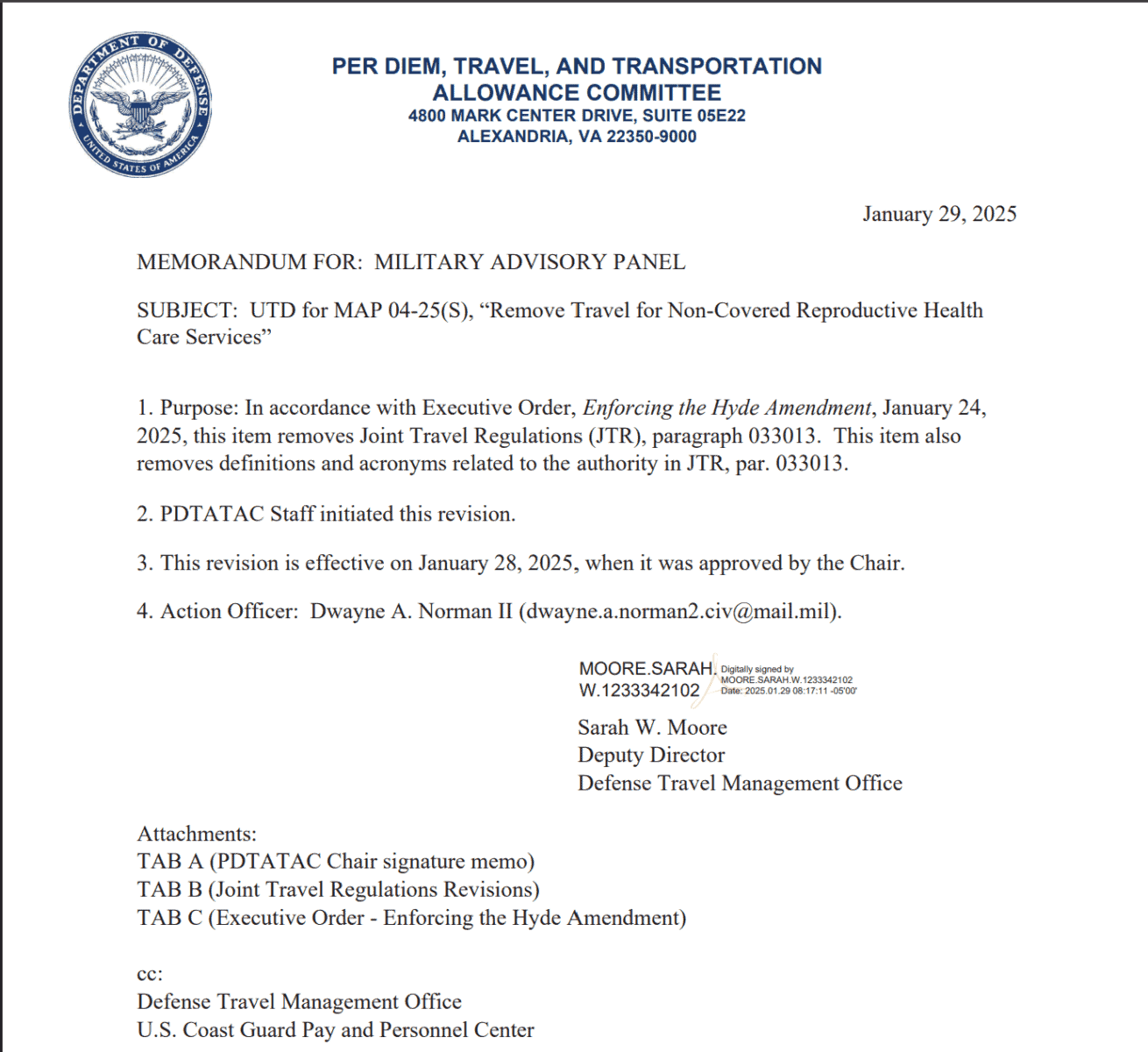
A separate 2025 change affecting many service members, particularly women, involved rescinding Biden era policies that had expanded reimbursements and administrative absences for travel to obtain certain non-covered reproductive health care. One primary artifact is the Joint Travel Regulations update removing travel allowances for non-covered reproductive health care services.
CRS summarized these DoD policy changes and noted subsequent adjustments that reestablished travel authority for certain non-covered assisted reproductive technology services that are lawfully available.
The net effect is that, compared with the prior policy baseline, some service members may face higher out of pocket costs, more administrative friction, or more dependence on personal leave for certain reproductive health related travel.
You may be interested in reading: The State of Safety: How LGBTQIA+ People Are Navigating a Changing America
Real World Fallout
Rollbacks in Veteran Healthcare Services
The Department of Veterans Affairs announced rollback of coverage for gender transition–related care for transgender veterans.
- Healthcare reduction: As reported by the Washington Post, hormone therapy and related follow-up care, previously available, are now limited for new recipients; only those already on treatment before changes are able to continue.
- VA leaders and advocacy groups have publicly criticized the policy for undermining trust in veteran care and mental health.
5) Separation, retirement, and long term benefits
Retirement system
The core retirement framework, including the Blended Retirement System (BRS), remains in place. DoD’s official BRS site describes the pension plus Thrift Savings Plan structure and provides calculators and education materials.
This system applies broadly across demographic groups.
Separation pathways
For transgender service members impacted by the 2025 policy, separation guidance is a central, career defining change. DoD’s own implementing documents lay out how separations may proceed and what options are available in the near term.
6) Veteran status and access to VA health care and services
LGBTQIA+ veteran services
VA maintains a national LGBTQ+ health program and local LGBTQ+ Veteran Care Coordinator infrastructure, framed as ensuring welcoming, competent care for LGBTQ+ veterans.
Transgender related VA health policy changes
In March 2025, VA announced it would phase out treatment for gender dysphoria in ways described in VA communications and policy notices, while stating that eligible veterans would continue to receive comprehensive VA health care including preventive and mental health care.
This is a significant post service change for transgender veterans because it can affect continuity of hormone therapy initiation and other gender dysphoria related care pathways inside the VA system, depending on individual circumstances and the scope of services addressed in the policy.
Takeaway
Since January 2025, the most direct and consequential change for “who can serve” has been the federal policy shift targeting service by individuals with gender dysphoria, supported by DoD implementation guidance and allowed to proceed during ongoing litigation.
For women and racial and ethnic minorities, the changes have been more indirect, especially through reductions and removals of DEI labeled content and initiatives rather than through explicit categorical bars to service.
Health policy changes have mattered along the pipeline as well, including the rollback of certain reproductive health travel benefits for service members, and VA’s 2025 policy shift on gender dysphoria related treatment for veterans.
Journalistic and think-tank reporting has highlighted broader cultural impacts of these policy shifts.
Analysts argue elimination of DEI initiatives undermines institutional support for women and minorities, possibly affecting recruitment and retention of underrepresented groups.
Resource list:
- White House executive order: Prioritizing Military Excellence and Readiness
https://www.whitehouse.gov/presidential-actions/2025/01/prioritizing-military-excellence-and-readiness/ - DoD News release and memo link: Digital Content Refresh memorandum
https://www.war.gov/News/Releases/Release/Article/4079501/pentagon-releases-digital-content-refresh-memorandum/ - DoD implementing memo (PDF): Implementing Policy on Prioritizing Military Excellence and Readiness
https://media.defense.gov/2025/May/08/2003706668/-1/-1/1/IMPLEMENTING-POLICY-ON-PRIORITIZING-MILITARY-EXCELLENCE-AND-READINESS.PDF - DFAS official pay tables landing page
https://www.dfas.mil/MilitaryMembers/payentitlements/Pay-Tables/ - DoD Blended Retirement System official portal
https://militarypay.defense.gov/blendedretirement/ - Congressional Research Service: Military basic pay and reform proposals (CRS product page)
https://www.congress.gov/crs-product/IN12367 - Congressional Research Service: DoD policy changes on reproductive health benefits
https://www.congress.gov/crs-product/IN12512 - VA national LGBTQ+ Health Program
https://www.patientcare.va.gov/lgbt/ - VA press release: VA to phase out treatment for gender dysphoria
https://news.va.gov/press-room/va-to-phase-out-treatment-for-gender-dysphoria/