America’s most important water source is disappearing. Here’s why it matters.
For generations, the Ogallala Aquifer has quietly powered one of the greatest agricultural success stories in history. Stretching beneath the Great Plains from South Dakota to Texas, this vast underground reservoir transformed what was once largely dry prairie into some of the most productive farmland on Earth.
Most Americans rarely think about where the water for their food comes from. They turn on the tap, fill their grocery carts, and assume the nation’s agricultural engine will continue humming along as it always has.
But scientists have been warning for years that one of America’s most important natural resources is being depleted far faster than nature can replace it. The concern is not that the entire aquifer will suddenly run dry. Rather, large portions of it—particularly in the southern High Plains—are steadily losing the groundwater that has sustained farms, ranches, rural communities, and billions of dollars in agricultural production for decades.
The challenge raises difficult questions about how the United States will balance food production, water conservation, and the long-term sustainability of one of its most valuable natural resources.
A water supply thousands of years in the making
The Ogallala, officially known as part of the High Plains Aquifer system, covers roughly 175,000 square miles beneath eight states, from South Dakota to Texas. It supplies approximately 30 percent of all groundwater used for irrigation in the United States, making it one of the most important freshwater resources in the country.
Unlike a reservoir that can refill after a wet winter, much of the Ogallala accumulated over thousands of years as water slowly seeped through soils and rock layers. In many areas, nature replaces only a tiny fraction of the water removed each year.
That imbalance has become increasingly pronounced since large-scale irrigation expanded after World War II. According to the U.S. Geological Survey (USGS), the High Plains Aquifer lost an estimated 286 million acre-feet of recoverable groundwater between predevelopment conditions and 2019.
Why farmers depend on the aquifer
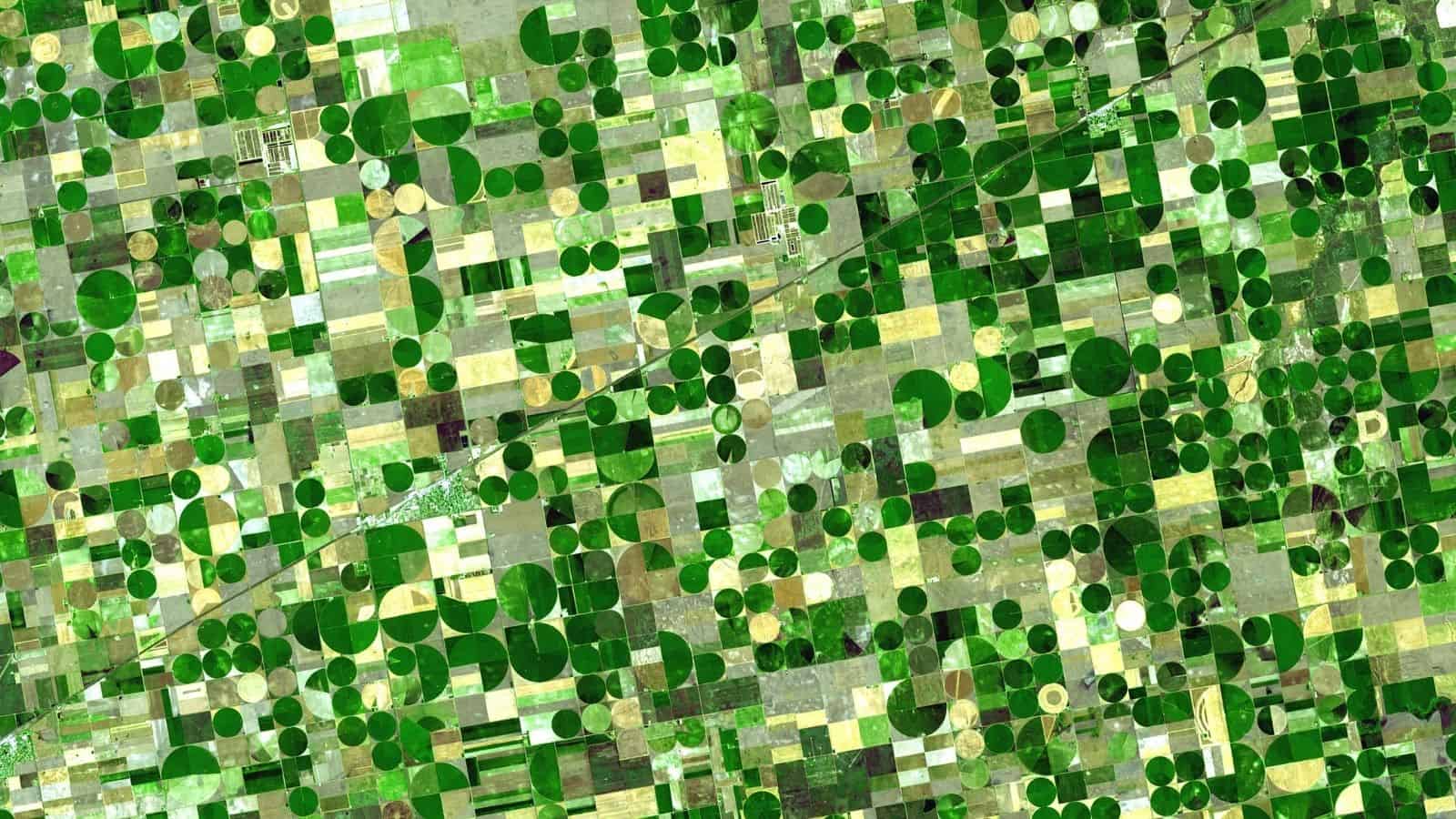
By NASA – httpearthobservatory.nasa.govNewsroomNewImagesimages.php3img_id=17006, Public Domain
The Great Plains are naturally semi-arid. Rainfall alone is often insufficient to support the yields needed for modern commercial agriculture.
The arrival of center-pivot irrigation fundamentally changed that equation. Vast circles of irrigated corn, wheat, cotton, sorghum, and other crops spread across landscapes that previously could not support such intensive farming.
Today, irrigation from the Ogallala supports billions of dollars in agricultural production each year. In parts of Texas, roughly 95 percent of groundwater pumped from the aquifer is used for agriculture.
That irrigation doesn’t simply grow crops. It supports livestock operations, food processing industries, transportation networks, rural employment, and ultimately grocery stores across the country.
Without reliable groundwater, much of that economic system would have to change.
Why the aquifer cannot keep up
The fundamental problem is remarkably straightforward.
In many parts of the High Plains, farmers are withdrawing water much faster than rainfall can replace it.
Natural recharge occurs when precipitation slowly infiltrates through the soil into the aquifer. But much of the southern Great Plains receives relatively little rainfall, experiences high evaporation rates, and has geological conditions that naturally limit how quickly groundwater can be replenished.
Climate change adds another layer of pressure. Higher temperatures increase evaporation from both soils and crops, often requiring additional irrigation during already dry years. Longer droughts can further reduce opportunities for groundwater recharge.
The result is a growing imbalance between withdrawals and replenishment that has persisted for decades.
Not every part of the aquifer is declining equally
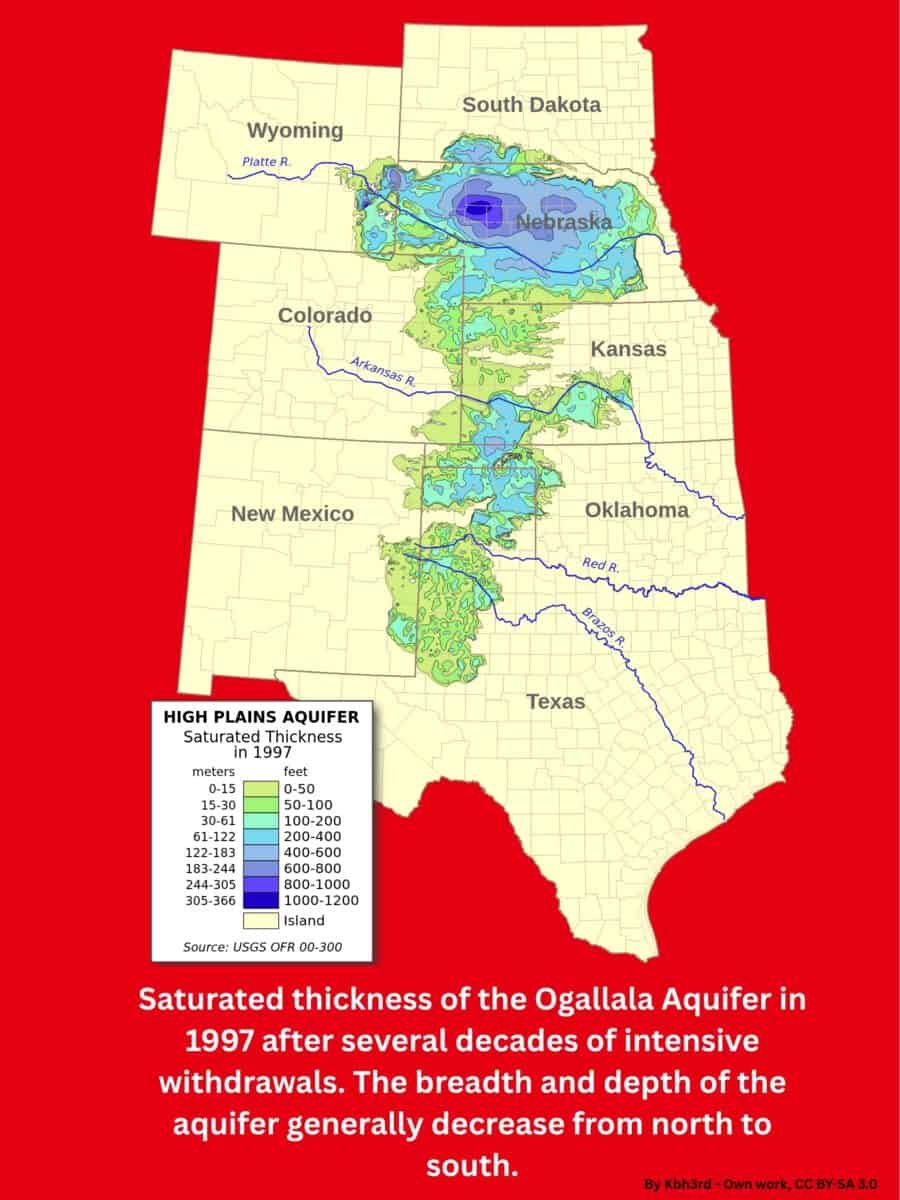
One of the biggest misconceptions about the Ogallala is that it is declining uniformly across all eight states.
It isn’t.
Some regions, particularly parts of Nebraska, have remained relatively stable because they receive more rainfall, have greater natural recharge, and have implemented stronger groundwater management in many areas.
The southern High Plains tell a different story.
Texas has experienced the largest cumulative groundwater losses within the aquifer. In portions of the Texas Panhandle, groundwater levels have fallen by more than 200 feet since large-scale irrigation began. Some wells no longer produce enough water to remain economically viable.
Kansas, Oklahoma, and parts of eastern New Mexico have also experienced substantial declines, although the severity varies considerably by location.
Understanding those regional differences is important because the future of the aquifer is unlikely to be one uniform outcome. Some areas may continue supporting irrigation for generations, while others are already being forced to adapt.
What happens if current trends continue?
Contrary to some alarming headlines, the most likely future is not a single moment when the Ogallala suddenly runs dry.
Instead, the impacts are expected to unfold gradually.
As groundwater levels fall, wells become more expensive to operate. Some require deeper drilling. Others produce less water. Eventually, pumping costs may exceed the economic value of irrigating certain crops.
Farmers may respond by switching to less water-intensive crops, reducing irrigated acreage, or returning some land to dryland farming. Rural communities that depend heavily on irrigated agriculture could experience slower economic growth, declining property values, and population loss.
Researchers have estimated that nearly one-quarter of currently irrigated land over the High Plains Aquifer may no longer be able to sustain irrigation by the end of this century if current trends continue.
The consequences would ripple well beyond the farms themselves, affecting food production, livestock operations, local businesses, and regional economies.
Why more efficient irrigation is only part of the answer
Installing more efficient irrigation systems sounds like an obvious solution, and in many cases it helps farmers grow more crop using less water per acre.
But efficiency alone does not necessarily reduce total groundwater use.
If farmers use those efficiency gains to irrigate additional acreage or shift to crops that require more water, total pumping may remain unchanged—or even increase.
Water experts have long noted that meaningful conservation depends not only on technology but also on limiting total groundwater withdrawals.
Efficiency matters.
So do the rules governing how much water can actually be pumped.
What governments can do
Because groundwater is largely managed by individual states rather than the federal government, solutions vary across the High Plains.
Water experts generally point to several strategies that can slow depletion:
- Establishing enforceable pumping limits.
- Expanding groundwater monitoring and metering.
- Supporting voluntary conservation programs.
- Providing incentives for farmers to transition to less water-intensive crops.
- Investing in research that improves water-use efficiency without increasing overall withdrawals.
- Encouraging long-term regional planning instead of responding only during drought emergencies.
Federal agencies already support many conservation efforts through technical assistance and financial incentives, but long-term success depends heavily on state and local groundwater management.
What farmers, businesses, and consumers can do
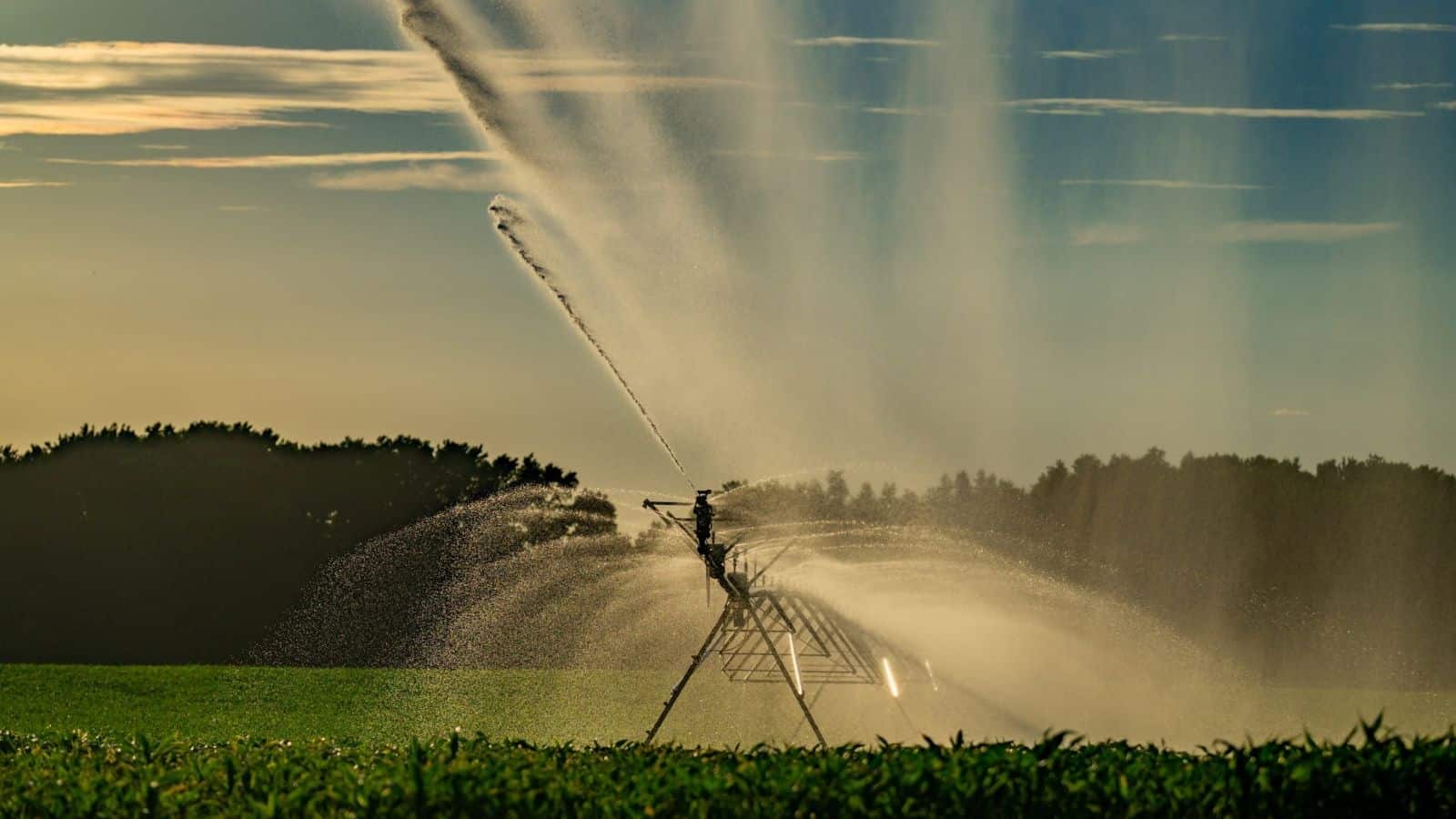
Protecting the Ogallala is not solely a government responsibility.
Farmers continue developing practices that improve soil health, increase water retention, adopt precision irrigation technologies, and carefully match crop selection to available water supplies.
Food companies increasingly examine the long-term sustainability of the regions that produce their ingredients. Financial institutions are beginning to assess groundwater availability as part of agricultural lending decisions.
Consumers also play a role, even if indirectly. Supporting research, conservation programs, and agricultural policies that reward sustainable water use helps create economic incentives for protecting groundwater over the long term.
No single solution will preserve the aquifer.
Progress is more likely to come from thousands of individual decisions made across farms, businesses, communities, and government agencies.
The bottom line
The Ogallala Aquifer is not disappearing overnight, and the nation is not on the verge of an immediate agricultural collapse.
But the long-term trend is difficult to ignore.
For decades, large portions of the aquifer have been losing water faster than nature can replace it. In some regions, the consequences are already visible in declining well productivity, rising pumping costs, and changing farming practices.
The choices made over the next several decades—by policymakers, farmers, businesses, and consumers—will help determine whether future generations inherit an agricultural system that remains resilient or one forced to adapt to a steadily shrinking water supply.
America’s food security has always depended on more than fertile soil. It also depends on protecting the natural resources that make that soil productive in the first place.
Question for Readers: If protecting our food supply means changing how we use water today, what trade-offs do you think Americans should be willing to make?
You may also want to read:
- Chicago powers all city-owned facilities with 100% clean energy in major climate milestone
- 12 global examples of countries prioritizing sustainability over resource extraction
- 10 American states bracing for an unusually intense drought season right now