You’ve Seen These Religious Practices—but Do You Know What They Actually Mean?
Every religion looks strange from the outside.
People bow before statues, walk in circles around buildings, wear specific garments, avoid ordinary foods, touch walls, shave their heads, cover their hair, light lamps, carry ceremonial blades, or refuse to work on particular days. Remove the explanation and almost any religious ritual can look arbitrary.
That’s usually the mistake.
Religious practices develop inside stories, scriptures, communities, and systems of meaning. What looks like an inexplicable rule to an outsider may remind a believer of God every time they eat breakfast. A strange-looking piece of clothing may represent a centuries-old commitment that once carried the risk of persecution. A repetitive physical ritual may turn an abstract belief into something the body remembers.
You don’t have to believe what another religion teaches to understand why its practices matter. Sometimes all that’s missing is the story behind them.
Here are 10 religious practices that make much more sense once you know what they mean.
1. Muslims Circle the Kaaba Seven Times
During the Hajj and Umrah pilgrimages, Muslims perform tawaf, moving counterclockwise seven times around the Kaaba in Mecca. To an outsider, millions of people circling a cube-shaped building can be one of Islam’s most visually striking rituals.
Muslims aren’t worshipping the Kaaba. They worship God, and Islamic theology strongly rejects worship directed toward physical objects. The Kaaba instead functions as Islam’s central sacred sanctuary and the direction toward which Muslims around the world face in prayer.
Islamic tradition connects the Kaaba with Abraham and his son Ishmael, who are described in the Quran as raising its foundations. Circumambulation therefore places individual pilgrims inside a collective ritual connecting them with sacred history and with Muslims from around the world.
The visual symbolism is difficult to miss. Rich and poor, powerful and obscure, people from different nations and languages all move around the same center. The building isn’t God.
It points everyone toward the same God.
READ: 10 Bible Stories Christianity, Judaism and Islam Tell Surprisingly Differently
2. Observant Jews May Avoid Flipping a Light Switch on the Sabbath
To someone unfamiliar with Jewish law, refusing to flip a light switch on Saturday can sound like an ancient rule being awkwardly applied to modern technology.
The actual reasoning is much more interesting.
The Torah commands Jews to refrain from melachah on Shabbat, but the Hebrew term doesn’t simply mean “work” in the modern sense of exertion or employment. Rabbinic tradition developed 39 broad categories of prohibited creative activity based partly on the kinds of labor associated with construction of the Tabernacle.
Modern technology then created new questions. How should electricity be classified? Does closing an electrical circuit resemble building? Does an incandescent filament involve kindling fire? Different rabbinic authorities have analyzed the details differently, but observant communities generally prohibit intentionally operating ordinary electrical devices on Shabbat.
The goal isn’t to pretend electricity doesn’t exist. Shabbat creates a recurring boundary in time during which ordinary control over the material world is deliberately restricted.
For roughly one day each week, life is supposed to work differently.
3. Sikhs Carry a Ceremonial Blade
One of the Five Ks maintained by initiated Sikhs is the kirpan, a blade carried as an article of faith. To someone encountering it without context, the immediate question may be obvious: why would a religion require someone to carry a weapon?
The kirpan isn’t simply a weapon. It symbolizes a Sikh’s obligation to resist injustice, protect the vulnerable, and remain prepared to defend others rather than passively tolerate oppression.
Its history matters. Sikhism developed in South Asia amid periods of severe political and religious conflict. Guru Gobind Singh established the Khalsa in 1699 and gave initiated Sikhs a distinctive religious identity that included the Five Ks. The ideal wasn’t merely personal spirituality; it combined devotion with courage and responsibility.
Modern kirpans vary considerably in size and form, and their legal treatment differs by country and institution. The religious principle, however, isn’t “carry a knife because violence is sacred.”
It’s almost the opposite.
Power carries an obligation to protect.
4. Some Buddhist Monks Shave Their Heads Because Hair Can Represent the Life They Left Behind
A shaved head is one of the most recognizable signs of Buddhist monastic life. It can look like a simple uniform, but its meaning is tied to renunciation.
Hair can carry enormous social significance. People style it to express beauty, status, identity, sexuality, fashion, ethnicity, rebellion, or conformity. Maintaining it takes time and attention. Removing it strips away one ordinary avenue of self-presentation.
Buddhist monastic codes include rules surrounding hair and grooming, and shaving became part of the visible separation between monastic and ordinary household life. A person entering the monastic community isn’t merely adopting a new hairstyle. They’re stepping away from many of the expectations that structure ordinary social existence.
Other religions have used hair in almost opposite ways. Sikhism treats keeping hair uncut as a sacred commitment, while Buddhist monasticism may remove it.
That contrast is useful. The hair itself isn’t inherently spiritual.
The commitment attached to it is.
5. Hindus May Ring a Bell Before Worship
Walk into a Hindu temple and you may hear bells ringing as worshippers arrive or rituals begin.
The sound isn’t merely decorative.
In Hindu worship, bells can announce the worshipper’s presence, mark the beginning of ritual attention, and help shift the mind away from ordinary distractions toward the divine. Different traditions provide different theological and symbolic explanations, and temple practices vary enormously across Hinduism.
Sound itself has deep religious significance in Hindu traditions. Sacred syllables, mantras, chanting, music, and recitation can be understood as more than accessories to worship. They are part of the religious act.
That helps explain why a bell matters. Religion isn’t always supposed to happen silently inside someone’s thoughts.
Sometimes the body needs a signal that ordinary time has stopped and worship has begun.
You may want to read: You’ve Heard These Religious Rules. Here’s the Meaning Behind Them.
6. Orthodox Jews May Touch a Small Case on the Doorpost
If you’ve entered an observant Jewish home, you may have noticed a small object attached to the doorframe. Some Jews touch it as they enter or leave, sometimes bringing their fingers to their lips afterward.
It’s called a mezuzah.
The case itself isn’t the central object. Inside is a handwritten parchment containing biblical passages from Deuteronomy, including the Shema’s declaration of God’s unity and commandments to love God and keep these words close.
The practice comes directly from the biblical command to write these words “on the doorposts of your house and on your gates.” Jewish tradition turned that instruction into a physical practice that follows a person through ordinary life.
That’s what makes the mezuzah so effective as a religious object. You don’t need to schedule a pilgrimage to encounter it.
You pass it when you leave for work.
You pass it when you come home.
The doorway becomes a reminder.
7. Some Christians Handle Snakes During Worship
This is one of the most startling religious practices in the United States.
A small number of Pentecostal Holiness congregations, historically concentrated in Appalachia and parts of the American South, have practiced handling venomous snakes during worship.
The practice is connected especially with a passage at the end of the Gospel of Mark stating that believers will pick up serpents and not be harmed by deadly things. Most Christians don’t interpret the passage as a command to handle snakes, and many modern Bibles note that the longer ending of Mark is absent from some of the earliest important manuscripts.
For snake-handling believers, however, the practice became an extreme demonstration of faith and submission to God’s will. Participants have sometimes been bitten, and some have died.
That danger is precisely why the practice can’t be understood as religious theater. For believers who participate, the risk is real.
It’s also a reminder of how dramatically interpretation matters. Millions of Christians can read the same biblical verse without ever considering touching a rattlesnake, while a tiny community can build an entire religious practice around it.
8. Muslims Wash Before Prayer Because Prayer Involves the Body Too
Before formal prayer, Muslims commonly perform wudu, a ritual washing involving parts of the body including the face, hands, arms, head, and feet.
To an outsider, it can look like practical hygiene.
Cleanliness is certainly relevant, but wudu is ritual preparation rather than simply washing because someone is physically dirty. A Muslim can be freshly showered and still need wudu before prayer if the ritual state has been broken.
The practice reinforces a concept found in many religions: approaching the sacred involves preparation. Judaism has ritual immersion, Christianity has baptism and washing traditions, Hinduism contains sacred bathing practices, and Shinto emphasizes purification.
Wudu makes that preparation repetitive and physical. Prayer doesn’t begin only when the worshipper starts reciting words.
Preparation begins at the water.
You may want to read: Why Muslims believe Jesus was not crucified
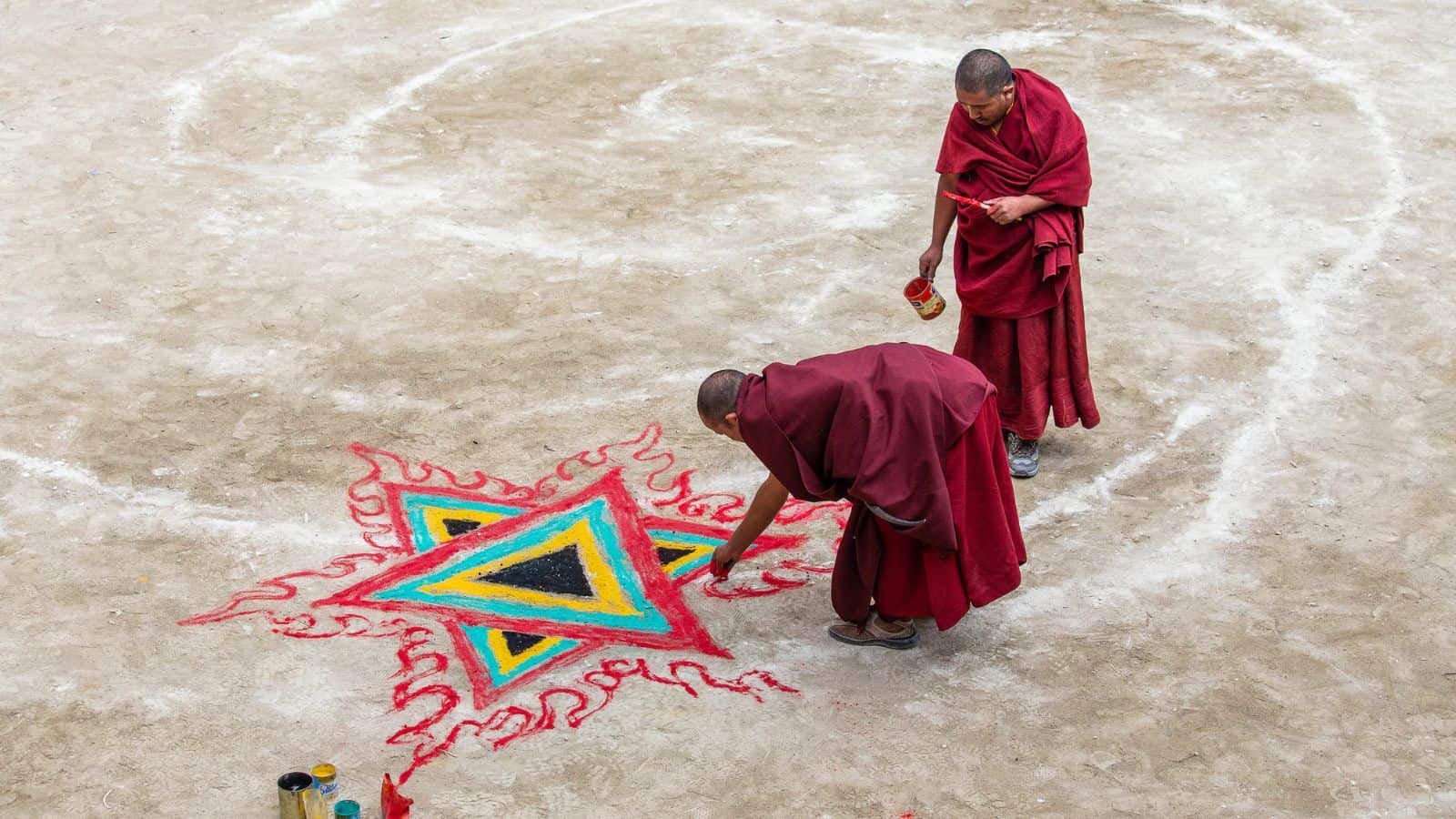
9. Tibetan Buddhists May Create Elaborate Sand Mandalas—and Then Destroy Them
Imagine spending days carefully creating an intricate work of art from colored sand.
Then imagine deliberately sweeping it away.
Tibetan Buddhist monks can construct elaborate sand mandalas through painstaking work, placing tiny amounts of colored material into complex geometric designs. The finished mandala can be astonishingly detailed.
Then it may be dismantled.
To a culture obsessed with preserving art, that can seem almost painful. Why spend so much effort creating something only to destroy it?
Because impermanence is part of the lesson.
Buddhism repeatedly emphasizes that conditioned things don’t last. Bodies age. Relationships change. possessions disappear. Civilizations rise and fall. Trying to make impermanent things permanent creates suffering.
A sand mandala doesn’t merely tell you that.
It makes you watch it happen.
10. Religious Rituals Often Look Strangest When Their Stories Are Missing
Take almost any familiar religious practice and remove its explanation.
Eating bread and drinking wine while speaking about someone’s body and blood would sound bizarre without Christianity. Refusing food and water from dawn until sunset would sound pointless without Ramadan. Avoiding a cheeseburger because meat and milk shouldn’t mix seems arbitrary without Jewish dietary law. Walking around an ancient building seven times makes little sense without the Hajj.
Context transforms behavior.
That’s why calling another religion’s practice “weird” usually tells us more about familiarity than about the ritual itself. People rarely notice how strange their own traditions would look to someone seeing them for the first time.
Religion works partly by giving ordinary objects extraordinary meanings. Water becomes purification. Hair becomes commitment. A doorway becomes a reminder of God. Sand becomes a lesson about mortality. A blade becomes a promise to defend the vulnerable.
Once you know the story, the practice may still look unusual.
But it usually stops looking meaningless.
Every Religion Looks Strange From Somewhere
Human beings don’t practice religion only with ideas. They practice it with bodies, clothing, food, water, sound, movement, objects, calendars, and physical spaces.
That’s why religious traditions produce rituals that can seem baffling from the outside. Beliefs become memorable when they’re turned into actions repeated again and again.
You don’t have to believe a mandala is sacred to understand what destroying it teaches about impermanence. You don’t have to observe Shabbat to understand why deliberately disconnecting from ordinary activity can transform a day. You don’t have to carry a kirpan to understand why a community shaped by persecution might make protection of others part of its visible identity.
The practice is what outsiders notice first. The meaning is what makes it last.