
10 Religions With So Few Followers Their Survival Is Remarkable
Imagine belonging to a religion so small that its entire worldwide population could fit inside a single sports stadium. Finding someone who shares your beliefs might mean traveling to another country, and the loss of a handful of religious leaders could threaten traditions that have survived for centuries.
For some religious communities, that’s a very real concern. While Christianity, Islam, and Hinduism count their followers in the billions, other religions have maintained distinctive beliefs, sacred writings, and rituals with remarkably small populations.
Some of these communities were already practicing their faith before Christianity existed. Others survived persecution, forced migration, and the disappearance of the civilizations that once surrounded them. Several don’t traditionally accept converts, making their continued existence even more remarkable.
Here are 10 religious communities that demonstrate why the size of a religion doesn’t necessarily determine its ability to survive.
1. The Samaritans: A Biblical People With Roughly 1,000 Members
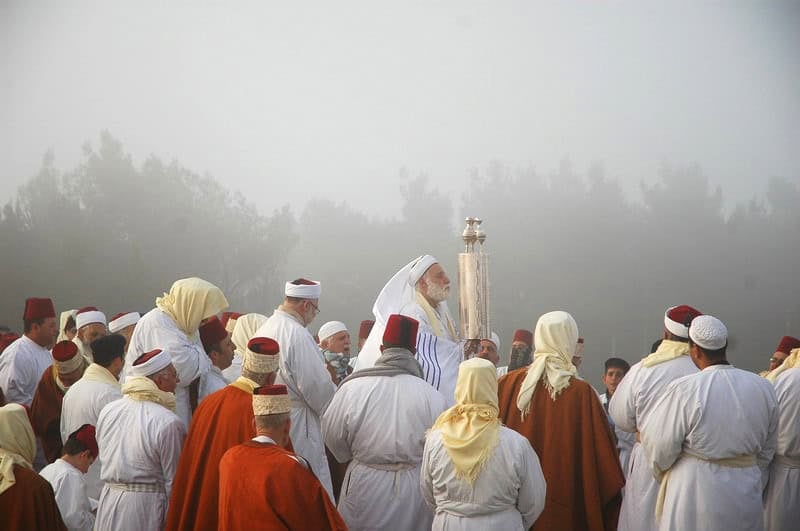
Most people encounter the Samaritans through the biblical parable of the Good Samaritan. The story is so familiar that the word Samaritan has become associated with helping strangers. Yet remarkably few people realize that the Samaritans are still a living religious community, numbering roughly a thousand members.
Samaritans preserve their own version of the Torah and regard Mount Gerizim, near the West Bank city of Nablus, as the sacred place chosen by God. Their religious calendar, priesthood, and annual Passover sacrifice maintain a distinctive Israelite religious heritage that developed alongside Judaism.
An ancient religious disagreement about where God should be worshipped continues to shape the lives of a community small enough to fit inside a school auditorium. Samaritan numbers declined dramatically over the centuries because of persecution, political upheaval, and demographic pressures. Today, families living around Mount Gerizim and in Holon, Israel, continue working to preserve their religious identity while navigating the practical challenges of belonging to such a small community.
2. The Mandaeans: A Religion That Reveres John the Baptist but Isn’t Christian
The Mandaeans have one of the most distinctive religious traditions to emerge from the ancient Middle East. Their sacred literature describes a spiritual world of light and darkness, and John the Baptist occupies an important position in their religious understanding. Yet Mandaeans are not Christians, and their beliefs differ substantially from Christian teachings.
Unlike Christians who generally undergo baptism once, Mandaeans practice repeated ritual immersion in flowing water. These ceremonies require trained religious specialists and appropriate conditions, making the preservation of their faith particularly challenging when communities become geographically scattered.
With a worldwide population generally estimated in the tens of thousands, the Mandaeans face a problem that larger religions rarely encounter: finding enough qualified religious leaders to sustain essential ceremonies. Historically concentrated in Iraq and Iran, many Mandaeans have relocated to Australia, Europe, and North America following persecution and instability. Their traditional restrictions on conversion and marriage outside the community add another layer of complexity to their efforts to preserve an ancient religious inheritance.
You may also want to read: 10 Ancient Religious Communities That Are Somehow Still Here
3. The Parsis: Descendants of a Religion That Once Dominated Ancient Persia
Zoroastrianism was once associated with some of the most powerful empires in the ancient world. Today, one of its best-known communities is the Parsis, descendants of Zoroastrians who migrated from Iran to the Indian subcontinent centuries ago.
India’s 2011 census recorded approximately 57,000 Parsis, a substantial decline from earlier decades. The community has nevertheless maintained a cultural influence far beyond its numerical size, particularly through contributions to business, philanthropy, education, science, and the arts.
The Parsis face a demographic dilemma that has no universally accepted solution within their community. Low birth rates, an aging population, and disagreements over conversion and the religious status of children from mixed marriages have complicated efforts to reverse population decline. Some Parsis believe maintaining traditional boundaries is essential to preserving their identity, while others favor more inclusive approaches. Their experience raises a difficult question for any small religious community: how much can a tradition change in order to survive without losing the characteristics that make it distinctive?
You may also want to read: Why Some Religions Want You to Convert—and Others Rarely Ask
4. The Kalash: A Few Thousand People Maintaining an Ancient Mountain Religion
In remote valleys of Pakistan’s Hindu Kush mountains lives a small community whose religious practices differ dramatically from those of the surrounding Muslim majority. The Kalash maintain a distinctive tradition involving seasonal festivals, sacred places, ritual offerings, and beliefs concerning multiple divine beings.
Their celebrations are closely connected with agriculture, livestock, the changing seasons, and community life. Colorful clothing, music, dancing, and elaborate ceremonies have attracted considerable outside interest, although popular accounts sometimes exaggerate or romanticize their origins.
The Kalash number only a few thousand, yet their religious traditions have survived in a region that has experienced enormous political and religious transformations. Their continued existence depends partly on the transmission of knowledge within families and communities. Economic pressures, migration, religious conversion, and the impact of tourism present challenges, but the Kalash remain active participants in shaping their future rather than simply preserving an unusual remnant of the past.
5. The Yazidis: A Community That Has Survived Repeated Attempts to Destroy It
The Yazidis maintain a distinctive religious tradition centered historically in northern Iraq, with communities elsewhere in the Middle East and a growing international diaspora. Their faith includes sacred hymns, pilgrimage traditions, hereditary religious roles, and reverence for Tawûsî Melek, often called the Peacock Angel.
For centuries, outsiders misunderstood or deliberately misrepresented Yazidi beliefs. Those distortions contributed to persecution, culminating in the genocide perpetrated by the Islamic State group in 2014. Many survivors were displaced from their ancestral communities, creating enormous challenges for families attempting to rebuild their lives.
Although the worldwide Yazidi population is generally estimated in the hundreds of thousands, it remains relatively small compared with major international religions. The community’s traditional prohibition on conversion means that religious survival depends heavily on the well-being of existing Yazidi families. Preserving sacred traditions, supporting survivors, rebuilding communities, and maintaining connections with the holy site of Lalish are therefore about much more than religious observance. They are essential parts of protecting a cultural and spiritual identity.
You may also want to read: 10 Religions That Nearly Disappeared Because Their Followers Were Persecuted
6. The Dönmeh: Descendants of a Religious Movement That Went Underground
In the seventeenth century, a Jewish religious figure named Sabbatai Zevi attracted followers who believed he was the long-awaited Messiah. His conversion to Islam in 1666 under Ottoman pressure created an enormous crisis for the movement, but some followers continued to regard him as a messianic figure.
A community subsequently developed whose members outwardly practiced Islam while preserving distinctive Sabbatean religious traditions. Known historically as the Dönmeh, they became particularly associated with the Ottoman city of Salonica, now Thessaloniki in Greece, before many relocated to Turkey.
What makes their history remarkable is that a religious movement survived even after the event that appeared to invalidate its central belief. The community developed its own customs, religious interpretations, and internal relationships over generations. Its present-day size is difficult to establish, and the extent to which distinctive religious practices continue is uncertain. Many descendants have assimilated into wider society, making this an example of how a religious identity can leave a lasting cultural inheritance even as its organized religious life becomes less visible.
7. The Shakers: A Once-Thriving American Religion Reduced to a Handful of Believers

During the nineteenth century, Shaker communities were established across parts of the United States. Their distinctive religious life emphasized communal property, celibacy, simplicity, equality, and disciplined work. Their craftsmanship and furniture designs became famous far beyond their religious communities.
At their height, the Shakers attracted several thousand members. But because they practiced celibacy, they depended on new converts and other people entering their communities rather than raising biological families to continue the faith.
A religion that once maintained numerous prosperous settlements eventually dwindled to just a handful of practicing members. Sabbathday Lake in Maine became the last active Shaker community, preserving a religious tradition that many Americans mistakenly assume disappeared long ago. The Shakers’ experience illustrates an unusual demographic reality: a community can be admired for its values, architecture, craftsmanship, and history while attracting very few people willing to embrace its demanding religious lifestyle.
8. Japan’s Hidden Christians: Families That Preserved Their Faith Without Churches
Christianity reached Japan in the sixteenth century, but religious persecution and government prohibitions eventually made public Christian worship extremely dangerous. Some believers continued practicing secretly, passing prayers and ceremonies from one generation to the next without regular access to priests or formal church institutions.
When restrictions eased in the nineteenth century, some of these communities reunited with the Catholic Church. Others maintained distinctive traditions that had developed during centuries of isolation. These latter communities are often associated with the term Kakure Kirishitan, or Hidden Christians.
Their ancestors preserved religious practices for more than two centuries under conditions that made ordinary public worship nearly impossible. Today, the continuation of these distinctive traditions faces different challenges, including aging populations, migration, and declining participation among younger generations. Their story demonstrates that surviving persecution is not necessarily the final obstacle a religious community must overcome. Sometimes the greatest threat comes much later, when descendants are free to choose whether to continue the traditions their ancestors struggled to preserve.
9. The Karaites: A Jewish Community That Rejects Rabbinic Religious Authority
Most contemporary Jewish religious traditions recognize the importance of rabbinic interpretation and literature, including the Talmud. Karaite Judaism takes a different approach, emphasizing the authority of the Hebrew Bible without accepting rabbinic oral law as independently binding.
Karaite communities developed distinctive interpretations of religious obligations, dietary practices, the Sabbath, and the religious calendar. Historically, they established communities across parts of the Middle East, North Africa, and Eastern Europe.
A disagreement about the authority of religious interpretation helped produce a separate Jewish tradition that has endured for more than a thousand years. Today, Karaites constitute a relatively small minority within the wider Jewish world, with communities particularly in Israel and elsewhere. Population estimates vary, partly because historical Karaite identities developed differently in different regions. Their survival offers a fascinating example of how a relatively small religious movement can maintain its identity through scholarship, family traditions, and distinctive approaches to shared sacred texts.
10. The Yarsan: A Religious Community Many Outsiders Have Never Encountered
The Yarsan, also known in some contexts as the Ahl-e Haqq, maintain a distinctive religious tradition historically associated with western Iran and neighboring regions. Their beliefs include sacred manifestations, spiritual transformation, and teachings preserved through religious poetry, music, and communal ceremonies.
The tanbur, a traditional stringed instrument, occupies an important position in Yarsan religious life. Sacred compositions and oral transmission help preserve teachings that have historically been less accessible to outsiders than the scriptures of larger religions.
Even determining how many Yarsan followers exist is difficult because religious identity, historical discrimination, and differing community classifications complicate population estimates. Estimates range from hundreds of thousands to more than a million, depending on the source and definition used. Although the Yarsan are larger than several other communities on this list, they remain a relatively small and frequently overlooked religious minority. Their survival demonstrates how religious traditions can remain culturally rich and internally distinctive without attracting widespread international recognition.
Why Small Religions Can Be Surprisingly Difficult to Preserve
A religion with millions of followers can lose a congregation, a school, or even an entire regional community without necessarily threatening its worldwide existence. For a much smaller tradition, the loss of a religious specialist, a sacred language, or a handful of participating families can have far greater consequences.
These communities have developed different ways of responding to that vulnerability. Some maintain strong boundaries around marriage and membership, while others adapt to new countries and cultural environments. Some rely heavily on written scriptures, and others preserve religious knowledge through music, ceremonies, and oral teaching.
The greatest threat to a small religion isn’t always persecution. Sometimes it’s simply the disappearance of the next generation willing to carry it forward. That makes the continued existence of these communities particularly remarkable. Their histories remind us that religious significance cannot be measured by population alone, and that some of humanity’s most distinctive cultural inheritances are maintained by remarkably few people.
Reader question: If you belonged to a tiny religious community that was gradually disappearing, would you favor changing its traditional membership rules to attract new followers, or would you preserve those rules even if the religion eventually vanished?