Are HBCUs inclusive for everyone? 12 questions people are debating
Critics sometimes ask a loaded question about HBCUs: if segregation was wrong, why should schools founded during segregation still exist at all?
The argument usually frames HBCUs as relics of a divided America, often invoking comparisons to the era when Black Americans were barred from sharing classrooms, neighborhoods, and even water fountains with white Americans. But that framing skips a critical distinction. HBCUs were not created to enforce separation; they were created because exclusion left Black students with few other options.
More than a century later, those institutions are navigating a very different reality. Non-Black enrollment is rising, international recruitment is expanding, and debates over gender identity, disability access, mental health, and campus demographics are reshaping what inclusion means inside schools originally built around a specific historical mission. In 2024, UNCF noted that HBCUs make up just 3% of U.S. colleges and universities, yet produce nearly 20% of all Black college graduates in the country.
The modern debate is no longer simply whether HBCUs should exist. It is whether institutions designed to protect opportunity for a historically excluded population can broaden who they serve without losing the purpose that made them necessary in the first place.
Are HBCUs changing as non-Black enrollment grows?

In 2022, non-Black students made up 24% of enrollment at HBCUs, up from 15% in 1976. The national figure, though, flattens a split that is far more dramatic at the institutional level. More than 80% of the student body at 65 of the 99 HBCUs was Black that year. At eight others, more than half of the student body was not Black.
West Virginia State University, founded in 1891 as a historically Black college, now enrolls a student body that is approximately 61% white. Bluefield State College, also in West Virginia, has pushed further. 2024 and 2025 data show its student body is over 80% white. Lincoln University of Missouri sits at roughly 40% white, with its white president, John Moseley, acknowledging in a 2025 interview the dual identity this produces: a school founded by Black Civil War soldiers, drawing heavily from the surrounding predominantly white region of central Missouri.
HBCU status is tied to a school’s founding purpose, not its current enrollment, so changing demographics do not alter the designation. But as former Lincoln admissions dean Darius Watson noted, HBCUs were built for a closed market that no longer exists. The legal label remains fixed; what changes is how institutions define their mission and who gets to shape it.
How inclusive are HBCUs for LGBTQ+ students?
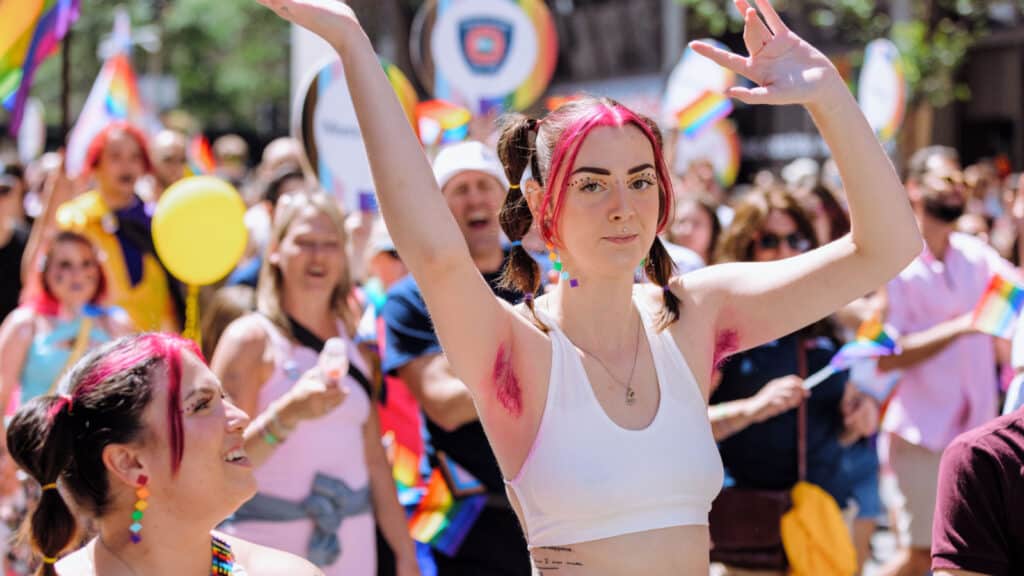
Bowie State University was the first HBCU to open a Gender and Sexualities Diversity Center and the first to have a Queer Studies course approved. The fact that this happened recently and was treated as significant news tells you where the baseline sits. Many HBCUs were founded by or remain affiliated with Black churches, a connection that has historically shaped campus culture on sexuality in ways that written policy alone cannot override.
Some campuses have made concrete policy changes. Clark Atlanta University offers gender-inclusive housing policies, gender-neutral bathroom lists, and preferred-name updates in campus systems. Howard University piloted gender-neutral housing in 2016. Spaces designed only for transgender students do not meet every need, and the university is still reevaluating its approach.
The experience varies sharply depending on which campus a student lands on. At schools with dedicated infrastructure, the results are meaningful. At schools without it, LGBTQ+ students are navigating the same isolation that the HBCU model was supposed to prevent.
Why are Black men disappearing from HBCUs?

Black men account for only 26% of the students at Historically Black Colleges and Universities, down from 38% in 1976. In absolute numbers, there are fewer Black men enrolled at HBCUs today than there were in 1976, a decline that has been running for nearly five decades through enrollment expansions, demographic shifts, and everything in between. Across all accredited HBCUs, 61.5% of students are women, exceeding the national college average of 56%.
In general, young men arrive on college campuses less academically skilled than women. That’s even more true of Black men, men of color. Harvard economist Raj Chetty’s research found that the income gap between Black and white Americans is driven entirely by differences in men’s economic circumstances, not women’s, which makes HBCU enrollment not just a campus demographic question but a generational wealth predictor.
The specific pressures are well-documented: high suspension rates in high school, mass incarceration, the immediate financial demands of low-income families, and tuition costs. HBCUs produce 50% of Black lawyers, 40% of Black engineers, and more Black medical school applicants than any other institutional type. Every year, the Black male enrollment gap persists, and fewer men are moving through those pipelines.
Are HBCUs meeting the needs of disabled students?

19.4% of U.S. undergraduates during the 2015–2016 academic year reported having a disability. Apply that proportion to HBCUs’ roughly 289,000 enrolled students, and you get approximately 56,000 students with disabilities on HBCU campuses, a population whose experience at these institutions remains among the least documented in higher education research.
Web accessibility remains inconsistent across many HBCU websites, directly affecting how students with visual impairments, cognitive disabilities, or motor difficulties navigate accommodation processes and institutional services. A 2006 doctoral dissertation by Moore-Cooper found that HBCU disability offices were frequently understaffed and underfunded, even relative to their size. The finding predates the digital accessibility gap by nearly two decades and has not been comprehensively revisited since.
Public HBCUs average just $7,265 in endowment per student, compared with $25,390 at PWI public colleges. Disability services require dedicated staff, assistive technology, accessible physical infrastructure, and administrative bandwidth. HBCUs’ founding mission is to provide access to those excluded by other institutions. Students with disabilities, Black and non-Black, are the most direct continuation of that mission. The infrastructure to fulfill it has not caught up.
Why the HBCU funding gap still matters
The top 10 largest endowments from Predominantly White Institutions and the top 10 HBCUs in 2024 were $336 billion and $2.6 billion, respectively, a 129-to-1 ratio. Harvard’s endowment alone exceeds $50 billion. Howard University only recently became the first HBCU to cross the $1 billion endowment mark, a milestone that 226 PWIs had already reached.
In 2023, officials found that 16 states had underfunded HBCUs by $13 billion over the course of three decades. Only Ohio and Delaware were found to have funded their HBCU land-grants equitably. Florida A&M University is estimated to have been denied nearly $2 billion in state funding since 1987. Florida State University sits less than a mile away, separated by a railroad track. FAMU students noticed that some classrooms lack equipment.
Dr. Walter Kimbrough, president of Dillard University, named the structural dynamic plainly: we are underfunded schools that serve underfunded students. The white-Black wealth gap, currently 6-to-1, means Black alumni have historically had less to give. State funding formulas compounded that.
Every conversation about what HBCUs can offer- mental health services, disability infrastructure, LGBTQ+ centers, international student support- runs directly through what they have been given to work with.
HBCUs help mental health, but treatment gaps remain
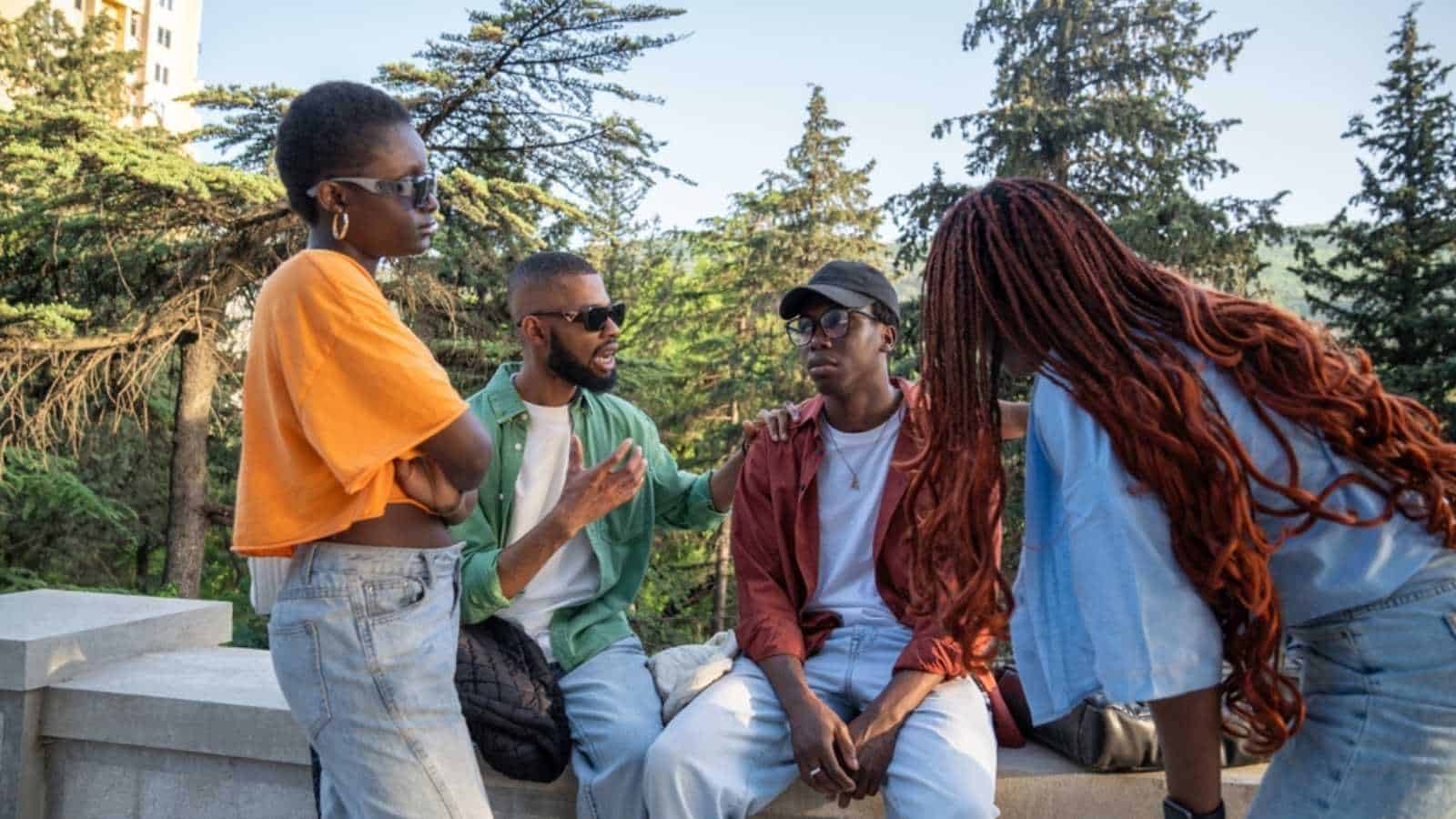
45% of HBCU students report flourishing mental health, compared to 36% in national samples and 38% among Black students at predominantly white institutions. That finding comes from a 2024 UNCF and Healthy Minds Network study examining more than 2,500 students across 16 HBCUs.
83% of HBCU students report feeling part of their campus community, compared with 73% nationally and 72% among Black students at PWIs. HBCU students also report lower rates of anxiety, substance use disorders, and eating disorders than the national average.
54% of HBCU students with moderate to severe symptoms received no mental health treatment, higher than both the national average (41%) and Black students at PWIs (47%). HBCU students report higher rates of perceived stigma around mental health treatment (52%) compared to the national average (41%).
An institution can produce the strongest belonging numbers in higher education and simultaneously under-treat its most symptomatic students. At most HBCUs, both are true at once.
HBCUs may be America’s strongest engines of mobility

Graduates of HBCUs are 51% more likely to move into a higher-income quintile than graduates of non-HBCUs, according to McKinsey analysis cross-referenced with Harvard’s Opportunity Insights project. The mean mobility rate across all U.S. colleges is 1.6%, but for HBCUs it is 3.0%.
Nationwide, institutions admit low-income households earning less than $46,000 annually, at a rate of 22.5%. Ivy League schools admit 9.3%. HBCUs admit 51.3%. The White House Council of Economic Advisers found that about 30% of HBCU students move up at least 2 income quintiles from their parents’ income by age 30, nearly double the 18% rate at non-HBCUs.
Most HBCUs rank in the 90th percentile nationally for helping students move from the bottom 40% of household income into the top 60%. These outcomes were produced with a 129-to-1 endowment disadvantage.
International students are growing at HBCUs

As of the 2017–18 academic year, Morgan State had the highest international enrollment among HBCUs with 10 or more international students, at 945 students, ahead of Howard University at 920 and Tennessee State at 584.
By 2018, that number had fallen to 488, tracking a broader national decline that began in fall 2016. Between 2011–12 and 2015–16, new international student enrollment in the U.S. had grown from 228,467 to 300,743. By 2017–18, it had dropped to 271,738.
In some cases, staff contact information is not visible on the ISSS webpage, so researchers had to call the institution directly. For a prospective international student, a phone-dependent intake process is a meaningful filter.
The HBCUs most active in international recruitment are trying to connect two things simultaneously: the HBCU’s historical relationship with the African diaspora, and the practical infrastructure needed to support students arriving from outside the U.S. The first exists. The second is still being built.
Black women carry much of HBCU life

Black women made up 55.6% of all African American enrollments at HBCUs in 1976, 58.4% in 1986, 61.4% in 2000, and 65.7% in 2020. The climb is unbroken across 44 years. For every Black man at an HBCU today, there are approximately 2.5 Black women.
The majority of enrollment does not translate into an uncomplicated experience. While HBCUs may offer students a nurturing experience, HBCUs are the same world in terms of gender dynamics. Gender bias and microaggressions exist on HBCU campuses just as they do at PWIs.
The specific pressure Black women describe is cultural: the expectation to subordinate gender concerns to racial solidarity, to set aside questions of sexism in service of a unified Black institutional identity. A cultural tax, distributed unevenly, sits beneath enrollment data that, on the surface, appears an unambiguous success.
At HBCUs, gender ratio imbalances- often featuring female-to-male ratios of 2: 1 or higher- profoundly shape campus culture. This dynamic intersects with cultural scripts around Black masculinity, producing distinct interpersonal relations, dating cultures, and social challenges that are unique to the HBCU environment.
What role do white students play at HBCUs?

Today, white students make up roughly 10% of all HBCU enrollment, totaling about 28,000 students nationwide. Most arrive for practical reasons- proximity, affordability, program-specific draws- rather than cultural ones. White students sometimes choose HBCUs over PWIs for reasons of access, affordability, and specific program offerings that their local PWI might not have.
Some arrive seeking cultural exposure. That kind of exposure, when it happens organically, tends to produce more durable understanding than any formal diversity curriculum.
The historical precedent makes the demographic conversation at HBCUs structurally different from the diversity debate at a state university. At a PWI, increasing minority enrollment signals equity gains. At an HBCU, a growing white majority has a documented track record as a mechanism for institutional transformation, not always gradual or in the direction of the founding mission.
When Bluefield State hired its first white president in 1966, Wendell G. Hardway appointed 23 new faculty members within two years, all white. A faculty that had been entirely Black as recently as 1954 was 30% Black by 1967. The student body followed. HBCU status remained. The institution did not.
First-generation students are central to the HBCU mission

More than 70% of HBCU students receive federal Pell Grants, typically awarded to students from households below $60,000 annually. HBCUs are, in measurable terms, primarily institutions of the working class. That framing, HBCUs as Black working-class colleges, changes the lens through which every inclusion question should be evaluated.
Over half of all institutions in the 95th percentile nationally for social mobility into the middle class are HBCUs. Most HBCUs rank in the 90th percentile for helping students move from the bottom 40% of household income into the top 60%.
An HBCU with a 23% four-year graduation rate is not failing its mission; it is enrolling students with no college-going family history, balancing work and school, often supporting dependents, and still graduating at rates that shift their family’s economic position across a generation. The denominator changes what the rate means entirely.
Can HBCUs stay mission-driven while becoming more inclusive?

Three institutions that would never be confused for one another: Howard University with a $1 billion endowment, Bluefield State College with a 90% white student body, and Xavier University of Louisiana, sending more Black students to medical school per capita than any university in the country. They all carry the same federal HBCU designation.
The share of non-Black students at HBCUs now approximately equals the share of Black male students- both around 25–26%. That crossover is not symbolic. The population HBCUs were founded to serve, and whose exclusion from American higher education created the institutional category in the first place, now represents no larger a share of these schools than students who had access to every other institution all along.
The HBCU that protects Black students’ mental health at rates no PWI matches while simultaneously under-treating 54% of its most symptomatic students, with a 129-to-1 endowment disadvantage and $13 billion in documented state underfunding behind it, is doing something extraordinary. The question is whether extraordinary is enough- and who gets to count on it.
Key takeaways

- HBCUs were created in response to exclusion from higher education, not as instruments of segregation.
- Rising non-Black enrollment is changing the demographic makeup of some HBCUs faster than many people realize.
- HBCUs remain major drivers of Black economic mobility despite large funding disparities with PWIs.
- Students’ experiences differ widely depending on campus support for LGBTQ+, disabled, and international communities.
- The central tension is whether HBCUs can expand inclusion while preserving their historic mission.
Disclaimer – This list is solely the author’s opinion based on research and publicly available information. It is not intended to be professional advice.
Like our content? Be sure to follow us