Could you spot an internet romance scam? Here is a 5-question reality check.
You meet someone online. They’re attractive, attentive, interested in the same things you are, and somehow always know exactly what to say. A few weeks later, you feel as though you’ve known them for years.
Would you know if they weren’t real?
Internet romance scams have been around almost as long as internet dating, but artificial intelligence is making them considerably harder to spot. The awkward messages, obviously stolen photographs, strange grammar, and inconsistent stories that once gave scammers away are becoming easier to eliminate.
Today’s scammer may know where you went on vacation, what kind of dog you have, that you recently got divorced, which sports team you follow, and where your children went to college—before they’ve ever said hello.
According to a recent CyberGhost investigation into AI-driven romance scams, scammers can combine information from social media, dating profiles, data brokers, and other online sources with AI tools to research potential victims, create convincing identities, and carry on highly personalized conversations.
And they’re not necessarily sitting at a computer chatting with one unsuspecting person at a time.
CyberGhost cites a 2026 Associated Press investigation in which a worker involved in romance-baiting scams used AI-powered software to manage more than 100 simultaneous conversations across dozens of fake profiles during a single shift.
That raises an unsettling question:
Could you recognize a romance scam before you fell for the person behind it?
Here are some of the biggest warning signs.
They seem almost suspiciously perfect for you
You love golden retrievers. So do they.
You lost your spouse three years ago. They understand because they’ve experienced a heartbreaking loss too. You adore Italy. Amazingly, Florence is their favorite city.
It could be wonderful chemistry.
Or it could be research.
CyberGhost points out that scammers can gather information from public social-media posts, photographs, dating profiles, interactions, and data-broker records. That information can reveal everything from someone’s interests and location to relationship status and major life events.
AI makes sorting through that information much faster.
A scammer doesn’t necessarily have to spend days studying your Facebook account anymore. AI tools can analyze large amounts of publicly available information and help identify details that could be useful for creating an emotional connection.
The things making someone seem like your perfect match may actually have come from you.
The relationship becomes intense incredibly fast

You’ve been talking for nine days and they’re already telling you they’ve never felt this way before. By week three, they’re talking about your future together.
Romance scammers frequently use love bombing, overwhelming a target with affection, attention, compliments, and declarations of emotional intimacy. There’s a reason for the speed.
The scam ultimately depends on trust.
A request for $5,000 from a stranger sounds ridiculous. A desperate request for $5,000 from someone you believe you love can feel completely different.
That’s why the money request may not arrive immediately. A sophisticated scammer may spend weeks or months establishing the relationship first.
The romance isn’t separate from the scam. The romance is what makes the scam possible.
They always have a reason you can’t meet
This remains one of the biggest warning signs.
Your new love interest works overseas. They’re stationed on a military base. They’re on an oil rig. They’re traveling for business. They’re caring for a sick relative somewhere far away.
There always seems to be a perfectly plausible explanation for why meeting isn’t possible quite yet. Eventually, perhaps they’ll even make plans to visit.
Then something happens. The flight gets canceled. There’s a medical emergency. Their bank account gets frozen. Customs is holding something important. A business deal suddenly goes wrong.
And conveniently, money could solve the problem.
The Federal Trade Commission’s advice remains wonderfully uncomplicated: Never send money or gifts to a romantic interest you haven’t met in person.
But you’ve video chatted with them

This used to be one of the best ways to establish that someone was real. Not anymore.
Scammers can use AI-generated portraits, altered photographs, face swapping, deepfake technology, and voice cloning to make fake identities considerably more convincing. That doesn’t mean every slightly glitchy FaceTime call is a criminal conspiracy.
It does mean that seeing someone’s face on a screen should no longer be treated as absolute proof that the person is who they claim to be.
In one experiment cited by CyberGhost, participants trying to distinguish real human faces from AI-generated ones were correct only 61% of the time.
We’re not nearly as good at spotting fake people as we think we are.
You may want to read: 12 ways to spot a scammer using AI voice technology
Their photographs look real—and a reverse-image search finds nothing
Another old piece of scam advice was to reverse-search someone’s profile picture.
It’s still worth doing. But a clean result no longer proves much.
Traditional scammers often stole photographs of real people, meaning the same picture might appear elsewhere online under another person’s name.
AI changes that.
Scammers can now generate entirely new portraits or modify stolen photographs with AI-generated elements. A photograph that has never existed anywhere else on the internet won’t necessarily show up in a reverse-image search.
Use image searches as one piece of evidence, not a certificate of authenticity.
They want to leave the dating app quickly
You meet on a dating platform and almost immediately hear:
“I hate messaging on here. Can we switch to WhatsApp?”
Maybe they really do hate the app. But moving conversations elsewhere also moves them away from some of the platform’s safety systems, moderation, and reporting tools.
CyberGhost recommends staying on the dating platform while getting to know someone and treating attempts to move elsewhere unusually quickly as a reason to be cautious.
It’s not proof of a scam.
It’s a yellow flag worth noticing.
Eventually, money enters the conversation
This is the point where caution should become a hard stop.
Sometimes it’s direct:
I hate asking, but I have an emergency.
Sometimes it’s romantic:
I finally bought my ticket to come see you, but my card isn’t working.
And sometimes the scammer never asks you to give them money at all.
Instead, they want to help you make money.
That’s an increasingly important version of romance fraud. After establishing trust, the person casually mentions how successful they’ve been investing, often in cryptocurrency. Eventually they offer to show you how to do it too.
The investment platform may look completely legitimate. Your account may even appear to be making money. The numbers on the screen can be fake. The money you transfer is very real.
An online romantic interest should never be directing your investments.
They ask for gift cards, cryptocurrency, or a wire transfer
The story surrounding the request can be elaborate. The payment method often tells you considerably more. Scammers favor payment methods that can be difficult or impossible to reverse, including cryptocurrency, wire transfers, and gift cards.
No legitimate romantic emergency requires you to buy $2,000 worth of gift cards and read the numbers over the phone.
If someone you’ve met online tells you exactly how to move money in an unusual way, stop before sending anything.
Then tell someone else what’s happening.
That second step matters because an outsider isn’t emotionally invested in the relationship and may recognize something you don’t.
They gradually ask for more personal information
Money isn’t the only thing worth stealing. A romance scammer may also be after your identity.
Scammers may gradually obtain information such as a home address, phone number, date of birth, banking information, login credentials, or copies of identity documents.
The requests may not seem suspicious because they happen within what feels like a genuine relationship.
Combined with information already available through social media, data breaches, or data brokers, those details could potentially help someone impersonate you, reset passwords, access accounts, or commit other forms of fraud.
Think carefully before sharing information that answers questions commonly used to verify your identity.
Someone doesn’t need your bank account password to begin assembling the pieces required to steal your identity.
Intimate photographs can become weapons
A romantic relationship becomes sexual. Someone asks for an intimate photograph or video. Then everything changes.
Scammers can threaten to send the images to family members, friends, coworkers, or social-media contacts unless the victim pays.This is sextortion.
AI has made the situation even more disturbing. Scammers can now potentially create fake intimate images or video using artificial intelligence, meaning compromising material doesn’t necessarily have to originate with the victim.
The safest assumption is that anything intimate sent digitally can eventually leave the conversation in which you sent it.
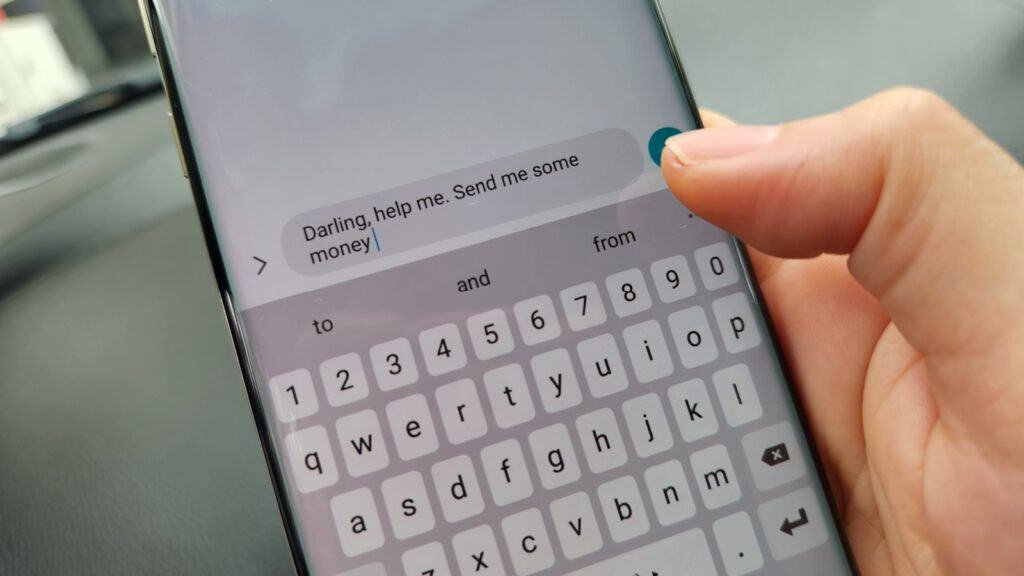
They ask you to receive or transfer money
This one can sound harmless.
Their bank isn’t working. They’re having trouble receiving a payment. Could someone send money to you, and then you forward it?
Don’t.
CyberGhost warns that romance-scam victims can unknowingly become money mules, receiving or transferring funds obtained through criminal activity. At that point, you may not simply be losing money.
You could be moving stolen money on behalf of criminals without realizing it.
You may want to read: How to spot a financial scam before you lose money
Social media may be a bigger hunting ground than dating apps
You don’t have to use Tinder, Bumble, or any other dating app to encounter a romance scammer.
In fact, FTC data released in 2026 found that nearly 60% of people who reported losing money to a romance scam in 2025 said it began on social media.
That makes sense.
Social media doesn’t simply provide scammers with access to potential victims. It can provide the research material too.
Your relationship status, hobbies, family members, political interests, favorite restaurants, vacations, pets, job, birthday celebrations, and recent losses may all be visible in one place.
A message from a stranger who happens to share three of your interests can feel wonderfully serendipitous.
It may also be extremely well targeted.
Make yourself harder to research
One of the more useful points in the CyberGhost research is that protecting yourself doesn’t begin when a suspiciously attractive stranger sends you a message.
It begins with how much strangers can learn about you before they make contact.
Review who can see your social-media posts and friends lists. Consider making personal accounts private. Delete old accounts you no longer use. Be careful about publicly sharing your location, workplace, relationship status, travel plans, phone number, and other identifying information.
Review the permissions you’ve given apps, particularly access to your contacts, location, photographs, microphone, and camera. Use unique passwords and multifactor authentication on important accounts.
None of these steps makes romance fraud impossible. They simply give a scammer less material to work with.
The five-question reality check
If an online relationship is becoming serious, ask yourself five questions:
- Have I actually met this person in real life?
- Has the relationship become unusually intense unusually quickly?
- Do they repeatedly have reasons we cannot meet?
- Have money, cryptocurrency, investments, gift cards, banking, or financial emergencies entered the conversation?
- Would I feel uncomfortable showing our entire conversation to someone I trust?
One “yes” doesn’t prove you’re talking to a scammer.
Several of them should make you stop and investigate before the relationship goes any further.
And if someone you’ve never met asks you for money, the answer should simply be no.
If you think you’re being scammed
Stop sending money immediately.
Don’t send one final payment because the person promises it will solve everything. Don’t pay a fee to unlock an investment account. Don’t send money so they can finally travel to meet you.
Contact your bank, credit-card issuer, cryptocurrency exchange, wire-transfer company, or other payment provider immediately and ask whether the transaction can be stopped or recovered.
Save the messages, photographs, usernames, phone numbers, transaction records, wallet addresses, and other evidence.
Report the account to the dating or social-media platform where contact began, and report the fraud to the Federal Trade Commission.
And tell someone you trust.
Romance scams work partly because victims can feel embarrassed once they begin questioning the relationship. That embarrassment can keep people isolated—and isolation gives the scammer more control.
The most dangerous romance scam may be the one that doesn’t look like a scam
The old stereotype of an internet romance scammer is increasingly outdated.
They don’t necessarily write strange messages. Their photograph doesn’t necessarily belong to someone else. Their stories don’t necessarily contain obvious contradictions. They may be able to talk to you on the phone or appear on video.
AI can help scammers sound more natural, remember personal details, manufacture convincing identities, and maintain enormous numbers of relationships simultaneously.
That doesn’t mean online relationships should automatically be treated with suspicion. Millions of real relationships begin online.
It means the old test—Does this person seem real?—is no longer enough.
A better question may be:
Can I independently establish that this person is who they say they are before I trust them with my money, identity, intimate photographs, or financial decisions?
Because falling for someone online isn’t foolish. But in the age of AI, making someone prove they’re real before you put yourself at risk is increasingly just common sense.
Reader question: Would you know what to look for if you suspected a friend or family member was falling for an online romance scam?
You may want to read:
- 12 ways to spot a deepfake scam targeting American seniors right now
- How to spot a financial scam before you lose money