How the Bible’s books were chosen—and why some early Christian writings were left out
Have you ever wondered who decided which books belonged in the Bible—and why some early Christian writings were left out?
The answer is far more complicated than many people realize. During Christianity’s first few centuries, there was no universally accepted New Testament. Different churches used different collections of writings, and debates over which texts accurately reflected the teachings of Jesus and the apostles continued for generations.
One of the most influential figures in that debate was Marcion of Sinope, a wealthy second-century teacher whose controversial collection of Christian writings is widely regarded by many scholars as the earliest known attempt to establish a fixed Christian canon.
His ideas were rejected by the emerging church, but they helped accelerate the process that eventually produced the New Testament used by most Christians today. Along the way, numerous other gospels and religious texts were excluded from the canon, offering a fascinating glimpse into the diversity of early Christianity. Here’s how that remarkable story unfolded.
The billionaire shipowner who beat everyone to the punch
Back in 140 CE, a super-wealthy shipping magnate named Marcion of Sinope sailed into Rome with a massive donation and a radical idea. He donated a whopping 200,000 sesterces, millions today, to get the Roman church’s attention. At the time, the mainstream church had no official “New Testament” canon.
Marcion took matters into his own hands and is believed to have compiled the world’s very first Christian Bible. He believed Christianity was a brand-new revelation that must sever its Jewish roots. His wealth allowed his ideas to spread like wildfire across the Roman Empire.
A wild theory of two opposing gods
Marcion’s theology was built on a jaw-dropping premise: the God of the Old Testament and the God of the New Testament were completely different beings. He argued that Yahweh was a vindictive, legalistic creator deity who punished humanity with brutal violence. But Jesus revealed an entirely new, Supreme God of pure love, mercy, and grace.
This meant Christianity had absolutely nothing to do with Judaism, a view that got him swiftly excommunicated.
Horrified church leaders handed back his massive donation and kicked him out. But Marcion didn’t stop. He went on to establish his own massive network of churches that rivaled orthodox Christianity about a century ago.
The heavily edited gospel of the Lord
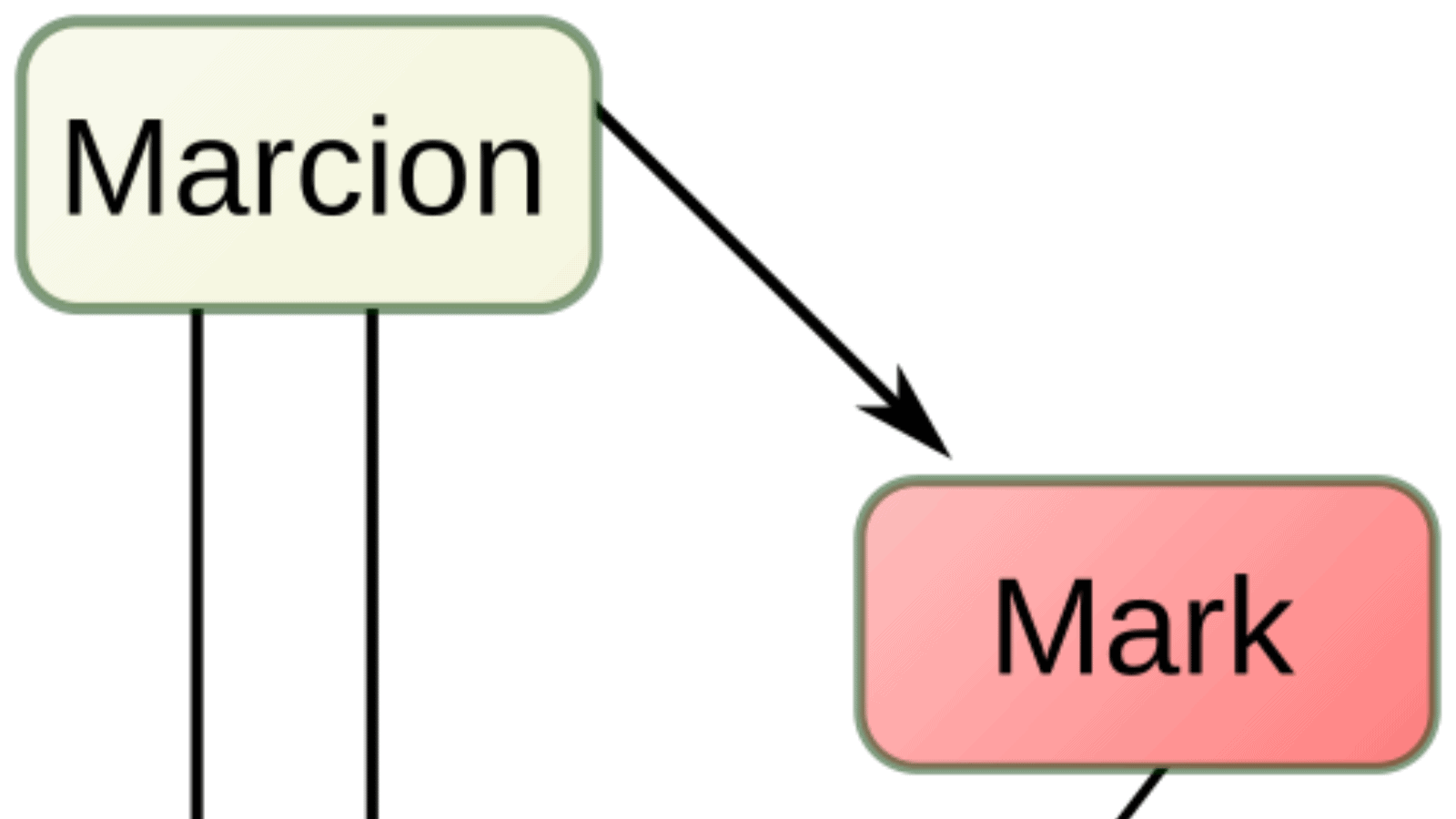
Believing Jesus had no Jewish connection, Marcion sliced up the only gospel he accepted. His Bible contained only ten letters of Paul and a heavily redacted version of the Gospel of Luke. He cut out the first chapters of Luke because Jesus’s birth and family tree were “too Jewish.“
Church fathers were utterly horrified by his theological editing. Tertullian famously complained that Marcion openly used a knife on scripture, expunging anything that contradicted his personal beliefs. He even changed the Lord’s Prayer to petition for the Holy Spirit rather than for God’s kingdom. However, modern scholars like Jason BeDuhn suggest that Marcion might have actually inherited a pre-existing alternative version of Luke rather than editing it himself.
How the church used his playbook to fight back
Before Marcion, early Christians read scattered, unstandardized scrolls. But Marcion’s wild success forced the mainstream church to define what was actually “orthodox.” In 367 CE, Archbishop Athanasius listed today’s 27 books and ordered all others purged. The hunt was on to destroy any “unauthorized” scripture floating around the empire.
This search-and-destroy mission was highly successful at wiping out competing texts. Surprisingly, 94% of our 5,800 Greek New Testament manuscripts date from after the 9th century. As expert Bart Ehrman notes, we can track how these texts changed over time by comparing these thousands of copies.
The secret library hidden in a clay jar
Fearing the church’s purge, a group of rebel Egyptian monks made a move that saved history. Sometime in the 4th century, they packed 52 outlawed texts into a clay jar and buried it. There it lay until 1945, when a local farmer named Muhammed al-Samman dug it up near the town of Nag Hammadi.
This discovery completely shook the foundations of biblical archaeology.
Suddenly, the “heretics” were finally allowed to speak in their own voices. The library included a wild mix of pagan, Jewish, and Christian ideas. It revealed a diverse early Christian world that had been buried for over 1,500 years.
The erased gospel of Thomas and the light within

Among the buried treasures of Nag Hammadi was the Gospel of Thomas, a book that completely flips the traditional narrative. Thomas skips Jesus’s birth, death, resurrection, and miracles. Instead, it lists 114 cryptic sayings challenging readers to find the divine within.
If Thomas had become the dominant gospel, Christianity would look more like an eastern wisdom tradition than an organized religion. Expert Elaine Pagels points out that Thomas teaches that self-ignorance is the ultimate form of self-destruction. The banned Gospel of Mary pushed for female leadership, prompting severe apostolic pushback. Tertullian lashed out at women in his church, calling them “the devil’s gateway” and blaming them for the fall of man.
What this means for modern Bible readers

Today, we’re seeing a massive shift in how Americans interact with these ancient scriptures. Though 87% of Americans own Bibles, 45% seldom or never read them. Barna’s 2025 survey reveals 50% of Millennials now read the Bible weekly, a huge spike.
Yet, skepticism about the Bible’s absolute accuracy has hit an all-time high.
Only 9% of U.S. adults have ever read the entire book from start to finish. This reading-to-belief gap shows Americans asking the same questions Marcion asked 1,800 years ago. As our views on faith continue to evolve, the ancient struggle between strict dogma and personal spiritual awakening remains as alive as ever.
Key takeaway

The Bible we read today is not a single, untouched book that dropped from heaven; it’s the product of an intense historical battle. By trying to crush heretics like Marcion, the early church built the New Testament canon we have today. But in doing so, they locked away a vibrant, diverse world of early Christian voices that we are only just beginning to rediscover.
More articles you might like:
- 12 Ancient Prophecies That Seem To Reflect Modern Life
- 10 Lessons From The Bible That Make Sense Even Outside Religion
- 12 People God Welcomes and Those He Turns Away