Is there still hope for U.S. democracy? Experts weigh in
American democracy is in real trouble, but history, law, social science, and global politics all suggest that rights can be rebuilt, and that people and institutions are already laying the groundwork to do it.
The bad news, plainly
Harvard political scientist Steven Levitsky, who studies democratic backsliding, has warned that the United States in Trump’s second term risks “ceas[ing] to meet standard criteria for a liberal democracy,” citing threats to civil liberties, electoral integrity, and peaceful transfers of power.
Freedom House and other democracy monitors have already downgraded the U.S. in recent years over political violence, refusal to accept election results, and attacks on independent institutions. Internationally, European policymakers now openly discuss “ill winds” from Washington and are building a “Democracy Shield” to protect their own systems from U.S.-exported illiberalism, a striking reversal from the postwar era in which the U.S. was the anchor of the “liberal core.” None of that can be sugar‑coated, and serious scholars are split between those who think the damage is manageable and those who fear a lasting turn toward semi‑authoritarianism.
And yet, most of those same experts also argue that breakdown is not destiny, and that the ingredients of democratic recovery are visible in U.S. history, in current institutions, and in human psychology.
History: America’s long arc of loss and recovery
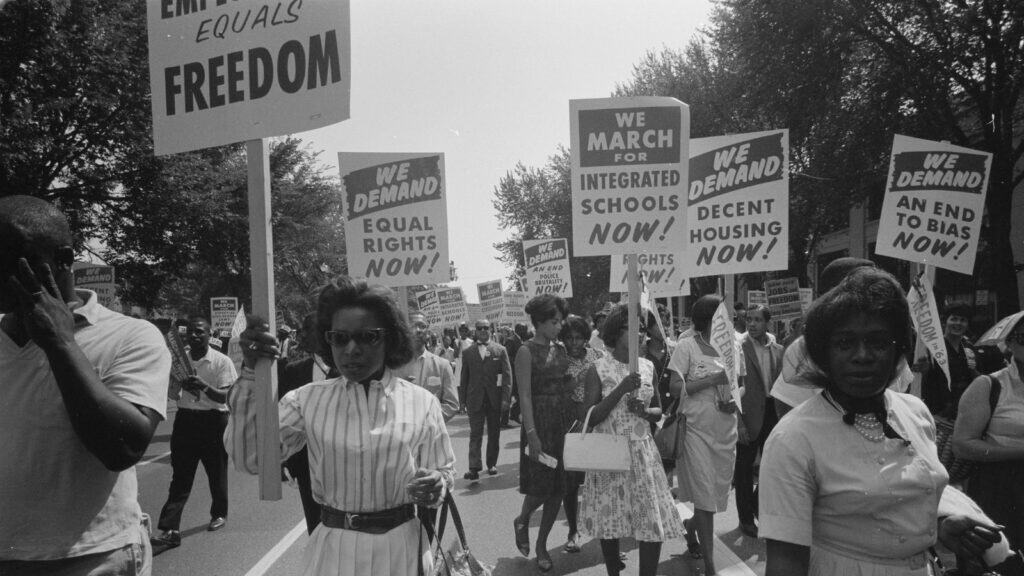
American rights have never moved in a straight line; they lurch, collapse, and then get rebuilt, often stronger and more inclusive than before. During the Civil War and Reconstruction, slavery was abolished, birthright citizenship and equal protection were written into the Constitution, and Black men briefly exercised meaningful voting and political power across the South. Those gains were then gutted by white supremacist violence, Jim Crow laws, and Supreme Court decisions that “paved the way for racial violence, disenfranchisement… and Jim Crow segregation,” collapsing Reconstruction’s promise for nearly a century.
Yet those same Reconstruction Amendments later became the legal backbone for the mid‑20th century civil rights revolution: desegregation rulings, voting rights protections, fair housing laws, and more. A similar story repeats with women’s rights and LGBTQ+ rights, where decades of backlash and criminalization gave way, through organizing, litigation, and cultural change, to marriage equality and anti‑discrimination protections that would have been politically unthinkable in 1960. As legal historian scholars writing in Daedalus put it, American civil rights have advanced in “waves,” with periods of expansion followed by retrenchment—and then renewed mobilization that reinterprets the Constitution’s “progressive ideals” for a new era.
This pattern matters now: it shows that severe reversals—far worse than what we are living through—have not been the end of the story, and that the tools for repair often come from earlier, half‑fulfilled rights revolutions.
Law and institutions: damaged, but not gone
Even critics who are dire about Trump’s impact emphasize that American institutions are unusually dense and hard to capture completely. Levitsky points to “many, many well‑organized foundations and civic organizations,” independent courts, and a viable opposition party as reasons the U.S. is “pretty well‑equipped to resist.” Recent examples are messy but instructive: a federal judge blocked an aggressively partisan redistricting map in Texas, and a federal appeals court, including two Trump‑appointed judges, rejected Trump’s defamation suit against CNN as meritless, reaffirming strong protections for political speech.
Constitutional lawyers and advocacy groups are also actively developing new doctrinal paths to restore and expand rights, especially using state constitutions and Reconstruction‑era principles. The Constitutional Accountability Center, for instance, is pushing arguments that the text and history of federal law require hospitals to provide life‑saving abortion care in emergencies and that Reconstruction provides a “clarifying lens” for more equitable criminal procedure—strategies aimed at rebuilding rights even in a hostile Supreme Court environment. Scholars in the State Law Research Initiative are similarly urging state courts to enforce “anti‑punishment” clauses and bans on excessive sentences that have long been dormant, as a way to curb mass incarceration from the bottom up.
None of this guarantees success; other legal scholars argue the current Supreme Court majority will block major rights expansions and that relying on courts alone is a dead end. But law is not static: amendments, statutory changes, state‑level innovations, and long‑term litigation campaigns have repeatedly turned what looked like permanent defeats into new starting points.
Sociology: why movements keep working
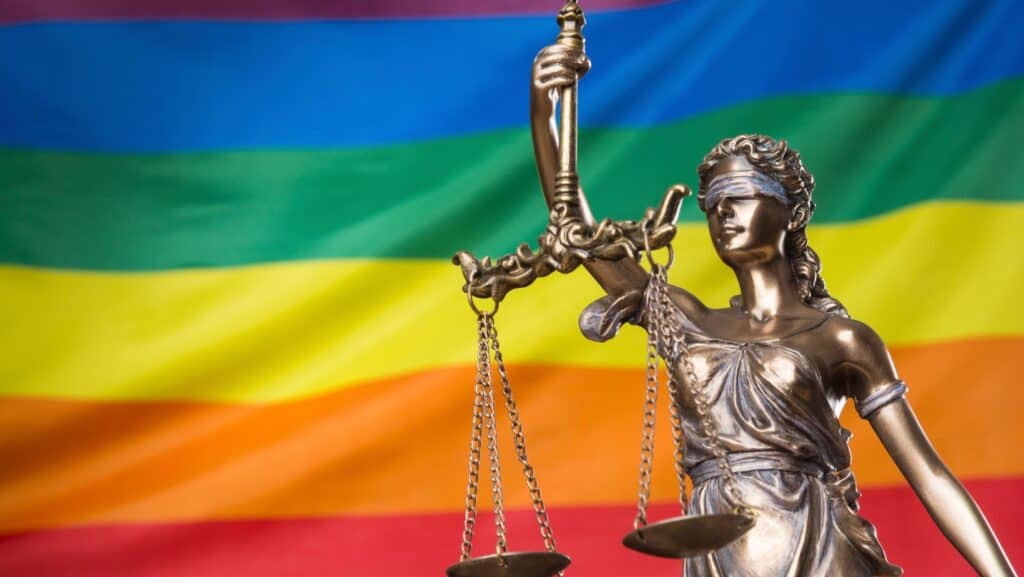
Social movements are the engine that has driven every major U.S. rights expansion, and there is strong evidence that they can still bend institutions even in harsher conditions. Sociological work on the civil rights movement shows how a relatively small but disciplined network of churches, student groups, and legal organizations leveraged media, courts, and shifting public opinion to turn what seemed like a regional moral crusade into national law. Later LGBTQ+ organizing followed a different path—using cultural visibility, litigation, and corporate and local government alliances—but it, too, turned marginal demands into mainstream policy within a few decades.
Recent scholarship on the LGBTQ+ rights movement underscores that “dramatic shifts in levels of mobilization” around key events—Stonewall, the AIDS crisis, state marriage bans—created turning points that forced elites to respond, even amid intense backlash. That pattern is echoed in current resistance to democratic erosion: Levitsky notes that organized faculty, students, and civil society actors at Harvard were able to push back against attempts to punish universities, generating “a real burst of energy and encouragement… to civil society across the country.” In other words, organized communities still matter, and they can still change the cost‑benefit calculus for elites tempted by authoritarian shortcuts.
There is a debate inside sociology about how much movements can achieve under severe repression; some argue that today’s polarization and disinformation make classic civil‑rights‑style strategies less effective, while others insist that decentralized, intersectional networks are precisely what can withstand those pressures. The consensus is not that success is guaranteed, but that collective organization remains one of the few consistently effective tools ordinary people have to alter political trajectories.
Psychology: hope as a political resource
If you zoom in from movements to individuals, social psychologists studying protest under repressive conditions have started to treat hope not as naïve optimism but as a mobilizing resource. A recent integrative review on “collective action under repressive conditions” finds that when fear of repression is accompanied by hope—the sense that one’s group is capable of improving its situation—people are more likely to engage in sustained, organized resistance than when fear is paired with despair. The authors emphasize that “efficacy beliefs” (the belief that action can work), politicized identity, and a sense of community cohesion all predict whether people will act or withdraw.
Crucially, the paper notes that repression does not have a uniform effect: it can demobilize, but it can also provoke backlash when people feel that authorities have crossed a red line and when alternative organizations are available to channel anger. That maps onto U.S. experience from Selma to the Trump era, where crackdowns often trigger surges in support for rights, if there are visible movements ready to absorb and direct that outrage. Other research on political extremism and collective action suggests that intense commitment, on the left or right, tends to increase willingness to take risks, which is dangerous when yoked to authoritarian projects but powerful when aligned with pro‑democratic goals.
The uncomfortable disagreement here is that the same psychological machinery that sustains democratic resistance can also fuel anti‑democratic mobilization; the data do not promise that the “good side” always harnesses these dynamics better. What they do show is that cultivating realistic hope, shared identity, and credible paths to impact is not just emotionally comforting—it is part of what keeps people engaged in defending and rebuilding rights.
The democratic world: respect can be rebuilt

Outside the U.S., many democratic allies are alarmed by Trump’s rhetoric, his embrace of illiberal leaders, and the freezing of U.S. democracy assistance funding. European governments are now preparing for a “post‑U.S. democracy agenda,” exploring multilateral funds and new forms of cooperation that are “less associated with U.S. interests and more multilateral and egalitarian.” That shift is one reason many Americans feel they have lost the moral authority and trust that once attached—sometimes unfairly—to the United States by default.
Yet even these critical analyses leave room, and in some cases, explicit expectation, for a U.S. “course correction” when Trump leaves office or when domestic checks reassert themselves. Former ambassador Michael McFaul, writing about a recent near‑crisis in which Trump’s threats risked war with a democratic ally, notes that “European unity, in combination with American constraints on presidential power, such as the stock market, Congress, and public opinion, compelled Trump to blink,” illustrating that allied democracies still matter in shaping U.S. choices. History offers precedent here: after Vietnam and Watergate, after the Iraq invasion, and after earlier rights crackdowns, U.S. standing eventually improved not because other countries forgot, but because they saw visible legal reforms, accountability, and renewed commitments that matched democratic rhetoric with practice.
Today, many non‑U.S. democracies are frankly tired of American dominance in the “democracy promotion” space, but that does not preclude future respect; it simply means that respect will have to be earned in a more plural, less U.S‑centric order.
So what is the real takeaway?
If you step back from the day‑to‑day outrages, the picture from history, sociology, psychology, and law is sobering but not hopeless: American rights and democratic reputation have been destroyed and rebuilt before, often from darker places than this one. The institutions that make rights possible—courts, constitutions, organized civil society, international alliances—are damaged but still functioning, staffed by people who are actively experimenting with new ways to limit repression and reopen space.
That does not mean “it will all work out.” Many credible scholars think the U.S. could entrench a semi‑authoritarian system, especially if anti‑democratic forces remain unified while pro‑democratic coalitions fracture. What the research does support is a narrower, harder kind of hope: the belief that future rights and global respect are contingent, on organizing, on legal creativity, on cross‑border solidarity, and on millions of people choosing participation over resignation. That kind of hope is not a mood; it is a plan.
You may be interested in reading:
- The Black history Americans think they know vs. lived truth
- Did Trump Really End Eight Wars? Fact-Checking His Nobel Peace Prize Boast
- What Has Changed for Women, LGBTQ+ People, and Minorities in the U.S. Military In 2025