Midterms 2026: Democrats rediscover God as Republicans debate faith’s role
Religion is no longer the quiet subtext of American politics in 2026; it is on the mic, in the stump speech, and increasingly in the hands of pastors-turned-candidates who are reshaping how both parties talk about God, freedom and what it means to belong.
On the campaign trail, Democrats are testing more explicit religious language to connect with believers and skeptics alike, while Republicans are locked in loud debates over antisemitism, free speech and who speaks for America’s faith communities. Underneath it all, religious identity is doing what party strategists quietly admit it does best: moving people off the couch and into the voting booth.
Democrats find their religious voice
Inside a party that has grown more secular, a cadre of “faith-forward” Democrats is arguing that talking openly about God is not a liability but a missing piece of the brand. Figures like Sen. Raphael Warnock, a pastor at Atlanta’s Ebenezer Baptist Church before heading to the Senate, have framed their politics as an extension of a Christian ethic of neighbor love, describing faith as a bridge rather than a weapon in debates over health care, immigration and voting rights.
Strategists say that kind of language is slowly spreading as Democrats look for ways to reach voters who are religious but wary of culture-war rhetoric. A 2024 analysis from Pew shows that while Democrats now rely heavily on religious “nones” and members of minority faiths, millions of Christian voters, especially Catholics and Black Protestants, still form the backbone of their coalition, giving party leaders incentive to speak fluently about moral values without sounding like church from the podium.
Pastors on the ballot
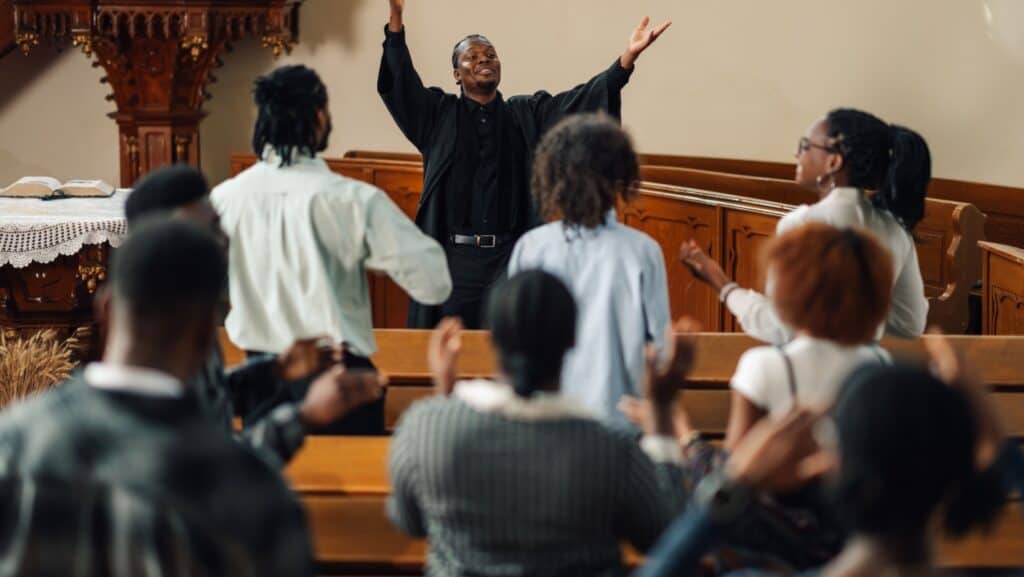
The most striking shift this cycle may be who is actually running. In 2026, a “shocking” number of white clergy — roughly 30, by one national organizer’s count — are seeking office as Democrats, a reversal of decades in which white pastors who jumped into politics typically did so on the Republican side. Progressive Christian networks like Vote Common Good are recruiting and training these candidates, encouraging them to quote Scripture online and in town halls as they argue for Democratic priorities on immigration, civil rights and poverty.
This is happening alongside a broader loosening of the wall between pulpit and podium. In 2025, the Internal Revenue Service announced that churches and other houses of worship may endorse political candidates to their members without losing tax-exempt status, carving out an exception to a rule that had constrained clergy for seventy years. The ruling has split pastors and politicians alike: some see a new chance to “be advocates for issues that matter” and hold officials accountable, while others , including Sen. Tim Kaine, warn that turning sermons into campaign rallies could erode trust in both church and state.

Republicans, antisemitism and free speech
On the Republican side, faith remains central, but the messaging is more fractured than ever around antisemitism, campus protests and what it means to protect religious freedom. President Donald Trump has wrapped his second term in sweeping religious language, telling faith audiences that he has “ended the radical left war on faith” and restored God “back into our public square,” and recently using the National Prayer Breakfast to question how “a person of faith can vote for a Democrat.”
At the same time, Republican lawmakers have elevated antisemitism on campus as a defining cultural fight, using high-profile hearings to press universities and tout new enforcement powers. Senate Republicans have promoted measures like the Antisemitism Awareness Act, which would lock in the International Holocaust Remembrance Alliance’s definition of antisemitism for civil-rights investigations, arguing that tougher rules are needed to protect Jewish students even if they collide with campus speech norms. Democrats, by contrast, have used the same hearings to warn that poorly drawn laws could chill legitimate criticism of Israel and undermine broader commitments to free speech, underscoring how the same faith-inflected issue produces dueling narratives about rights and safety.
Faith blocs that actually vote

Behind these rhetorical battles is a stubborn data point: religious identity remains one of the strongest predictors of how — and whether — Americans vote. In 2024, more than eight in ten white evangelical Protestants backed Trump, and preliminary exit polls show that about 72 percent of white Christians overall voted Republican, while Black Protestants, Jews, members of other minority faiths and the religiously unaffiliated leaned heavily Democratic. Those patterns persisted among young voters: evangelicals and other Christians made up the majority of young Trump voters, while young Harris voters were far more likely to report no religious affiliation.
Turnout data reinforce the point that who shows up is at least as important as what they believe. A Pew analysis of the 2020 and 2024 elections found durable gaps in participation across groups, while new research on U.S. elections from 2016 through 2024 suggests that cultural identity, especially religion, clusters voting behavior more strongly than income or urban-rural divides, giving campaigns a powerful reason to micro-target by faith. That helps explain why Christian mobilization outfits like Christians Engaged are investing heavily in 2026, boasting that they have already reached more than one million believers with text and email reminders and setting goals to touch up to 2 million Christians with voting tools and Bible-themed civic events.
Takeaway: Politics in a pew-shaped country
If the early contours of the 2026 campaign trail are any guide, Americans are heading into an election where the loudest voices may not come from party headquarters but from pulpits, prayer breakfasts and faith-based group chats. Democrats are cautiously rediscovering religious language and elevating clergy who can speak progressive theology in a familiar cadence, while Republicans double down on being the party of embattled believers, even as internal fights over antisemitism and free speech expose tensions in their own coalition.
For voters, that means the question in 2026 isn’t whether religion belongs in politics — it’s whose religion, and which moral story, will define what “family values,” “freedom” and “security” sound like at the ballot box. In a country where religious identity tracks turnout and partisanship as closely as any demographic, campaigns that ignore the pews risk talking to themselves, while those that lean in too hard may discover that mixing scripture and spin can just as easily galvanize opponents as inspire the faithful.
You may want to read:
- The Shift From Organized Religion to Personal Spirituality
- 10 key differences between the Catholic and Orthodox churches
- Does Woke Atonement Leave the Church Spiritually Broke?