World Space Week: 12 Stunning Milestones in Human Space Exploration
From Sputnik’s first beeps to James Webb’s golden mirrors, World Space Week spotlights the milestones that redefined humanity’s place in the cosmos.
World Space Week is a time to look up and remember that the sky has never been a limit. Since the mid twentieth century, human beings have reached for the stars with rockets, telescopes, and daring ideas. Each step has reshaped how we understand the universe and ourselves.
Here are twelve milestones that defined space exploration and continue to inspire new generations.
1. The Launch of Sputnik in 1957

When the Soviet Union launched Sputnik 1 into orbit, it sent shockwaves around the globe. It was the first artificial satellite, no larger than a beach ball, but it represented something much bigger. Humanity had officially entered the Space Age. The beeping signal from Sputnik could be heard by radios on Earth, a simple sound that symbolized an extraordinary leap forward.
2. Yuri Gagarin Becomes the First Human in Space

In 1961, Soviet cosmonaut Yuri Gagarin climbed into a capsule named Vostok 1 and made history. He orbited Earth once, proving that people could survive the journey into space. His famous words, “I see Earth. It is so beautiful,” captured both wonder and pride. Gagarin’s achievement made him a global hero and a lasting symbol of exploration.
3. The Moon Landing in 1969

Few moments in history are as iconic as Neil Armstrong stepping onto the lunar surface during Apollo 11. With Buzz Aldrin by his side, Armstrong’s first steps were broadcast live to millions. The sight of the American flag planted in the gray dust became a lasting image of human ingenuity. The landing was not just a victory in the space race but a victory for humanity itself.
4. The First Spacewalk in 1965

Before astronauts could dream of building stations or walking on the Moon, they had to master moving outside their spacecraft. Alexei Leonov achieved this when he became the first human to perform a spacewalk. Floating above Earth tethered to his capsule, Leonov showed that astronauts could work in open space. It was both dangerous and exhilarating, paving the way for future missions.
5. The Space Shuttle Era Begins in 1981
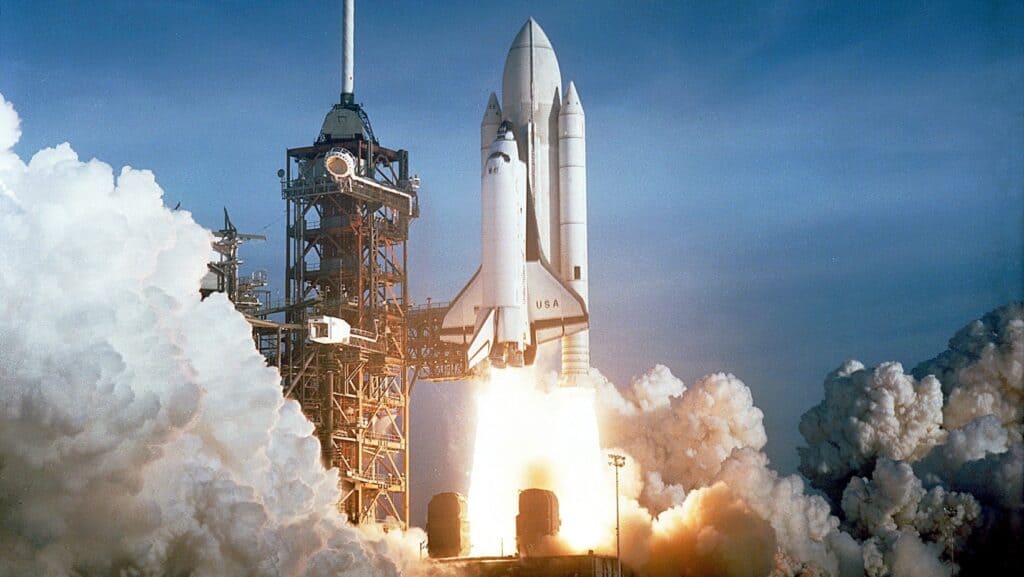
With the launch of Columbia, the Space Shuttle era transformed spaceflight. Shuttles could be reused, making trips to orbit more sustainable. They carried satellites, telescopes, and entire modules for the International Space Station. Astronauts performed scientific experiments that shaped medicine, technology, and our understanding of life beyond Earth.
6. Hubble Space Telescope Opens Our Eyes in 1990

When Hubble was launched, scientists knew it would change astronomy. Even after an initial repair mission to correct a flawed mirror, Hubble delivered images that stunned the world. From colorful nebulae to distant galaxies, the telescope gave us a window into the origins of the universe. Hubble showed not only beauty but science, deepening our understanding of space itself.
7. The International Space Station Takes Shape in 2000

Orbiting Earth since 2000, the International Space Station represents cooperation on a global scale. Built by multiple countries, it has become a laboratory for science, engineering, and diplomacy.Astronauts live and work in microgravity for months, conducting experiments that would be impossible on Earth. The ISS proves that space can unite nations in pursuit of shared goals.
8. Mars Rovers Explore the Red Planet

From Spirit and Opportunity to Curiosity and Perseverance, rovers have given us the most detailed look at Mars. These robotic explorers have found evidence of ancient water, sent breathtaking panoramas, and tested technology for future human missions. Each rover has a personality of its own, celebrated by millions who follow their journeys from Earth.
9. The First Private Spaceflight in 2004

Space travel was no longer only for governments when SpaceShipOne made its successful suborbital flight. This achievement marked the beginning of commercial spaceflight. It opened the door for companies like SpaceX, Blue Origin, and Virgin Galactic to reimagine who could go to space and how.
10. SpaceX Lands a Reusable Rocket in 2015

When SpaceX’s Falcon 9 booster landed upright on a drone ship in the ocean, it changed the economics of space. Rockets had always been single use, expensive machines. Reusability meant lower costs and more frequent launches. This milestone accelerated the possibility of Mars missions and a future where space is more accessible than ever.
11. James Webb Space Telescope in 2021

The James Webb Space Telescope has given us images that go beyond what Hubble could ever achieve. By peering into infrared wavelengths, Webb can see the earliest galaxies, star formation, and even the atmospheres of exoplanets. It is already rewriting what we thought we knew about the origins of the universe.
12. Artemis I and the Return to the Moon

NASA’s Artemis program is the first step toward returning humans to the Moon and eventually sending them to Mars. Artemis I, launched in 2022, was an uncrewed test flight, but it demonstrated new spacecraft and systems. The program’s goal is not only to revisit the Moon but to build a sustainable presence there, marking a new era of exploration.
The Takeaway

World Space Week celebrates not just technology but courage, imagination, and persistence. Each milestone in space exploration shows what humans can achieve when they dare to look beyond their horizon. From the beeping of Sputnik to the golden mirrors of James Webb, space exploration is a story still unfolding.
Viking 1 at 50: How NASA’s First Mars Lander Changed the Way We See the Red Planet
Fifty years ago, on August 20, 1975, NASA launched Viking 1, a spacecraft that would redefine humanity’s relationship with Mars.
READ: Viking 1 at 50: How NASA’s First Mars Lander Changed the Way We See the Red Planet