15 Famous Roles That Were Originally Male—Until Women Took Them On.
Some characters are so closely associated with the actors who played them that it’s almost impossible to picture them any other way. But a surprising number of famous roles could have looked very different.
Long before audiences met these characters on screen, some were men in books, comics, earlier TV shows, or original versions of the story. Others were roles initially developed with male actors in mind before filmmakers decided to go in another direction.
Sometimes the change was made to give women more substantial roles. Sometimes filmmakers wanted to shake up a familiar character. And occasionally, the right actress simply made everyone forget that the role had ever been envisioned differently.
From a swaggering fighter pilot to a legendary detective’s closest partner, these famous characters prove that changing the original blueprint can completely transform a story.
Starbuck in Battlestar Galactica
Played by: Katee Sackhoff
It’s difficult to imagine Battlestar Galactica without Katee Sackhoff’s Kara “Starbuck” Thrace, but longtime fans knew a very different Starbuck.
In the original 1978 television series, Lieutenant Starbuck was a man played by Dirk Benedict. When Ronald D. Moore reinvented the show for a new generation, Starbuck became a woman.
The decision initially generated plenty of controversy among fans of the original series. Sackhoff soon made the character her own, however, preserving Starbuck’s swagger, recklessness, and talent in the cockpit while creating a character who stood completely apart from Benedict’s version.
Kara Thrace ultimately became one of the defining characters of the reboot—and one of television’s most memorable examples of a gender-swapped role.
Joan Watson in Elementary
Played by: Lucy Liu
Sherlock Holmes and Dr. Watson had been solving mysteries together for more than a century before Elementary made one enormous change to the partnership.
Watson became a woman.
Lucy Liu played Dr. Joan Watson opposite Jonny Lee Miller’s Sherlock Holmes in the CBS series. Instead of simply recreating the familiar Holmes-and-Watson relationship with a female actor, the show developed Joan into a distinct character.
She begins as Holmes’ sober companion before discovering that she has considerable investigative talents of her own. Eventually, she becomes his professional partner and an accomplished detective.
Changing Watson’s gender also gave the series an intriguing possibility it largely resisted: turning one of fiction’s most famous partnerships into a conventional romance. Instead, Sherlock and Joan developed an unusually deep platonic bond.
Jeri Hogarth in Jessica Jones
Played by: Carrie-Anne Moss
Marvel comic readers knew Jeryn Hogarth as a male lawyer and business associate connected to Iron Fist. Netflix’s Jessica Jones introduced audiences to someone considerably different.
Carrie-Anne Moss played Jeri Hogarth, a powerful attorney whose intelligence, ambition, and willingness to cross ethical lines made her nearly as intimidating as some of the show’s superpowered characters.
The change wasn’t merely cosmetic. The television series expanded Hogarth into a major recurring character with her own relationships, ambitions, and personal conflicts.
Moss went on to play Hogarth across several of Marvel’s Netflix shows, turning what could have been a relatively minor supporting character into one of the most recognizable non-superpowered figures in that corner of the Marvel universe.
The Ancient One in Doctor Strange
Played by: Tilda Swinton
Marvel made one of its most dramatic character changes when it brought the Ancient One to the big screen.
In the comics, Doctor Strange’s mystical mentor was traditionally depicted as an elderly Asian man. The 2016 movie instead cast Tilda Swinton.
Director Scott Derrickson discussed the difficulty of adapting a character whose comic-book origins involved stereotypes, but the eventual solution created controversy of its own. Critics questioned the decision to cast a white British actress in a role associated with an Asian character.
Whatever viewers thought about that decision, Swinton’s Ancient One was dramatically different from the traditional comic-book incarnation. Her mysterious, almost otherworldly performance made gender feel like only one of many things the character had transcended during a very long life.
Ghost in Ant-Man and the Wasp
Played by: Hannah John-Kamen
Comic-book Ghost and movie Ghost share a memorable ability to phase through solid objects, but Marvel Studios dramatically reworked the character for Ant-Man and the Wasp.
Ghost was originally introduced in Marvel Comics as a male antagonist associated with Iron Man. The movie turned the character into Ava Starr, played by Hannah John-Kamen.
It also gave Ghost a considerably more sympathetic motivation.
Rather than simply wanting to defeat the hero, Ava is suffering from a painful condition caused by quantum energy and desperately searching for a way to survive.
The result blurred the traditional line between superhero and villain. Ghost remained dangerous, but audiences could understand exactly why she was fighting.
Evelyn Salt in Salt
Played by: Angelina Jolie
Angelina Jolie’s Evelyn Salt wasn’t adapted from an existing male character, but the role has one of Hollywood’s most interesting gender-switch stories.
The spy thriller was originally developed around a male protagonist, with Tom Cruise attached to the project. After Cruise departed, the filmmakers didn’t simply find another male action star.
They rewrote the lead for Jolie.
That meant more than changing the character’s first name. The filmmakers reconsidered parts of the character and story rather than simply giving a woman dialogue originally intended for a man.
Jolie’s Evelyn Salt ultimately became the center of a globe-trotting action movie that earned nearly $300 million worldwide—a striking example of what can happen when filmmakers stop treating the gender of an action hero as fixed.
Dizzy Flores in Starship Troopers
Played by: Dina Meyer
Anyone who encountered Starship Troopers through Paul Verhoeven’s 1997 movie might be surprised by Dizzy Flores in Robert A. Heinlein’s original novel.
Dizzy was a man.
For the movie, the character became Dizzy Flores, a woman played by Dina Meyer and one of Johnny Rico’s fellow soldiers.
The change had a major effect on the story. Movie Dizzy is in love with Rico, adding a romantic triangle that isn’t part of the character’s role in the novel.
She also became far more emotionally significant to the protagonist, meaning a seemingly straightforward gender swap helped reshape an entire part of the adaptation.
Kaa in The Jungle Book
Voiced by: Scarlett Johansson
The hypnotic snake Kaa has gone through several transformations during Disney’s different versions of The Jungle Book.
In Rudyard Kipling’s stories, Kaa is male. Disney’s famous 1967 animated movie also presented the character as male, with Sterling Holloway providing the voice.
Then came Disney’s 2016 remake.
Director Jon Favreau cast Scarlett Johansson as Kaa, giving the enormous python a low, hypnotic voice that made the character feel markedly different from the animated version.
Kaa’s appearance in the film is relatively brief, but Johansson’s casting provided a fresh interpretation of a character audiences had known for decades.
M in the James Bond Films
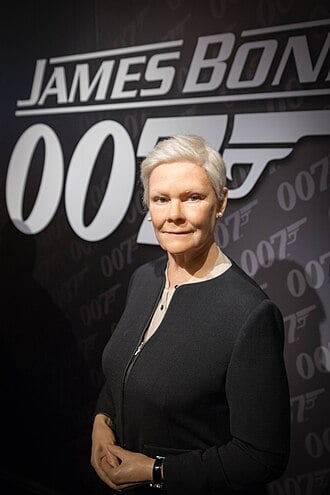
File:Madame Tussauds wax figure of Judi Dench as M (James Bond).jpg
Played by: Judi Dench
For decades, James Bond reported to male versions of M, the head of the British Secret Service and one of the few people with enough authority to keep 007 under control.
Then Judi Dench walked into the role.
Dench debuted as M in 1995’s GoldenEye, becoming the first woman to portray the character in the official Bond film series.
Her M wasn’t treated as a novelty. She was formidable, impatient with Bond’s behavior, and entirely comfortable reminding the famously self-assured spy exactly who was in charge.
Dench proved so successful that she remained in the franchise through the transition from Pierce Brosnan to Daniel Craig, giving her version of M an unusually long and important relationship with Bond.
Lucifer Morningstar in The Sandman
Played by: Gwendoline Christie
Readers of Neil Gaiman’s The Sandman comics encountered Lucifer as a male-presenting ruler of Hell, a character whose appearance was famously influenced by David Bowie.
Netflix’s adaptation went another way.
Gwendoline Christie, already familiar to fantasy audiences from Game of Thrones, was cast as Lucifer Morningstar.
The change fit particularly well within The Sandman’s strange supernatural world, where immortal beings aren’t necessarily bound by ordinary human ideas about identity.
Christie’s elegant but intimidating Lucifer also provided a very different screen presence from other famous versions of the character, including Tom Ellis’ portrayal in the television series Lucifer.
Lucifer Morningstar in The Sandman
Played by: Gwendoline Christie
Lucifer has been portrayed in plenty of different ways over the years, but Netflix’s The Sandman gave audiences one of the character’s most striking transformations.
In Neil Gaiman’s original comics, Lucifer is depicted as male, with an appearance famously inspired by David Bowie. When the story made the jump to Netflix, however, Game of Thrones star Gwendoline Christie was cast as the ruler of Hell.
The change works particularly well in the strange universe of The Sandman, where immortal beings don’t necessarily have to conform to ordinary human expectations about identity.
Christie’s Lucifer is elegant, imposing, and quietly terrifying. Rather than simply recreating the comic-book character, her performance gives Dream’s powerful adversary an entirely different presence.
For viewers accustomed to male versions of Lucifer—including Tom Ellis’ interpretation on Lucifer—Christie’s casting made a very familiar supernatural figure suddenly feel unfamiliar again.
Aslan in The Chronicles of Narnia: The Magician’s Nephew
Voiced by: Meryl Streep
Few characters seem as firmly established as Aslan.
C.S. Lewis consistently presents the great lion as male in The Chronicles of Narnia, and previous screen adaptations followed suit. Liam Neeson famously supplied Aslan’s deep, commanding voice in the three Narnia films released between 2005 and 2010.
Greta Gerwig’s new adaptation is taking the character somewhere unexpected.
Meryl Streep was cast to voice Aslan in The Magician’s Nephew, making this the first major screen version of the character voiced by a woman. Gerwig has explained that she was drawn to qualities in Streep’s performance that fit her interpretation of Aslan rather than simply trying to reproduce what previous adaptations had done.
It’s a particularly striking gender-crossing casting decision because Aslan isn’t an obscure supporting character. He’s one of the defining figures of the entire Narnia mythology.
Whether audiences embrace this new interpretation remains to be seen, but the casting already demonstrates how even a character readers have imagined a particular way for generations can be reconsidered when a new filmmaker takes control.
Captain Phasma in Star Wars: The Force Awakens
Played by: Gwendoline Christie
Captain Phasma’s gleaming chrome armor became one of the most instantly recognizable images from Star Wars: The Force Awakens.
But the imposing First Order officer wasn’t initially designed around the fact that a woman would be underneath the helmet.
The character grew out of earlier concepts for a male villain, and Gwendoline Christie’s casting helped turn Phasma into something unusual for the franchise: a female antagonist whose visual identity had nothing to do with emphasizing her gender.
That was partly what made the character interesting. If viewers didn’t already know who was underneath the armor, there was little about Phasma’s appearance that told them.
Christie’s role was smaller than many fans expected, but Phasma became another example of how easily a traditionally male-coded archetype could be reimagined.
Major Anderson in Ender’s Game
Played by: Viola Davis
In Orson Scott Card’s novel Ender’s Game, Major Anderson is a man who works alongside Colonel Hyrum Graff at Battle School.
The 2013 movie changed that.
Viola Davis took on the role, bringing a different energy to a character responsible for helping oversee the young Ender Wiggin’s brutal education.
Davis’ Anderson also provided a stronger counterweight to Harrison Ford’s Graff. While both characters are involved in pushing Ender toward his breaking point, Anderson shows greater concern about the psychological consequences.
It’s the kind of gender swap that can easily go unnoticed if you’ve only seen the movie—which is precisely why it works.
Mar-Vell in Captain Marvel
Played by: Annette Bening
Marvel fans expecting the traditional Mar-Vell got a surprise when Captain Marvel reached theaters in 2019.
In the comics, Mar-Vell is a male Kree warrior and one of the major figures in Captain Marvel’s complicated publication history.
The movie radically reworked him.
Annette Bening played Dr. Wendy Lawson, whose true identity is eventually revealed to be Mar-Vell. Rather than functioning as the traditional male superhero, this version is a Kree scientist whose work becomes crucial to Carol Danvers’ story.
The film therefore didn’t simply cast a woman in an existing male role. It rebuilt the character to serve a different narrative purpose while retaining the Mar-Vell identity.
For viewers familiar with the comics, it was one of the movie’s biggest departures from the source material.
Sometimes the Character Is Bigger Than the Blueprint
Gender-swapping a character can easily sound like a gimmick on paper. The best examples show why it doesn’t have to be.
Katee Sackhoff’s Starbuck isn’t memorable simply because the original Starbuck was a man. Lucy Liu’s Watson isn’t interesting simply because most previous Watsons were men. And Angelina Jolie didn’t make Salt work simply by stepping into a project once intended for Tom Cruise.
Those casting and writing decisions worked because the performers were allowed to make the characters their own.
In some cases, audiences now know the reinvented version better than the original.
And that may be the most interesting part of all: once the right performer inhabits a character, it’s surprisingly easy to forget that the blueprint ever said something different.
You may want to read:
- Who controls history? 12 patterns behind erased women’s stories
- 10 Trailblazing Women Who Have Shaped Television History