Signs of authoritarianism that worry people who escaped it
People who have lived under dictatorships often hear the alarm before everyone else does. Not because they are dramatic. Because they remember the sound. It does not always begin with soldiers in the street or a leader ripping up the Constitution on live television.
Sometimes it begins with a smirk at the press, a judge turned into a punchline, a university warned to fall in line, or a public servant treated like a traitor for doing ordinary work. To Americans who once fled strongman rule, those moments do not feel like harmless political theater. They feel like old weather returning.
The numbers make that unease harder to dismiss. V-Dem reported in 2026 that the U.S. Liberal Democracy Index fell 24% in one year, with America dropping from 20th to 51st out of 179 countries. Pew Research Center also found that the U.S. V-Dem score fell to 0.57 in 2025, its lowest mark since 1965.
Even more striking, Pew noted that checks on presidential power had sunk to their weakest level in more than 100 years. That does not mean the United States has become an outright autocracy. It still has elections, courts, local governments, civic groups, newsrooms, and voters with real power to push back.
But for people who escaped authoritarian systems, the danger rarely starts as a thunderclap. It starts as a drip. A norm mocked here. A guardrail was weakened there. A lie repeated until it feels like the weather. Democracy does not usually fall through one trapdoor. It leaks, one warning sign at a time.
The New Reality: U.S. Democracy Is Weaker Than It Looks
The United States still carries the bones of a strong democracy, but several major watchdogs now describe those bones as strained. Freedom House still rates the U.S. “Free,” with a 2026 score of 81 out of 100, but that score is down from 84 the year before and from the 90-plus range the country held through 2015, according to Pew’s review of democracy ratings.
The Economist Intelligence Unit classifies the U.S. as a “flawed democracy,” with a 2025 score of 7.65, below the 8-point cutoff for a full democracy. V-Dem went further, downgrading the U.S. from a liberal democracy to an electoral democracy.
Staffan I. Lindberg, director of the V-Dem Institute, put the concern in plain terms: “The U.S. democracy is currently in a much faster deterioration process than any other democracy in modern times.” That is the line many former exiles hear like a glass cracking in a quiet room.
What Americans Who Fled Dictatorships See

The pattern former exiles describe often matches what democracy researchers Steven Levitsky and Daniel Ziblatt laid out in their warning signs of would-be authoritarians: rejecting democratic rules, denying the legitimacy of opponents, tolerating violence, and trying to curb civil liberties, including press freedom.
That framework sounds abstract until it has a face. In a hypothetical example, a Russian-born accountant in suburban Illinois hears a politician call the press “enemies” and remembers state TV teaching people how to hate. A Venezuelan-born nurse in Florida hears courts dismissed as obstacles and thinks of institutions that still had marble floors, flags, and official seals, even as power slipped out of public reach.
Pew found in 2024 that 72% of Americans said the U.S. used to be a good example of democracy but had not been one in recent years. That is not fringe dread. That is a national mood, backed by numbers.
The Red Flags They Say Are Hard to Ignore

People who fled strongman politics do not all vote the same way, speak the same language, or tell the same story. Some escaped left-wing regimes. Some escaped right-wing regimes. Some fled military governments, one-party systems, kleptocracies, civil war, or rule by fear dressed up as patriotism. But the warnings they point to often rhyme.
International IDEA has called the U.S. a backsliding democracy since its 2021 global report, using a definition tied to the weakening of democratic institutions. Reuters reported that IDEA issued 20 U.S. alerts between January and April 2025, twice as many as in each of the prior two full years.
The alerts covered executive overreach, restrictions on academic freedom, efforts to criminalize protest, attacks on certified election results, selective media access, and due process concerns.
To someone born under a stable democracy, that may sound like a list of disputes. To someone who watched a democracy hollow out, it sounds like the table legs being sawed down.
Relentless Attacks on Independent Institutions
The first red flag is the campaign against independent institutions. Courts, inspectors, civil servants, universities, watchdogs, newsrooms, and law enforcement bodies are not glamorous, but they are the wiring behind the walls.
V-Dem said its 2026 findings showed a rapid concentration of power in the presidency, along with pressure on the civil service, oversight bodies, the judiciary, the press, academia, civil liberties, and dissenting voices.
Carnegie Endowment described the second Trump presidency as showing signs of “executive aggrandizement,” with power centralizing in the executive branch and pressure spreading toward courts, Congress, states, media, law firms, civic groups, and voting systems.
Harvard Kennedy School professor Erica Chenoweth warned that the “acceptance of those techniques without a ton of pushback is quite dangerous.” That line lands because authoritarianism often feeds on silence. It does not need everyone cheering. Some days, it only needs powerful people to lower their eyes.
Demonizing the Opposition and Eroding Shared Truth
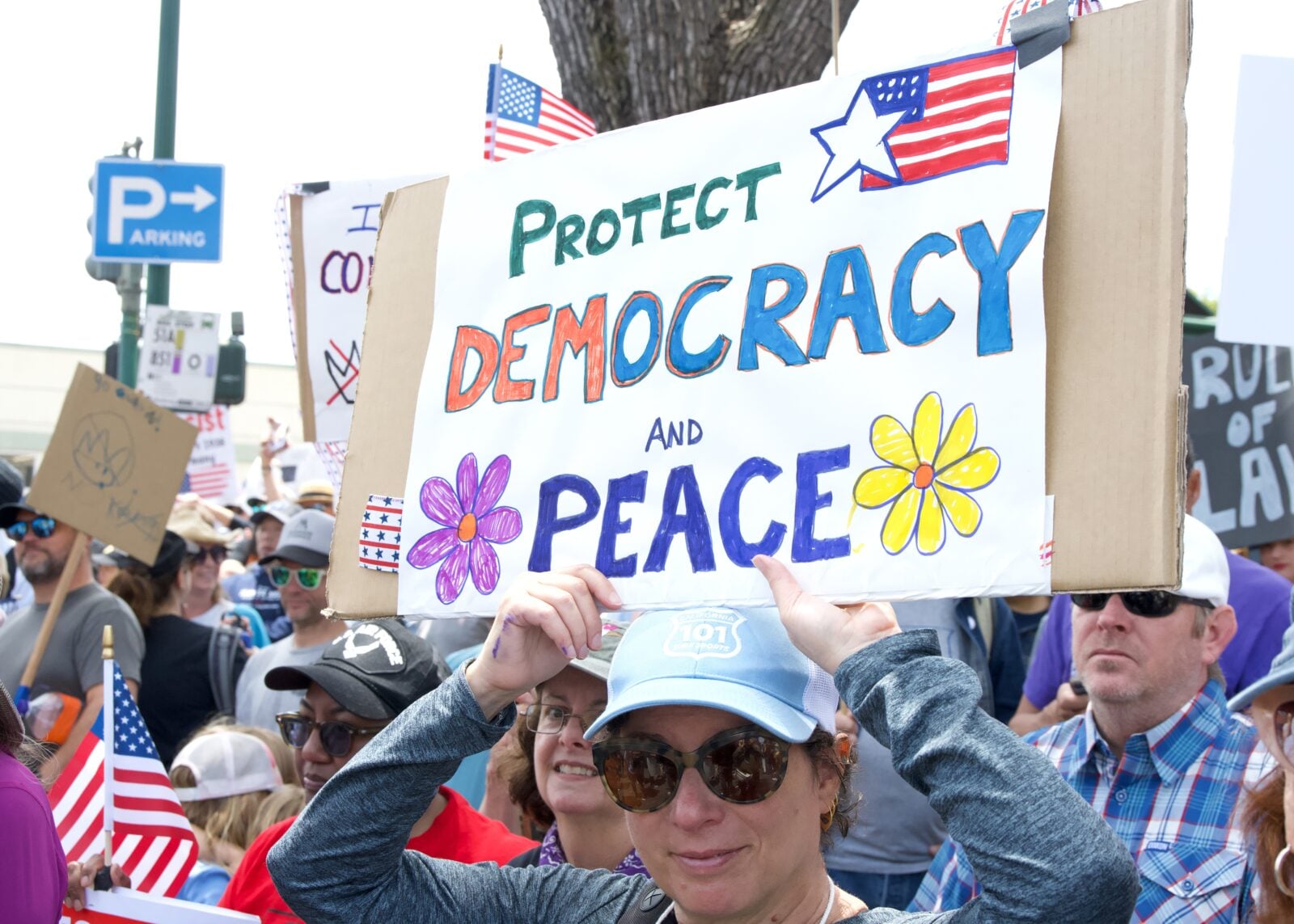
The second red flag is the move from rivalry to enemy-making. Democracy can survive anger, ugly campaigns, harsh ads, and loud arguments at Thanksgiving. It struggles when one side starts describing the other as illegitimate, criminal, treasonous, or less than fully American.
Bright Line Watch has found that experts rate U.S. democracy poorly on elected officials sharing a common set of facts and respecting the patriotism of political opponents. Pew’s 2026 polling found that 69% of U.S. adults were dissatisfied with how democracy is working, higher than most other high-income countries surveyed, with 86% of Democrats and 51% of Republicans expressing dissatisfaction.
For people who lived with state propaganda, the danger is not that Americans disagree. The danger is that shared reality becomes a burned bridge. Once every referee is corrupt, every loss is theft, and every critic is a traitor, democracy turns into a room where nobody trusts the lights.
Normalization of Political Violence and Intimidation
The third red flag is the softening of political violence. Democracies do not need perfect peace, but they do need a bright moral line around threats, mobs, intimidation, and revenge.
Reuters/Ipsos reported in June 2026 that two-thirds of Americans believed U.S. democracy was in danger of failing, up from 57% a year earlier, and 77% expected political violence to rise over the next five years. International IDEA’s U.S. alerts also pointed to restrictions on protests and the undermining of democratic norms.
From an exile’s point of view, the alarm is not only the violent act itself. It is the shrug after it. It is the joke, the excuse, the fundraiser, the leader who calls intimidation passion, the crowd that learns some threats will be forgiven.
In a hypothetical example, a Bosnian-American father hears his teenager laugh off political threats as “just online talk” and feels the old chill of knowing that violence often asks for permission long before it asks for blood.
Strategic Manipulation of Rules and Courts

The fourth red flag is rule-changing with clean paperwork. Modern authoritarians often prefer courts, commissions, emergency orders, district maps, voting rules, and technical changes to open coups.
The process can look boring, even legal, until the public realizes the game has been tilted. Pew’s 2026 review found that V-Dem’s measures of legislative and judicial limits on executive power fell to their lowest levels in more than 100 years.
American University Law Review has documented warning signs at the state level, including aggressive gerrymandering, efforts to control election administration, and pressure on local officials in states such as Georgia, Ohio, and Pennsylvania. At the federal level, courts now sit at the center of major fights over executive power, voting rights, protest rights, civil service rules, and press access.
For people who watched loyalist judges bless emergency powers back home, the lesson is simple: a country can still have courtrooms, gavels, and formal language even as fairness starts losing oxygen.
Economic Grievance as a Gateway to Strongman Politics
The fifth red flag is economic pain turned into fuel for strongman politics. Money stress does not automatically make people anti-democratic. Most people just want rent paid, groceries covered, a decent job, and a future that does not feel like a locked door. But economic humiliation can make a revenge-style leader sound like relief.
Freedom House links U.S. democratic strain to polarization, money in politics, discrimination, and gaps in wealth and influence. Pew found in June 2026 that 69% of Americans were dissatisfied with how democracy is working, and a separate Reuters/Ipsos poll found that 38% did not believe the U.S. would still exist as one nation in another 250 years.
That kind of doubt creates a market for hard promises. To someone who fled a regime that blamed “corrupt elites,” minorities, foreign enemies, or disloyal citizens for every hardship, the script can feel painfully familiar. The strongman does not always arrive as a villain. Sometimes he arrives as a salesman for wounded pride.
Why the Perspective of Escapees Matters
To some Americans, talk of authoritarianism can sound overheated, like the political volume has been turned too high. But people who fled dictatorships are not reading from a textbook. They are reading from memory.
Bright Line Watch reported in 2026 that expert ratings of U.S. democracy had largely stabilized after sharp declines, but at a diminished level, with no clear near-term recovery. That weaker plateau is exactly what worries many former exiles.
In their experience, countries rarely wake up one morning as dictatorships. They adapt. They explain things away. They tell themselves the next breach will be the last.
Steven Levitsky, Harvard professor and co-author of How Democracies Die, offered a middle path between denial and despair: “This is authoritarianism on the one hand, but it’s an authoritarianism that can be reversed.” That is the important part. The warning is not a funeral bell. It is a smoke alarm.
A Short Reflective Close

The people who escaped authoritarianism are not saying America is doomed. They are saying the small signs deserve grown-up attention. They know how a free country can keep its anthem, its flags, its courts, and its elections, even as fear starts moving through the pipes.
The data from V-Dem, Pew, Freedom House, International IDEA, Reuters, and Bright Line Watch do not tell one neat story, but they point in the same direction: the country is still free, still noisy, still capable of repair, and also weaker than many Americans want to admit.
The question is not how scared people should be. The better question is what they will refuse to normalize next.
Key Takeaways
- V-Dem reported in 2026 that the U.S. Liberal Democracy Index fell 24% in one year, with America dropping from 20th to 51st out of 179 countries.
- Pew found that the U.S. democracy rating fell to 0.57 in 2025, its lowest score since 1965, and that checks on presidential power reached their weakest level in more than a century.
- Freedom House still rates the United States “Free,” but its 2026 score dropped to 81 out of 100, down from 84 the year before.
- International IDEA has treated the U.S. as a backsliding democracy since 2021, and Reuters reported that IDEA issued 20 U.S. democracy alerts in early 2025.
- People who escaped authoritarian systems often focus less on one shocking event and more on patterns: attacks on institutions, enemy-style rhetoric, tolerated violence, rule manipulation, and economic pain turned into political revenge.
- The article’s hopeful thread is real: researchers such as Steven Levitsky argue that the slide can still be reversed, but only if citizens and institutions stop treating each new breach as normal.
Disclaimer – This list is solely the author’s opinion based on research and publicly available information. It is not intended to be professional advice.
Like our content? Be sure to follow us