
Religious Symbols You’ve Seen Everywhere—but Probably Don’t Know the Real Meaning Of
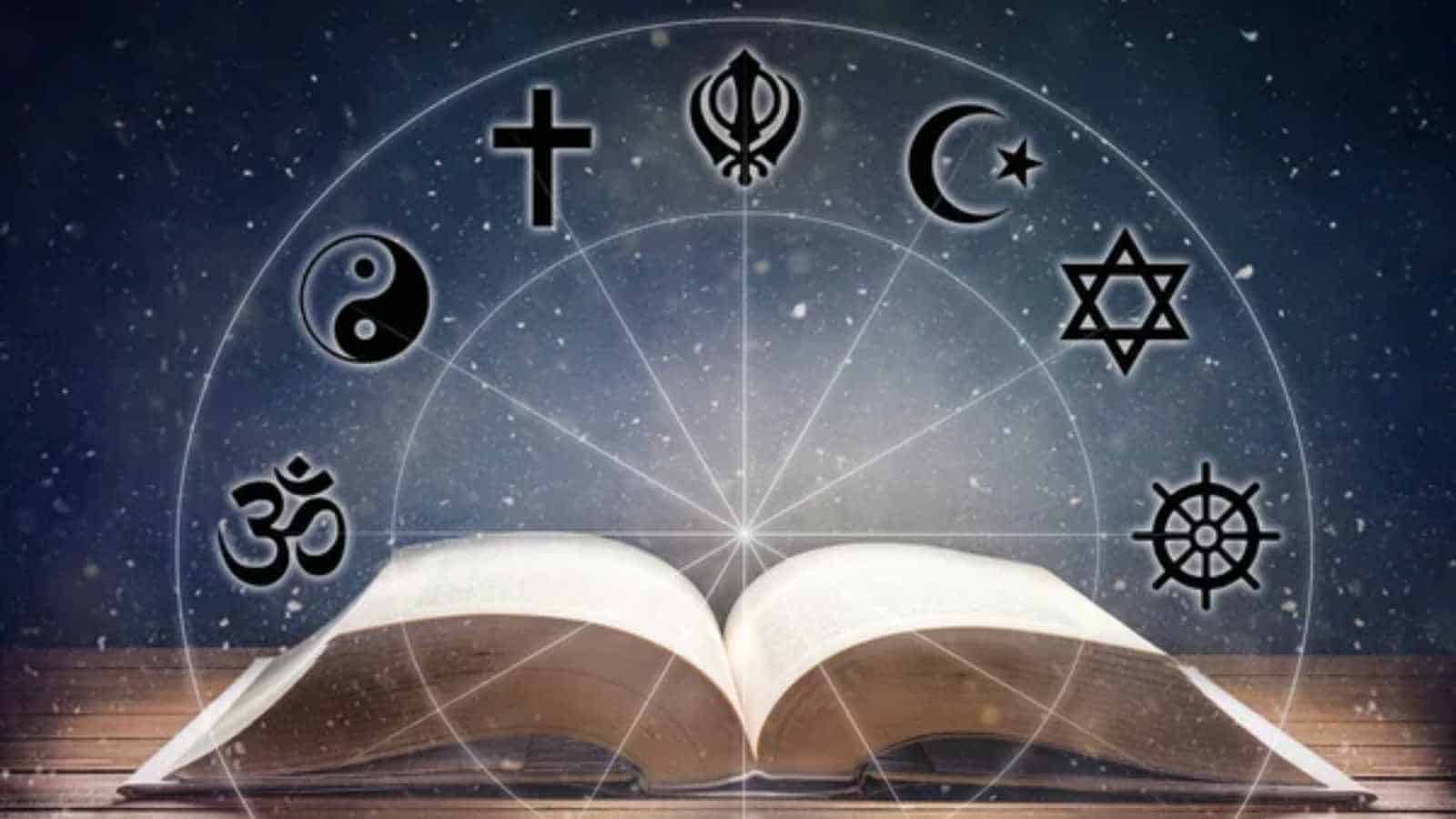
You’ve seen them on necklaces, flags, temples, car windows, jewelry, and even clothing. A six-pointed star. A crescent moon. A mysterious-looking character that resembles the number three. A wheel with eight spokes. A sword surrounded by a circle.
Most people can identify at least a few religious symbols. But recognizing a symbol and understanding what it actually means are two very different things.
Some symbols are much older than the religions we now associate them with. Others became popular centuries after the religions began. A few have meanings that are almost the opposite of what outsiders assume. And one ancient sacred symbol became so thoroughly associated with hatred in the 20th century that many people have no idea it had a very different history stretching back thousands of years.
Here are 10 religious symbols with stories far more interesting than their familiar appearances suggest.
1. The Star of David Wasn’t Always Judaism’s Defining Symbol
The six-pointed Star of David is so closely associated with Judaism today that it can seem impossible to imagine Jewish identity without it. It appears on Israel’s flag, outside synagogues, on jewelry, and throughout Jewish communities around the world.
But the Star of David wasn’t the original universal symbol of Judaism. The six-pointed geometric design appeared in different cultures and decorative traditions long before it became a widely recognized Jewish emblem. Jewish communities used it in various settings during the Middle Ages, and its importance grew substantially in later centuries.
The menorah, the seven-branched lampstand associated with the ancient Temple in Jerusalem, has a much older and more direct connection to biblical Jewish worship. The Star of David became especially prominent as a communal emblem in modern Jewish history and acquired an additional, painful significance when the Nazis forced Jews to wear identifying yellow stars.
Today the symbol carries religious, cultural, historical, and national meanings. Something that began as one design among many became one of the world’s most recognizable expressions of Jewish identity.
2. The Islamic Crescent and Star Aren’t Actually Required by the Quran
Ask someone to draw a symbol representing Islam and there’s a good chance they’ll sketch a crescent moon with a star beside it. The design appears on the flags of several Muslim-majority countries and on countless mosque decorations, signs, and religious publications.
Here’s the surprise: the Quran doesn’t establish the crescent and star as Islam’s official symbol. The design’s history is connected with older cultural traditions and, especially, its later association with the Ottoman Empire. Ottoman political influence helped spread the crescent-and-star image as a recognizable emblem associated with Muslim power and identity.
The moon itself has genuine religious importance in Islam. The Islamic calendar is lunar, and the sighting of the new crescent traditionally helps determine the beginnings of months such as Ramadan. But that doesn’t make the crescent-and-star design a divinely prescribed religious emblem.
Some Muslims embrace the image as a familiar cultural symbol, while others prefer not to identify Islam with any particular pictorial emblem. A symbol can become associated with a religion through history and politics without ever having been commanded by that religion’s scripture.
3. Om Is Much More Than a Religious Decoration
You’ve probably seen the Om symbol on yoga studio walls, meditation products, tattoos, or clothing. Its distinctive shape has become familiar far beyond Hindu communities, sometimes to the point where people treat it as a general symbol for relaxation.
For many Hindus, however, Om—or Aum—is something much deeper. It is a sacred syllable associated with ultimate reality, spiritual knowledge, and the divine. Ancient Hindu texts, especially the Upanishads, explore its significance, and it remains central to many forms of prayer, chanting, meditation, and ritual.
Om isn’t simply a decorative way of saying “peaceful.” It can represent profound ideas about existence itself, the relationship between the individual and ultimate reality, and the sacred power of sound. Different Hindu traditions interpret its significance in different ways, and the symbol also appears in Buddhist and Jain contexts.
That makes its modern commercial use particularly interesting. A symbol that can carry immense spiritual weight in one setting may be printed on a water bottle or exercise mat in another, with the buyer barely aware of its religious history.
4. The Buddhist Wheel Is Really a Map of the Path
A wheel with eight spokes appears frequently in Buddhist art and religious imagery. It’s called the Dharmachakra, often translated as the Wheel of Dharma.
At first glance, it looks like a simple decorative wheel. But its meaning reaches back to one of Buddhism’s central teachings. The eight spokes are commonly associated with the Noble Eightfold Path, which includes right understanding, intention, speech, action, livelihood, effort, mindfulness, and concentration.
The wheel also connects with the idea of the Buddha setting the Dharma in motion through his teaching. Rather than representing a creator god or a place of worship, it points toward a way of understanding and practicing life.
The wheel isn’t just telling you what Buddhists believe. It’s pointing toward what Buddhists are supposed to do. Its symbolism emphasizes that spiritual liberation involves a path of ethical conduct, mental discipline, and wisdom rather than simply accepting a set of doctrines.
Related Post: 10 Things Buddhism Doesn’t Actually Teach—Despite What Pop Culture Says
5. The Sikh Khanda Isn’t Just a Collection of Weapons
The Khanda is one of Sikhism’s most recognizable emblems. It typically features a central double-edged sword, a circular weapon, and two curved swords on either side.
To someone unfamiliar with Sikhism, it might look like a military insignia. But the design communicates religious principles that go far beyond warfare. The central sword is associated with divine knowledge and power, while the circular chakkar represents the eternal, boundless nature of the divine. The two outer swords are commonly interpreted through the Sikh principles of miri and piri: responsibility in worldly life and spiritual life.
As the Sikh Research Institute explains, the Khanda brings together ideas about divine oneness, dignity, and the responsibility to act in the world.
The symbol isn’t simply celebrating weapons. It’s expressing the belief that spiritual commitment and the duty to defend justice belong together. That connection helps explain why Sikh tradition places such importance on serving others, protecting the vulnerable, and resisting oppression.
6. The Swastika Was Sacred Thousands of Years Before the Nazis
Few symbols provoke a stronger reaction in the Western world than the swastika. Its association with Adolf Hitler, Nazism, genocide, and antisemitism is so powerful that many people assume it originated with the Nazi movement.
It didn’t.
The swastika existed for thousands of years before the 20th century and has long held positive religious meanings in Hinduism, Buddhism, and Jainism. In many South Asian contexts, it represents auspiciousness, well-being, prosperity, or good fortune. It can still appear on temples, religious objects, entrances, and ceremonial decorations.
The United States Holocaust Memorial Museum’s history of the swastika explains that the symbol was used in numerous cultures long before Hitler adopted it for the Nazi flag.
One of the world’s oldest symbols of good fortune became one of the modern world’s most infamous symbols of hatred. Both histories matter. The Nazis’ appropriation cannot be separated from the symbol’s modern impact, especially for Jewish communities and others targeted by Nazism. But the symbol’s ancient religious significance also remains important to millions of Hindus, Buddhists, and Jains who never stopped using it in its older contexts.
7. The Christian Fish Was More Than an Early Secret Sign
The outline of a fish is familiar from car decals and Christian merchandise. Many people have heard that early Christians used it as a secret identification sign during Roman persecution.
That story is popular, but the historical evidence for a widespread secret-code system is less straightforward than the legend suggests. What is certain is that fish imagery appeared in early Christian art and carried rich religious associations.
The Greek word for fish, ichthys, could also be understood as an acronym formed from words expressing belief in Jesus Christ as Son of God and Savior. Fish imagery additionally connected with New Testament stories involving fishermen, miraculous catches, and Jesus feeding crowds.
A simple fish could communicate an entire statement of Christian belief without spelling it out. Unlike the cross, which became Christianity’s dominant symbol over time, the fish offered early believers a visual image with multiple connections to Jesus and his teachings.
Its modern appearance on the back of a car is a reminder that religious symbols can survive long after the original setting that made them meaningful has disappeared.
8. The Lotus Flower Doesn’t Mean Exactly the Same Thing in Every Religion
A lotus flower growing from muddy water and opening into a beautiful blossom is an image almost anyone can appreciate. That natural transformation helps explain why the lotus became such a powerful religious symbol across parts of Asia.
In Buddhist traditions, the lotus frequently represents purity, awakening, and the possibility of spiritual development despite the difficulties of ordinary existence. A flower can rise from mud without being defined by the mud beneath it. In Hindu traditions, the lotus is also associated with beauty, purity, divine power, and cosmic creation, appearing in images of deities such as Lakshmi, Vishnu, and Brahma.
The same flower can represent different religious ideas without becoming a completely different symbol. That makes the lotus a useful example of how traditions can share imagery while developing their own interpretations.
It’s also why a lotus tattoo or decoration doesn’t automatically tell you whether its owner is Buddhist, Hindu, spiritually eclectic, or simply fond of the design. Recognition alone doesn’t reveal the meaning someone has attached to it.
9. The Hamsa Hand Doesn’t Belong to Just One Religion
A hand-shaped amulet, often featuring an eye in the palm, appears throughout parts of the Middle East and North Africa. It’s commonly called the hamsa, and many people associate it with protection against the evil eye.
But whose symbol is it?
Jewish traditions sometimes connect the hand with Miriam, the sister of Moses. In some Muslim cultural traditions, it is associated with Fatima, the daughter of Muhammad. The motif also has a broader history in regional protective and folk traditions, making it difficult to assign a single religious origin or meaning.
The hamsa is a reminder that religious symbols don’t always respect the boundaries between religions. Communities that disagree about theology can still share protective customs, visual motifs, and cultural practices shaped by centuries of living near one another.
For some wearers, the hand has a specifically religious significance. For others, it is a cultural symbol, a family tradition, a protective charm, or simply a familiar piece of jewelry. The same design can carry several meanings at once.
10. The Cross Wasn’t Christianity’s Only Early Symbol
Today, the cross is so closely associated with Christianity that it can be difficult to imagine the religion without it. Yet early Christian art included fish, anchors, shepherds, birds, and other imagery alongside developing uses of the cross.
The cross itself was an instrument of Roman execution. That’s part of what makes its transformation extraordinary. Christians came to understand Jesus’ crucifixion not merely as a humiliating death but as central to salvation, divine love, sacrifice, and victory over death.
Different Christian traditions also developed different forms of the cross and different ways of depicting it. A plain cross, a crucifix showing Jesus’ body, and the distinctive crosses used in various Eastern Christian traditions don’t necessarily emphasize identical aspects of Christian belief.
Christianity took a symbol associated with public humiliation and execution and transformed it into its most recognizable emblem of hope. That reversal may be one of the most dramatic symbolic transformations in religious history.
Related Read: Bible verses everyone quotes that aren’t actually in the Bible
A Religious Symbol Can Tell More Than One Story

The most interesting thing about religious symbols isn’t simply that they have hidden meanings. It’s that their meanings can change, overlap, and sometimes become almost unrecognizable over time.
The Star of David grew into a defining Jewish emblem. The crescent and star became associated with Islam through history rather than a scriptural command. Om carries sacred meanings far beyond its modern appearance on yoga products. The Khanda communicates both spiritual responsibility and worldly action. The swastika has an ancient religious history that the Nazis violently overshadowed.
A symbol doesn’t come with its entire history printed underneath it.
That’s why it’s so easy to misunderstand what we’re looking at. We recognize the shape and assume we know the story. But behind even the simplest design can be centuries of devotion, conflict, cultural exchange, and changing identity.
The next time you see a familiar religious symbol, the most interesting question may not be what it represents.
It may be how it came to represent that in the first place.
Related Read: Your everyday traditions have surprisingly ancient roots