
10 Religions That Nearly Disappeared Because Their Followers Were Persecuted
Imagine being told that practicing your religion could cost you your home, your livelihood, or your life. Your places of worship are destroyed, your sacred writings are confiscated, and your children grow up knowing that revealing the family’s beliefs could put everyone in danger.
For some religious communities, that wasn’t a distant nightmare. It was everyday life for generations.
History is filled with religions that spread across kingdoms, inspired remarkable art and literature, and attracted devoted followers—only to face persecution so severe that their survival became uncertain. Some disappeared as organized communities. Others survived in remote villages, within families, or among refugees who carried their traditions across borders.
And a few are still here, even though their followers number only in the thousands.
These 10 religious histories reveal how persecution can nearly erase a tradition—and why some communities refuse to let it disappear.
1. Zoroastrianism: A Major Ancient Religion Reduced to a Small Minority
Long before Islam became dominant in Iran, Zoroastrianism was deeply connected with the religious and political life of successive Iranian empires. Its teachings, associated with the prophet Zarathustra, emphasized truth, moral responsibility, and devotion to Ahura Mazda.
Today, Zoroastrians form a relatively small worldwide community. The extraordinary part isn’t simply that their numbers declined. It’s that a religion once associated with powerful empires survived centuries of upheaval without disappearing.
The Arab conquest of the Sasanian Empire in the seventh century began a long transformation of Iran’s religious landscape. Conversion to Islam unfolded over generations and involved a complex combination of social, political, economic, and religious factors. Zoroastrians experienced periods of discrimination, legal disadvantage, and persecution, although conditions varied greatly across rulers and eras.
Some Zoroastrians migrated to the Indian subcontinent, where their descendants became known as Parsis. Others remained in Iran and maintained their traditions despite substantial pressure. Their sacred fires, prayers, and communal institutions became important links with a much larger religious past.
Zoroastrianism’s survival is a reminder that political defeat doesn’t necessarily mean religious extinction. A tradition can lose its former position in society and still endure through the determination of its followers.
2. Manichaeism: A Religion That Spread Across Continents and Almost Vanished
In the third century CE, a religious teacher named Mani founded a movement that would spread from the Middle East toward Central Asia, China, and parts of the Mediterranean world.
Manichaeism offered a sweeping explanation of the struggle between light and darkness. It drew on religious ideas circulating in late antiquity while developing its own scriptures, institutions, and missionary networks.
At one point, Manichaeism had followers across an astonishing geographical range. Today, it has no widely recognized continuous religious community comparable to those of the major surviving world religions.
Its followers faced persecution under several different political and religious authorities. Mani himself died while imprisoned under the Sasanian ruler Bahram I, according to traditional accounts. Later, Manichaean communities encountered repression in the Roman Empire, parts of the Islamic world, and China.
The religion didn’t disappear overnight. Communities survived in some regions long after Manichaeism had been suppressed elsewhere, and traces of its teachings persisted in manuscripts, art, and historical records.
What makes its history particularly haunting is how much had to be rediscovered. For centuries, much of what outsiders knew about Manichaeism came from its opponents. Archaeological discoveries and surviving texts eventually revealed a more complicated religious tradition than those hostile descriptions suggested.
3. The Yazidis: A Community Targeted for Its Very Existence
The Yazidis are a religious minority whose traditions developed in the Middle East, particularly in areas of present-day Iraq. Their religious life includes distinctive sacred narratives, practices, and reverence for Tawûsî Melek, often called the Peacock Angel.
For generations, outsiders sometimes misrepresented Yazidi beliefs, including falsely accusing the community of devil worship. Such accusations contributed to discrimination and persecution.
In 2014, the Islamic State group launched a devastating campaign against Yazidis in northern Iraq. Fighters killed thousands, abducted women and children, enslaved survivors, and forced many families to flee. International investigators and other authorities have characterized the atrocities as genocide.
The attack wasn’t merely an effort to control territory. It targeted the continued existence of a religious community.
Yazidis survived through escape, rescue efforts, international support, and the persistence of families and community institutions. Yet the consequences remain profound, including displacement, missing relatives, trauma, and challenges to rebuilding religious life.
The Yazidi story is especially important because it isn’t simply ancient history. It demonstrates how quickly a living religious tradition can face an existential threat in the modern world.
4. The Mandaeans: An Ancient Community Forced From Its Homeland
The Mandaeans are a small religious community historically concentrated in Iraq and Iran. Their traditions place extraordinary importance on ritual purification in flowing water, and John the Baptist holds a revered position in their religious literature.
Their faith has roots in the religious world of late antiquity, although scholars continue to debate aspects of its early development.
For centuries, Mandaeans maintained a distinctive religious identity despite living among much larger religious communities. Their survival depended on family transmission, ritual specialists, sacred writings, and access to the water needed for important ceremonies.
The danger facing Mandaeans today isn’t only the possibility of direct violence. It’s the possibility that displacement could make their religious way of life increasingly difficult to sustain.
After the 2003 invasion of Iraq, many Mandaeans experienced threats, kidnapping, discrimination, and violence, prompting substantial emigration. Communities now exist across a diaspora that includes Australia, Europe, and North America.
That migration has offered safety to many families, but it also creates challenges. A religion with specialized rituals, a small clergy, and strong community ties cannot always recreate its institutions easily in a new country.
Their history raises a difficult question: what happens when a religion survives physically, but the social and geographical conditions that sustained it are scattered?
5. The Bahá’í Faith: A Modern Religion That Has Faced Generations of Repression
The Bahá’í Faith emerged in the nineteenth century in the Iranian religious world. Its teachings emphasize the unity of humanity, the essential unity of religions, education, and the need to overcome prejudice.
Its founder, Bahá’u’lláh, spent much of his life in exile and imprisonment. Earlier followers of the Báb, whose movement preceded the Bahá’í Faith, also experienced severe repression.
What makes the Bahá’í experience striking is that persecution didn’t end when the religion became internationally established.
Bahá’ís in Iran have faced longstanding restrictions affecting education, employment, property, burial, and religious community life. Members of the community have also experienced imprisonment and other forms of repression. Iranian authorities have disputed some allegations, but human rights organizations and United Nations experts have documented extensive discriminatory practices.
The Bahá’í Faith has grown into a worldwide religion, so it is not accurate to describe it as globally close to extinction. The existential threat has instead been especially acute for particular communities, notably in the land where the religion began.
That distinction matters. A religion can be thriving internationally while its followers in its birthplace face serious efforts to suppress their identity and institutions.
6. The Samaritans: A Biblical-Era Community That Survived Against Extraordinary Odds
The Samaritans are familiar to many Christians because of the parable of the Good Samaritan. But few readers realize that a small Samaritan religious community still exists.
Samaritans preserve an Israelite religious tradition centered on the Torah and regard Mount Gerizim, rather than Jerusalem, as the central sacred place chosen by God.
Over many centuries, Samaritan communities experienced political upheaval, religious conflict, demographic decline, and periods of severe repression. Major revolts against Byzantine rule in late antiquity were followed by harsh consequences, including killings and reductions in the community’s population.
A people once numerous enough to play a significant role in the region eventually dwindled to a community numbering only in the hundreds.
Today, Samaritans live principally around Mount Gerizim near Nablus and in Holon, Israel. They maintain distinctive religious observances, including Passover sacrifices on Mount Gerizim.
Their survival is remarkable not because they remained unchanged in every detail, but because they preserved a recognizable religious identity despite centuries of pressure and demographic vulnerability.
A community doesn’t need millions of members to carry an ancient religious inheritance into the present.
7. Japanese Christians: Believers Who Practiced in Secret for Generations
Christianity reached Japan in the sixteenth century through Catholic missionaries and attracted converts, including some influential political figures.
But the religion soon faced increasingly severe restrictions. Japanese authorities prohibited Christianity, expelled missionaries, and persecuted believers. Some Christians were executed, while others were pressured to renounce their faith.
The extraordinary part is what happened after public Christian worship became nearly impossible: some families continued practicing secretly for more than two centuries.
These communities, often called Hidden Christians or Kakure Kirishitan, preserved prayers, rituals, and religious identities without ordinary access to priests or church institutions. Their practices sometimes incorporated local forms and changed substantially during the long period of secrecy.
When Japan reopened to greater foreign contact in the nineteenth century, some hidden Christian communities revealed themselves to Catholic missionaries. Others maintained distinctive inherited traditions rather than fully joining the restored Catholic Church.
The story is not simply about an unchanged religion surviving underground. It is about how believers adapted their faith when the institutions that once sustained it had disappeared.
8. The Druze: A Distinctive Faith That Survived Through Strong Community Boundaries
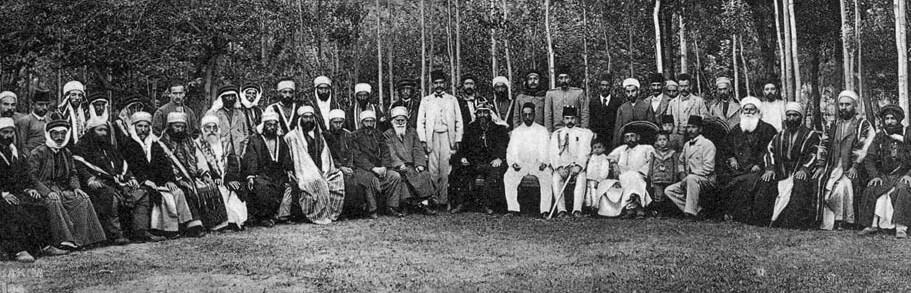
Meeting of Druze and Ottoman leaders in Damascus, about the control of Jebel Druze
Public domain, via Wikimedia Commons
The Druze religious tradition emerged in the eleventh century in the Middle East, drawing on an intellectual and religious environment associated with Isma’ili Islam while developing a distinct identity.
Druze communities are found especially in Lebanon, Syria, Israel, and nearby areas. Their religious teachings include distinctive interpretations of divine unity, and much of their religious literature and instruction is reserved for initiated members.
The Druze have faced episodes of persecution, violence, and political pressure over their history, although their circumstances have differed significantly by place and period.
One of the most unusual features of Druze religious life is that the community generally does not accept converts.
Membership is traditionally inherited, and marriage within the community has played an important role in preserving its identity. These boundaries have helped maintain continuity, but they also make demographic survival dependent on the community itself rather than new converts.
The Druze illustrate a form of religious resilience that doesn’t rely on missionary expansion. Instead, continuity is sustained through family, community institutions, and the transmission of a distinctive religious heritage.
You may want to read: Why Some Religions Want You to Convert—and Others Rarely Ask
9. The Cathars: A Medieval Christian Movement That Was Crushed
In parts of medieval southern France, religious communities associated with what historians call Catharism became the focus of a major campaign of repression.
Cathar beliefs and organization remain subjects of scholarly debate, partly because much surviving evidence comes from hostile church and inquisitorial records. Nevertheless, medieval authorities identified groups they regarded as heretical and launched efforts to eliminate their religious influence.
The Albigensian Crusade, beginning in 1209, brought warfare and devastation to the region. Subsequent inquisitorial investigations and punishments further weakened the movement.
This was a case in which religious disagreement became the justification for military conquest and systematic repression.
By the later Middle Ages, organized Cathar communities had largely disappeared. Modern groups sometimes claim spiritual connections with the Cathars, but there is no established continuous institutional survival from medieval Catharism into the present.
Their history is a warning about how difficult it can be to reconstruct a suppressed religion. When a movement’s own writings are scarce and much of its story is told by its persecutors, even historians must work carefully to distinguish evidence from accusation.
10. Indigenous Religious Traditions: Survival After Attempts to Erase Them
Across the Americas, Australia, and other colonized regions, Indigenous communities experienced efforts to suppress their languages, ceremonies, sacred places, and religious practices.
Missionary activity, government policies, forced displacement, and residential or boarding school systems sometimes worked together to replace Indigenous traditions with the dominant religion and culture.
In many places, the goal wasn’t simply to persuade people to adopt a new faith. It was to break the chain through which children learned their ancestors’ beliefs and ceremonies.
The experiences varied enormously. Some traditions were driven underground. Others survived through blended practices, private family transmission, or the determination of elders who continued teaching despite punishment.
It would be misleading to speak of Indigenous religion as one unified faith that nearly disappeared. These are many distinct traditions with their own histories, sacred places, and communities.
But the broader pattern is unmistakable: religious persecution can involve far more than banning worship. It can target language, land, family relationships, and the knowledge needed to carry a tradition into the next generation.
What It Really Takes for a Religion to Survive
Religions rarely disappear because their followers simply wake up one day and stop caring.
Some decline gradually as communities change, merge, or adopt different beliefs. Others are weakened by conquest, forced conversion, discrimination, exile, and the destruction of institutions that once sustained religious life.
The examples here also show why survival cannot be measured by one simple standard. Manichaeism largely vanished as an organized religion. Zoroastrianism and Samaritanism survived with much smaller populations than in their earlier histories. Yazidis and Mandaeans remain living communities confronting the consequences of recent violence and displacement.
A religion survives when people find ways to carry it forward—even when the world around them makes that extraordinarily difficult.
Sometimes that means protecting a sacred text. Sometimes it means leaving a homeland. Sometimes it means teaching prayers in secret or rebuilding a community thousands of miles away.
The most remarkable part of these histories isn’t only how close some traditions came to disappearing.
It’s that, in so many cases, someone refused to let the last generation be the final one.
You may also want to read: 10 Ancient Religions That Once Flourished but Nearly Disappeared