Postpartum depression doesn’t always look like depression: The signs families shouldn’t miss
A new mother can be feeding her baby, answering texts, showing up for appointments and smiling in family photos while privately feeling as though she is falling apart.
That’s one reason postpartum depression can be so easy to miss. This week, singer Alanis Morissette spoke publicly about experiencing postpartum depression after the births of all three of her children. She described not only depression, but terrifying intrusive thoughts and fear—symptoms that may be far removed from what many people picture when they hear the word “depression.”
Postpartum depression doesn’t always look like a mother crying in bed or saying she feels depressed. It can look like anxiety, anger, insomnia, withdrawal, frightening thoughts or simply a woman who no longer seems like herself.
And sometimes the partner, parent, sibling or friend standing beside her recognizes the change before she does.
The “baby blues” are common. Postpartum depression is different
Having a baby can turn a woman’s physical and emotional world upside down almost overnight. Hormones shift dramatically, sleep disappears, recovery from childbirth takes time and suddenly another human being needs attention around the clock.
Feeling overwhelmed doesn’t automatically mean someone has postpartum depression.
Many new mothers experience what’s commonly called the “baby blues”: mood swings, tearfulness, worry, irritability and exhaustion during the first days after giving birth. These symptoms generally improve within about two weeks.
Postpartum depression is different. The National Institute of Mental Health explains that when depression, anxiety or other significant mood symptoms are severe or continue for longer than two weeks, they may be signs of postpartum depression.
The important question isn’t simply, “Is she sad?” It’s “Is something interfering with her ability to feel like herself, function normally or care for herself or her baby?”
She may not look sad at all
One of the biggest misconceptions about postpartum depression is that depression must look like sadness.
It doesn’t.
A woman might become unusually irritable or angry. She may seem constantly anxious or unable to relax. She may withdraw from people she normally loves, lose interest in things she used to enjoy or seem emotionally flat.
She might repeatedly say she’s a terrible mother despite reassurance to the contrary. She may feel guilty, worthless or hopeless.
Some women describe feeling as though they’ve disappeared inside their new role as a mother. Others feel detached from the baby and then experience enormous guilt because they aren’t feeling the joy they expected.
That doesn’t mean they don’t love their child.
Difficulty bonding with a baby is a recognized symptom of postpartum depression.
Pay attention when anxiety seems to take over
Postpartum depression and anxiety can overlap, and sometimes anxiety is the symptom everyone notices first.
A mother may become consumed with the possibility that something terrible will happen to her baby. She may repeatedly check whether the baby is breathing, be terrified to let anyone else hold the child or find herself unable to sleep even when the baby is safely sleeping.
Some worry is completely normal with a newborn.
The warning sign is when fear becomes persistent, overwhelming or begins controlling everyday life.
A woman may know intellectually that her fears are excessive and still be unable to turn them off.
Sleep can provide an important clue
Every new parent is tired, so “she isn’t sleeping” doesn’t sound particularly alarming.
But there’s an important distinction.
A mother who desperately wants to sleep but can’t—even when someone else is caring for the baby and she has an opportunity to rest—may be experiencing something beyond ordinary newborn exhaustion.
Persistent insomnia can accompany depression, severe anxiety and other postpartum mental-health conditions.
If the baby is sleeping, someone trustworthy is handling everything, and Mom still lies awake night after night with racing thoughts, fear or agitation, pay attention.
Intrusive thoughts can be terrifying—and complicated
This is an area where people often become frightened and stop talking.
Some new mothers experience unwanted intrusive thoughts or mental images involving something terrible happening to the baby or themselves. The thoughts can be deeply disturbing precisely because the woman does not want them.
She may be so horrified or ashamed that she tells no one.
Having an unwanted frightening thought is not the same thing as wanting to act on it. But persistent intrusive thoughts, particularly when accompanied by depression, severe anxiety, hopelessness or difficulty functioning, deserve professional attention.
The safest response isn’t judgment or panic. It’s creating enough safety for the woman to tell someone what she’s experiencing and helping her connect with a healthcare professional who can evaluate what is happening.
Watch for the mother who appears to be functioning perfectly
Postpartum depression doesn’t always make someone incapable of functioning.
A woman may still go to work, take care of the baby, prepare meals and answer emails while experiencing tremendous distress internally.
Morissette has described this phenomenon as “functioning suffering,” and it’s an important concept.
Being productive doesn’t prove someone is okay.
Sometimes high functioning can actually make postpartum mental-health problems harder for others to recognize. Everyone sees a capable mother managing everything and assumes she must be fine.
Instead of asking only, “How’s the baby?” try asking, “How are you doing?”
And give her enough time to answer.
There are signs loved ones may notice first
Sometimes the change is subtle. A partner might notice she no longer laughs at things that normally make her laugh. Her mother may notice that she sounds strangely detached on the phone. A friend may notice that she has stopped responding to messages.
Other changes can be more obvious: frequent crying, unusual anger, extreme guilt, inability to make decisions, overwhelming anxiety, loss of appetite, inability to sleep, statements that the baby would be better off without her or repeated comments that she’s failing as a mother.
The key is often a significant change from the person you know.
You don’t need to diagnose her. You need to notice her.
Don’t say, “But you have so much to be happy about”
Well-meaning people can accidentally make postpartum depression harder to disclose.
“You’re so lucky.”
“Try to enjoy this.”
“Every new mom is exhausted.”
“The baby is healthy. That’s what matters.”
None of those statements treats depression.
They can instead reinforce the belief that she has no right to feel the way she does, adding guilt to an illness already capable of producing enormous guilt.
A better approach is simple: “I’ve noticed you don’t seem like yourself lately, and I’m worried about you. How are you really doing?”
Then listen.
If she tells you she’s struggling, believe her.
You may be interested in reading: 12 signs you may have high-functioning depression, according to experts
Offer practical help, not just encouragement

“Let me know if you need anything” sounds supportive, but it puts another task on someone who may already be overwhelmed.
Specific help is easier to accept.
Bring dinner. Hold the baby while she showers. Do a load of laundry. Drive her to an appointment. Sit with her while she calls her doctor. Take an older child to school. Help arrange a stretch of uninterrupted sleep if her healthcare situation and feeding plan allow it.
NIMH specifically recommends that family and friends help women with postpartum depression connect with healthcare providers, get to appointments and manage everyday responsibilities.
Support doesn’t replace treatment, but it can make getting treatment possible.
Postpartum depression is treatable
This is one of the most important things for a struggling mother and her family to understand.
Postpartum depression is a medical condition, and effective treatments are available.
Treatment can include psychotherapy, medication or a combination of approaches. The FDA has also approved medications specifically for postpartum depression, including zuranolone, the first oral medication approved specifically for the condition.
A woman who suspects she has postpartum depression can start with her obstetrician, primary-care clinician, mental-health professional or another healthcare provider.
She doesn’t have to wait until things become unbearable.
Postpartum psychosis is different—and it is an emergency
Postpartum psychosis is rare, but every family should know what it looks like because it requires immediate medical attention.
It is not simply a very severe version of feeling depressed.
According to NIMH, symptoms can include hallucinations, delusions, paranoia, mania and severe confusion. A woman may hear or see things other people don’t, develop beliefs that are clearly disconnected from reality, become extremely agitated or energetic, seem profoundly confused or behave in ways that are dramatically unlike herself.
She may not recognize that anything is wrong.
Postpartum psychosis is a psychiatric emergency.
If a postpartum woman appears psychotic, severely confused or disconnected from reality, or there is an immediate danger that she may harm herself or someone else, don’t wait for a routine doctor’s appointment. In the United States, call 911 or go to the nearest emergency department.
If she talks about suicide or harming herself, take it seriously
Comments such as “Everyone would be better without me,” “I can’t do this anymore,” or “I wish I could disappear” shouldn’t be dismissed as exhaustion.
Ask directly whether she is thinking about hurting herself or suicide. Asking the question does not plant the idea in someone’s head.
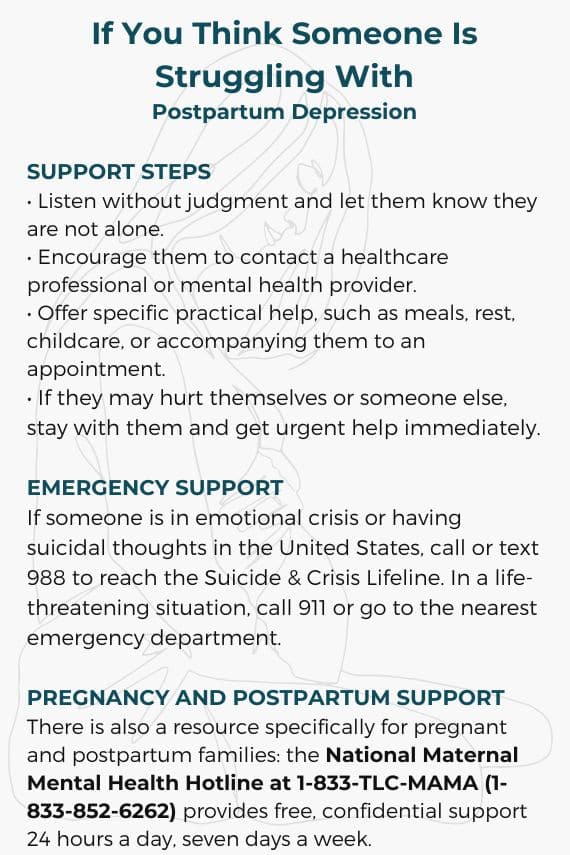
If someone is in emotional crisis or having suicidal thoughts in the United States, call or text 988 to reach the Suicide & Crisis Lifeline. In a life-threatening situation, call 911 or go to the nearest emergency department.
There is also a resource specifically for pregnant and postpartum families: the National Maternal Mental Health Hotline at 1-833-TLC-MAMA (1-833-852-6262) provides free, confidential support 24 hours a day, seven days a week.
Don’t wait for her to ask for help
Depression can make asking for help extraordinarily difficult.
A woman may believe she’s failing. She may be embarrassed by what she’s thinking. She may worry that someone will judge her parenting or take her baby away. Or she may simply be too exhausted and overwhelmed to figure out whom to call.
That’s why the people around her matter so much.
You don’t have to know whether it’s postpartum depression before doing something.
You can say, “I’m worried about you. Let’s call your doctor together.”
You can offer to make the appointment.
You can drive her there.
You can sit beside her while she tells someone what’s happening.
Sometimes helping someone get treatment begins with something that simple.
Final word
Having a baby is supposed to be one of life’s happiest experiences. That expectation can make postpartum depression particularly cruel.
A woman can adore her baby and still be depressed. She can be grateful and terrified. She can look competent while barely holding herself together. She can desperately want to be a good mother while feeling convinced she’s failing.
None of those contradictions makes her a bad mother. They may mean she needs help.
The people around a new mother don’t need to become amateur psychiatrists. They need to pay attention when she seems different, take her seriously when she says she’s struggling and know when symptoms have crossed the line from something to discuss with a healthcare provider to something requiring immediate help.
Postpartum depression is treatable. Recovery is possible. But someone has to recognize that something is wrong—and sometimes the person who recognizes it first is standing right beside her.