Why Some Analysts Think the Next Downturn Could Be Different: 13 Warning Signs
Debt is high, interest rates have risen sharply, asset prices look stretched, and geopolitical tensions are back in focus. None of these conditions are new on their own. What is unusual is how many of them are converging at once and how little room policymakers have to respond if they do.
In past cycles, stress tended to concentrate in one area while others acted as shock absorbers. A housing crash could be offset by aggressive rate cuts. A rate shock could be cushioned by lower debt levels. A global disruption could be met with coordinated stimulus. Today, those buffers appear weaker or already in use.
The risk isn’t that any one of these forces will tip the economy into recession. It’s that they are interacting, tightening financial conditions, restricting policy flexibility and simultaneously amplifying pressure across households, businesses, and governments. If that dynamic holds, the next downturn may not follow the usual pattern of a sharp break followed by a rapid rescue. It could be slower to start, harder to contain, and more difficult to resolve.
Rate Hikes Are Colliding With Record Debt Levels
The traditional economic playbook suggests that raising interest rates is a controlled burn designed to clear out inflationary brush. However, this cycle is navigating a landscape where U.S. total public debt has surged past $34 trillion, and the interest expense alone is tracking to hit $1 trillion annually.
Global debt now sits near $348 Trillion, a staggering leverage ratio that makes every 25-basis-point hike exponentially more painful than it was in the 1980s. When Paul Volcker pushed rates to 20%, the debt-to-GDP ratio was a mere 35%; today, the systemic sensitivity to the cost of carry is at an all-time high.
Critics like Nassim Taleb, author of The Black Swan, argue that we have spent 15 years in a Disneyland of zero-interest rates, creating a fragile environment in which debt-saturated entities cannot survive a return to historical norms.
Recent tracking of the 3,000 largest U.S. publicly traded companies found that nearly 639 firms met the zombie criteria. If these zombies begin to default simultaneously, the contraction won’t be a gentle cooling, but a jagged break in the credit transmission mechanism.
Housing Is No Longer the Epicenter

In 2008, housing was the runaway engine that drove the economy off a cliff. In 2026, the sector has transformed into a golden handcuff trap. With nearly 60% of active mortgages locked in at rates below 4%, the lock-in effect has effectively paralyzed the secondary market, leading to a 30% drop in existing home sales compared to the 2021 peaks.
Robert Shiller, the Nobel laureate behind the Case-Shiller Index, has noted that while prices remain high due to a lack of supply, the effect, which usually drives consumer spending, is beginning to stall.
Homes are worth more on paper, but they are less liquid than ever. Contrarily, this lack of inventory acts as a floor, preventing a total price collapse, but this ignores the rental squeeze.
As mortgage rates stay elevated, the demand for rental units has kept the Consumer Price Index (CPI) shelter component artificially high, forcing the Fed to remain hawkish even as other sectors cool. It is a slow-motion tightening of the screws where the lack of movement in the housing market is actually preventing the very economic cooling the Fed wants to see.
Liquidity Is Quietly Draining From the System
Forget the headline stock prices; the real story is in the plumbing of the repo markets and the Federal Reserve’s Quantitative Tightening (QT) program. The Fed has been shedding assets at roughly $95 billion per month, a silent withdrawal of the lifeblood that fueled the post-2020 rally.
The transitions from a world of plenty to one of scarcity in bank reserves is fraught with technical risks.
When that tank hits empty, volatility in the Overnight Financing Rate could spike, as it did during the 2019 repo crisis that forced an emergency intervention. The global liquidity is at its lowest levels since the Great Financial Crisis, yet the retail market remains oblivious.
This divergence is dangerous. If the plumbing clogs, it doesn’t matter how strong a company’s earnings are; if they can’t roll over their short-term paper, they face a solvency crisis. Everything looks fine until the moment everyone tries to exit through the same narrow door at once.
Asset Prices Remain Elevated Despite Tighter Conditions
There is a glaring cognitive dissonance between the S&P 500’s P/E ratios and the reality of 5% interest rates. Historically, when the Risk-Free Rate (10-year Treasury) rises, stock valuation multiples should compress. Yet, we are seeing the Shiller PE Ratio hovering around 34, nearly double its long-term average of 17.
This valuation defiance is largely driven by a handful of mega-cap tech stocks, the Magnificent Seven, which now account for nearly 30% of the S&P 500’s total market cap. We are in the midst of a super-bubble fueled by the narrative of AI productivity gains.
However, these companies are fortress balance sheets that act as safe havens. But even safe havens aren’t immune to the laws of physics; if the 10-year yield stays above 4.5%, the equity risk premium effectively vanishes.
We are essentially betting that earnings growth will be historic to justify these prices. If that growth misses by even 2%, the market re-rating could be violent, as seen in the 1974 Nifty Fifty collapse, when blue-chip stocks fell 80% despite solid underlying businesses.
Geopolitical Risk Is Feeding Directly Into Economic Fragility
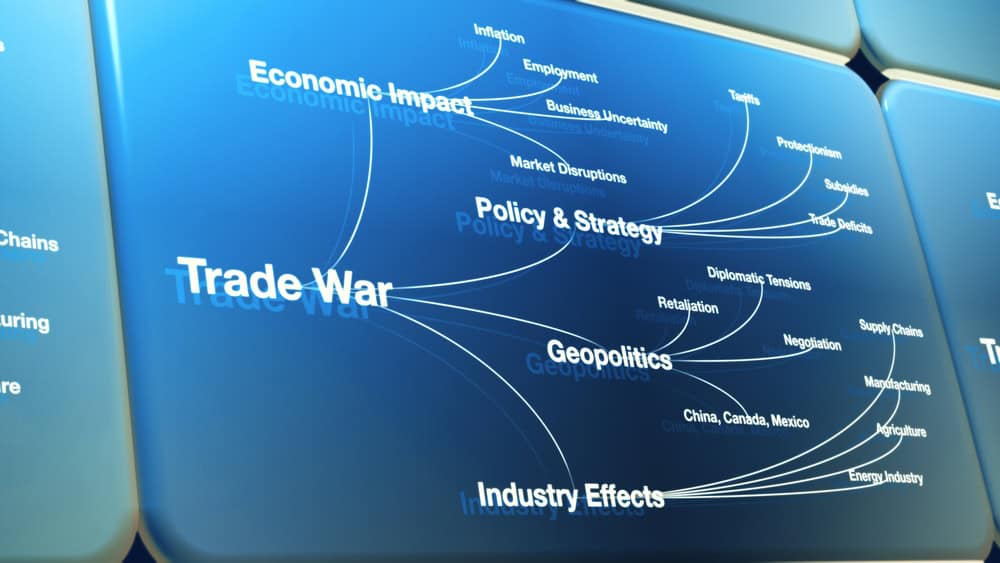
The IMF has warned that geo-economic fragmentation could shave up to 7% off global GDP. It’s no longer just about a temporary oil spike from a conflict; it’s about the permanent restructuring of supply chains.
The Red Sea disruptions and the ongoing de-risking from China have added a structural 0.7% to baseline inflation. Peter Zeihan, author of The End of the World Is Just the Beginning, argues that the U.S.-led global order, which ensured safe seas and cheap energy, is unraveling.
For example, the cost of near-shoring a semiconductor plant to Arizona is roughly 30% higher than building it in Taiwan. This means that even during a downturn, prices might not fall as they traditionally do.
We face a potential Stagflation 2.0, where the Fed cannot cut rates to save a slowing economy because the geopolitical costs of goods remain stubbornly high.
Consumer Strength Is Increasingly Debt-Fueled

The American consumer has been the hero of the post-pandemic story, but the cape is fraying. Credit card debt has crossed the $1.1 trillion mark for the first time in history, and more concerningly, the interest rates on that debt are averaging 21.5%.
Data from TransUnion shows that delinquency transitions, people moving from 30 to 60 days late on payments, are rising back to 2009 levels. The excess savings from the 2020 stimulus have been depleted, leaving the bottom 80% of earners reliant on revolving credit to maintain their standard of living.
While the job market looks strong on paper, the quality of employment is shifting, with a rise in part-time gig work replacing full-time roles with benefits. The Personal Saving Rate has collapsed to 3.2%, far below the pre-pandemic norm of 7-8%. The most recent report from the Bureau of Economic Analysis, released on March 13, 2026, shows a slight rebound to 4.5% for January 2026. While an improvement, it remains significantly lower than the 5.1% seen a year ago
The consumer isn’t spending out of confidence; they are spending out of necessity and habit, using the last of their credit runway. When that runway ends, the drop in consumption will be a cliff, not a slope.
Corporate Balance Sheets Are Starting to Show Stress

For years, corporations were the primary beneficiaries of financialization, using cheap debt to fund stock buybacks rather than capital expenditures. Now, the maturity wall is approaching. S&P Global notes that speculative-grade maturities escalate sharply to a peak of $851 billion in 2028, more than 3.2 times the amount that was scheduled to mature in 2026.
We are now seeing silent defaults and distressed exchanges in which creditors accept less than they are owed to avoid a formal bankruptcy filing.
This avoids the Lehman moment headline, but creates a credit drag that slows investment. A Moody’s report recently indicated that speculative-grade default rates are climbing toward 6%, a level usually reserved for the depths of a recession.
The divergence here is that while Big Tech has billions in cash, the Russell 2000 small-cap companies are largely unprofitable and are feeling the full weight of the rate hikes. This two-tier economy creates a situation in which the stock market index can remain high while the actual engine of American employment, small business, is quietly suffocating.
Banks Are More Stable But Credit Is Getting Harder to Access

The 2023 collapse of Silicon Valley Bank was a warning shot that stable banking isn’t as simple as it used to be. While the big six banks are well-capitalized under Basel III standards, the regional banks that provide 80% of commercial real estate (CRE) loans are in trouble.
There is approximately $2.7 trillion in CRE debt maturing by 2027, and with office vacancy rates in cities like San Francisco hitting 35%, the collateral behind those loans is evaporating. Banks are tightening lending standards across the board.
It’s not a bank run, we should fear, but a credit crunch. If a small business can’t get a line of credit to cover payroll between invoices, it fails. This mechanical slowing of the economy is harder for the Fed to fix than a stock market crash.
Paradoxically, the increased regulation since 2008 has made banks safer but also less willing to take risks, meaning that in a downturn, the very institutions meant to provide liquidity will be the ones hoarding it to protect their own balance sheets.
Policy Tools May Be Less Effective Than Before

In every crisis since 1987, the Fed Put (the belief that the Fed will lower rates to save the market) has been the ultimate backstop. But that put is now out of the money. With inflation still proving sticky due to labor shortages and supply chain shifts, the Fed cannot simply slash rates back to zero without risking a 1970s-style inflationary spiral.
Furthermore, the fiscal side is equally paralyzed. During the 2008 and 2020 crises, the U.S. government spent trillions to bridge the gap.
Today, with a 6-7% budget deficit during an expansion, there is no fiscal space left for a massive stimulus package without causing a crisis in the Treasury market. If a government tries to spend too much while the debt is already high, the bond market revolts.
This time, the economy might have to heal itself through the creative destruction of a true recession, a prospect that a generation of investors has never had to face.
Multiple Slowdowns Are Emerging at the Same Time
In 2001, it was tech. In 2008, it was housing. In 2026, we are seeing the simultaneous cooling of the three primary drivers of growth: global trade, domestic consumption, and capital investment.
The Conference Board’s Leading Economic Index has been in negative territory for a record-breaking duration, signaling a downturn that is long and thin rather than short and sharp. This synchronization is a result of the global tightening cycle; nearly every major central bank (except China and Japan) has been hiking in unison. This removes the venting mechanism where a weak U.S. dollar could boost exports to a strong Europe or Asia.
The long-Term debt cycle is reaching its limit, where the multiplier effect of new debt becomes negative. Every dollar of new debt now generates less than $0.30 of new GDP growth. When everything stops at once, momentum is nearly impossible to restart with traditional Fed funds rate fine-tuning.
Global Weakness Is No Longer Isolated

China’s property crisis, involving over $5 trillion in debt and developers such as Evergrande and Country Garden, is a slow-motion drag on global growth.
As the world’s factory slows, it exports deflation to its neighbors and reduces demand for U.S. and European high-tech exports. The Baltic Dry Index, a measure of global shipping costs and demand, has shown extreme volatility, reflecting a world that isn’t sure where the next demand source is coming from.
In Europe, Germany has flirted with technical recession for two years due to high energy costs and a demographic collapse. A study by the OECD suggests that for every 1% drop in Chinese GDP, global GDP drops by 0.5%.
We are no longer dealing with isolated localized shocks; we are in a highly interconnected web where a bank failure in Frankfurt or a real estate collapse in Shenzhen ripples through the U.S. corporate bond market in hours.
Market Signals and Economic Signals Are Diverging
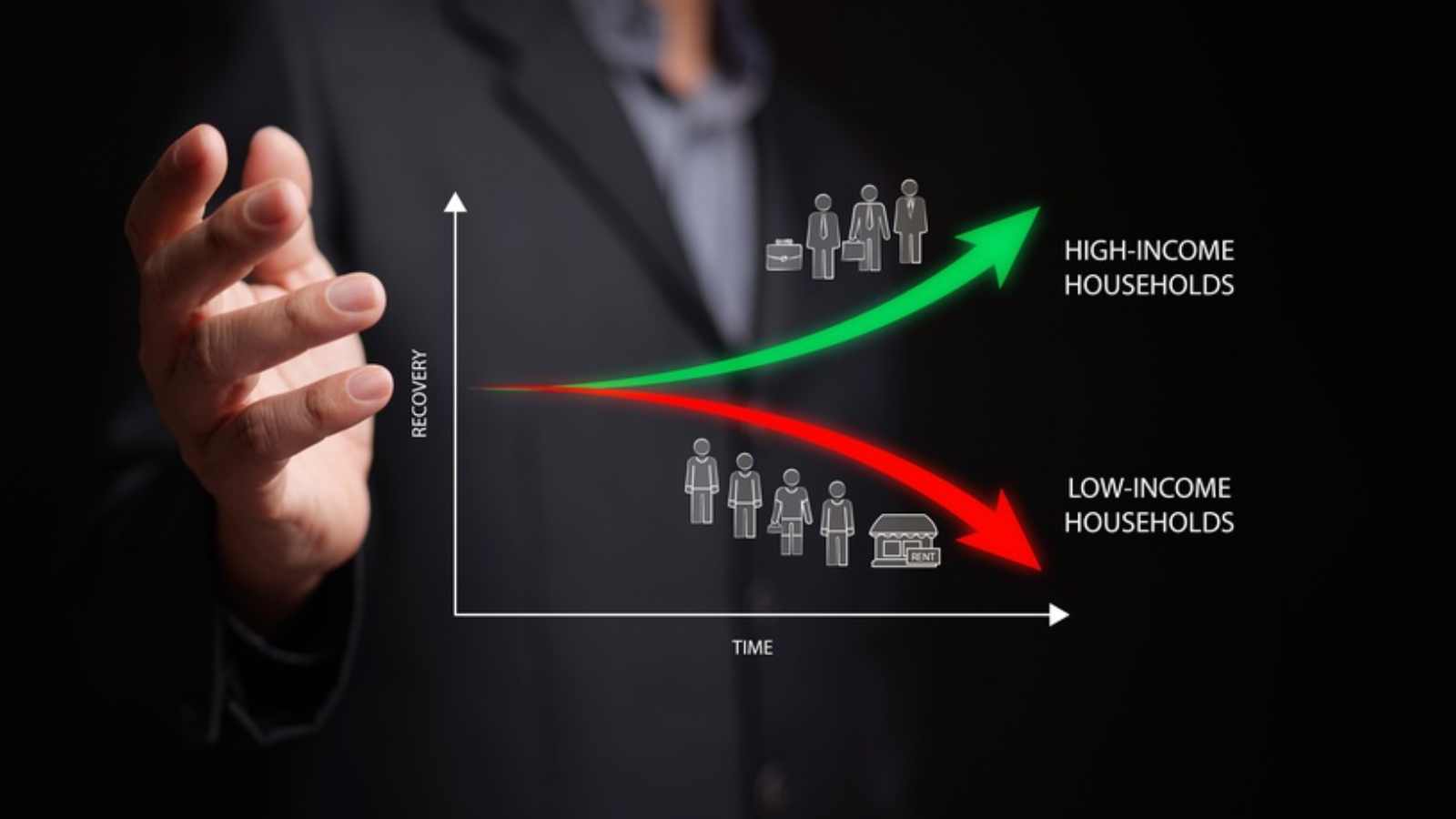
We are living through a K-Shaped reality that is baffling traditional models.
The GDP grew at a healthy clip in recent quarters, yet Consumer Sentiment remains at levels typically seen in the depths of a recession. This is rooted in the fact that while the economy (the data) is growing, the standard of living (the cost of being alive) is declining for many.
When the rate of return on capital (stocks/real estate) exceeds the rate of economic growth, inequality widens. This creates a political risk that analysts often ignore: populist movements that demand radical shifts in tax and trade policy.
The lag effect of the Inverted Yield Curve is simply longer due to the massive liquidity injected during 2020. Usually, the market wins that argument in the end.
The Risk Isn’t One Trigger

The 2026 downturn is likely to be a polycrisis, a term popularized by historian Adam Tooze. It is the interaction between a debt-heavy fiscal state, a geopolitical realignment, an aging demographic, and the disruptive but yet-to-be-productive AI transition.
Classical economics tells us that systems eventually return to equilibrium, but Complex Systems Theory suggests that when you push a system too far from its baseline, it may not return to equilibrium.
High rates grind against high debt, while liquidity losses make corporate refinancings impossible, all while the safety net is being pulled away. The different part of this downturn is the lack of a clear exit strategy.
We have used all our cheats (QE, stimulus, zero rates) to avoid the pain of the past. Now, we are facing an organic cycle that we have forgotten how to manage. The warning signs are clear, but the solution is nowhere to be found in the current playbook.
Key Takeaways
- Multiple economic pressures, rates, debt, liquidity and geopolitics, are converging at the same time rather than acting independently.
- Unlike past cycles, traditional shock absorbers such as rate cuts and fiscal stimulus appear more limited.
- High debt levels are amplifying the impact of rising interest rates across households, businesses, and governments.
- Key sectors such as housing and banking are not collapsing outright but are restricting movement and slowing the system from within.
- The next downturn may unfold differently, more prolonged, harder to stabilize, and lacking a clear or immediate recovery path.
Like our content? Be sure to follow us