8 Everyday Items Once Designed for Men, Now Seen as Feminine
A Pew Research survey found that 43% of adults say society is not accepting enough of men who take on roles typically associated with women. Similarly, 44% feel that society is not accepting enough of women who do the same. These societal expectations don’t just shape our behaviors; they influence the products we buy, the clothes we wear, and how we perceive everyday objects.
What might seem inherently “masculine” or “feminine” today often has a surprisingly different history. Here are eight everyday items that originated in the world of men before becoming staples of femininity.
High Heels

Today, high heels are the quintessential symbol of female footwear, but they started as a practical tool for men in battle. Google Arts & Culture states that in the 10th century, Persian cavalry soldiers wore heels to secure their feet in stirrups while riding horses. This provided the stability needed to stand and shoot arrows with greater accuracy.
By the 17th century, high heels had made their way to Europe, where male aristocrats adopted them as a status symbol. The extra height made them appear taller and more formidable. It wasn’t until later that women began wearing heels to make their feet appear smaller under long skirts. As heels became thinner and more decorative, men abandoned them, and the shoe became firmly associated with women’s fashion.
Handbags
Long before designer purses became a staple for women, men were the primary users of bags. In an era when clothes rarely had pockets, men carried small pouches, often attached to a belt, to hold coins and other personal items. These early bags were purely utilitarian.
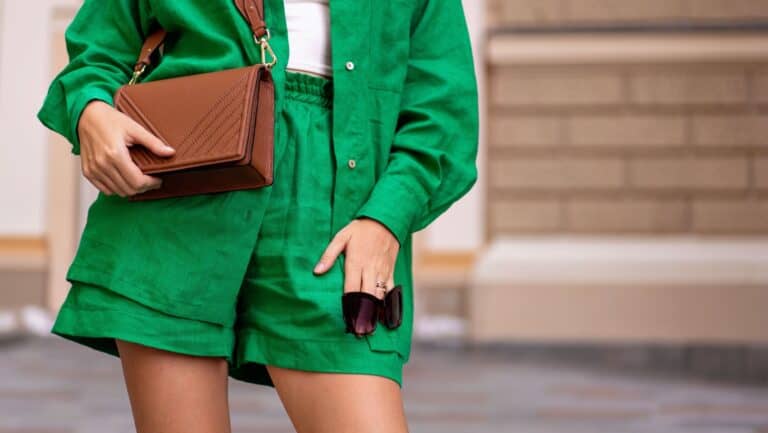
The modern women’s handbag emerged in the early 1900s, directly inspired by the handheld bags men carried. Designers adapted these bags, adding compartments and stylish fasteners to make them more functional and appealing to women. Over time, the handbag became a dominant female accessory, while men’s need for them diminished with the advent of pockets.
Thongs
The thong might seem like a modern invention, but its origins trace back to ancient loincloths worn by men. According to Racked, garments resembling thongs were used by men in Africa, Egypt, Greece, and Japan as early as 42,000 BC. Their purpose was to cover the gen*tals while leaving the butt*cks exposed, often for practical reasons related to climate or activity.
The modern thong for women gained prominence for very different reasons. It made its public debut at the 1939 New York World’s Fair whe mply with modesty standards while still performing. Later, the thong became popular as an underwear that eliminates visible panty lines.
Stockings

For centuries, stockings, also known as “hose,” were a standard part of a man’s wardrobe. Since at least the 9th century, men in Europe wore stockings for warmth and as a fashion statement. Wealthy men often sported white or brightly colored stockings to display their social standing, while commoners wore black.
Women only began wearing stockings in the 18th century. As men’s fashion shifted toward trousers, stockings became increasingly associated with women’s attire. By the 20th century, the transition was complete, and stockings became an exclusively female garment.
Disposable Menstrual Pads
One of the most surprising origin stories on this list belongs to the disposable menstrual pad. The absorbent material that made them possible was first developed with male soldiers in mind.
During World War I, nurses treating injured soldiers observed the effectiveness of a material called Cellucotton in absorbing blood. They began repurposing it for their own menstrual needs. After the war, the Kimberly-Clark company, seeing a new market, rebranded the material and began selling it as the first disposable menstrual pad, Kotex.
Bra Clasps
The simple hook-and-eye fastener, a key component of most modern bras, was invented by none other than author Mark Twain. However, he didn’t have lingerie in mind. Twain disliked the discomfort of suspenders and patented the fastener in 1871 as an “improvement in adjustable and detachable straps for garments,” intending for it to hold up men’s trousers.
While the hook and eye never caught on as a suspender alternative for men, it was quickly adapted for use in women’s clothing, including corsets and, eventually, bras, where it has remained a staple ever since.
Skinny Jeans

Skinny jeans are a recent fashion phenomenon, but their slim-fit style first gained popularity among men. In the mid-20th century, rock and roll musicians and rebels adopted tight-fitting jeans as a symbol of their countercultural movement. This look was decidedly masculine and edgy.
Over time, the style crossed over into women’s fashion. Levi Strauss & Co. introduced the first jeans for women in 1934, but it was much later that the ultra-slim silhouette became a mainstream trend. Today, skinny jeans are a wardrobe staple for women everywhere, having largely shed their rebellious, masculine origins.
The Color Pink
Perhaps the most famous example of a gender-norm reversal is the color pink. Until the mid-20th century, pink was considered a strong, masculine color—a lighter shade of the powerful color red. The University of Maryland reports that a 1918 article in Ladies’ Home Journal stated, “The generally accepted rule is pink for the boys, and blue for the girls. The reason is that pink, being a more decided and stronger color, is more suitable for the boy.”
It was common for boys to be dressed in pink, while blue, seen as a softer and more delicate color, was reserved for girls.
This association flipped after World War II. Advertisers and retailers began a concerted effort to market pink to girls. This campaign was so successful that by the 1980s, the color had become almost exclusively associated with femininity, from baby clothes to toys.
16 Best Jobs for Pregnant Women

16 Best Jobs for Pregnant Women
Pregnancy is a transformative and joyous period in a woman’s life, but it comes with unique challenges and demands. One of the most crucial aspects during this time is ensuring a healthy work-life balance.
Finding the right job during pregnancy is not just about earning an income; it’s about maintaining your health, well-being, and peace of mind.
Why Supersonic Flights Vanished From Our Skies

Why Supersonic Flights Vanished From Our Skies
Every year on August 19th, National Aviation Day celebrates the marvels of flight and the pioneers who made it possible. But as we look to the skies, one question lingers. If we could fly from New York to London in under three and a half hours back in the 1970s, why are we still taking nearly seven today? Supersonic travel was once a thrilling reality. So, what grounded it?