Why Christianity Has Thousands of Denominations if Christians Follow the Same Bible
Drive through almost any American town and you may pass a Catholic church, a Baptist church, a Methodist church, a Pentecostal church, and a Presbyterian church within a few miles of each other. All call themselves Christian. All look to Jesus. Most read essentially the same collection of New Testament books. Yet they may disagree about baptism, Communion, salvation, church leadership, predestination, saints, spiritual gifts, women in ministry, and even what should happen during a Sunday service.
Zoom out globally and Christianity becomes even more complicated. There are Catholics, Eastern Orthodox Christians, Oriental Orthodox Christians, Anglicans, Lutherans, Methodists, Baptists, Presbyterians, Pentecostals, Adventists, independent churches, and thousands of other Christian groups. So how did one religious movement produce so many different versions of Christianity?
The answer isn’t simply that Christians can’t agree on what the Bible says. Some of Christianity’s biggest divisions involved political power, geography, language, culture, church authority, and disagreements over who gets to decide what correct Christianity looks like in the first place.
And the divisions started much earlier than many people realize.
Christians Were Disagreeing From the Beginning
It’s easy to imagine the earliest Christians as one completely unified group that agreed on everything until churches began splitting centuries later. The New Testament itself tells a different story.
Early Christians argued about whether Gentile converts needed to be circumcised, which Jewish laws they should observe, what foods believers could eat, how spiritual gifts should be used, and other questions. Acts describes a major dispute over the requirements placed on Gentile converts, while Paul’s letters repeatedly address disagreements within Christian communities. Paul even describes confronting Peter over how he behaved toward Gentile Christians.
None of these groups were Baptist, Catholic, Methodist, or Presbyterian. Those labels wouldn’t exist for centuries. But Christianity was wrestling with disagreement almost from the beginning. The question was what Christians would do when those disagreements became impossible to contain.
The First Major Splits Weren’t Protestant Versus Catholic
Ask someone to name Christianity’s biggest historical split and they may immediately think of the Protestant Reformation. Christianity had already experienced major divisions long before Martin Luther was born.
Some of the earliest disputes centered on an enormous theological question: Who exactly was Jesus, and how should Christians understand his humanity and divinity?
Church councils attempted to settle those arguments. The Council of Nicaea in 325 famously addressed controversy over the relationship between the Father and the Son. Later councils confronted additional questions about the nature of Christ.
Not everyone accepted their conclusions. Disagreements surrounding the Council of Chalcedon in 451 contributed to lasting divisions between churches that accepted its definition and those that rejected it. Churches now grouped under the label Oriental Orthodox—including the Coptic Orthodox Church and Armenian Apostolic Church—developed separately from churches that accepted Chalcedon.
Christianity was therefore permanently divided more than 1,000 years before the Protestant Reformation.
Then Christianity’s Eastern and Western Churches Pulled Apart
For centuries, Christianity had major centers in both the Greek-speaking East and Latin-speaking West. Over time, the two worlds became increasingly different.
Language mattered. Greek dominated much of Eastern Christianity, while Latin became dominant in the West. Political circumstances differed. Worship developed differently. Theological disagreements accumulated.
One particularly important dispute involved the authority of the bishop of Rome—the pope. Western Christianity increasingly emphasized papal authority in ways Eastern church leaders did not accept. There were also theological disputes, including a famous disagreement over wording added to the Western version of the Nicene Creed concerning the procession of the Holy Spirit.
Tensions eventually exploded in 1054, a date traditionally associated with the Great Schism, when representatives of Rome and Constantinople exchanged excommunications. The split wasn’t really a single-day divorce. The separation developed over centuries and hardened afterward, particularly following events such as the Fourth Crusade’s sack of Constantinople in 1204.
Eventually, Western Christianity became centered on the Roman Catholic Church, while Eastern Orthodoxy continued through churches such as the Greek, Russian, Serbian, and other Orthodox traditions. Christianity now had another enormous family divide.
Then Martin Luther Challenged the Catholic Church
The next rupture transformed Christianity in Western Europe.
In 1517, Martin Luther publicly challenged practices and teachings associated with the Catholic Church, most famously through his Ninety-Five Theses and the controversy surrounding indulgences. Luther didn’t initially set out to create thousands of denominations.
But his conflict with church authorities escalated into something much larger. Luther challenged papal authority and emphasized scripture as Christianity’s highest authority, along with doctrines concerning salvation that became central to Protestant theology. Printing technology helped his ideas spread with extraordinary speed.
Other reformers soon emerged, and they didn’t always agree with Luther—or one another. That’s when the fragmentation accelerated.
Protestants Couldn’t Agree on What the Reformation Should Look Like
Once reformers rejected Rome as the final authority over Christian doctrine, another problem became unavoidable: Who would settle disagreements now?
Lutherans followed theological ideas associated with Luther. Reformed Christianity developed under figures including Huldrych Zwingli and John Calvin. Anabaptists rejected infant baptism and argued that baptism should follow a conscious profession of faith.
These weren’t minor disagreements. Reformers argued over Communion, baptism, predestination, church government, the relationship between church and state, and how particular biblical passages should be interpreted.
Luther and Zwingli famously disagreed about the Lord’s Supper. Both opposed aspects of Catholic teaching, but they couldn’t agree with each other about what Communion actually meant.
Breaking with one authority hadn’t produced one alternative Christianity. It produced several.
England Created Another Major Branch for Different Reasons
Not every Christian division began primarily with a theological argument.
England provides perhaps the most famous example.
King Henry VIII’s break with papal authority in the 16th century was deeply connected to his attempt to end his marriage to Catherine of Aragon after the pope refused to grant the annulment he wanted. Political authority, dynastic concerns, property, and theology subsequently became entangled in the English Reformation.
The Church of England eventually developed a distinctive identity containing both Protestant influences and many elements of older Christian tradition.
That Anglican tradition later spread around the world through the British Empire and developed additional branches of its own.
Once again, Christianity’s family tree became larger.
New Denominations Kept Emerging From Older Ones
The fragmentation didn’t stop with the Reformation.
Baptist movements developed in the early 17th century and emphasized believer’s baptism rather than infant baptism. Methodism emerged in the 18th century through the revival movement associated with John Wesley and others. Adventist movements arose in the 19th century. Modern Pentecostalism exploded in the early 20th century, emphasizing experiences associated with the Holy Spirit, including speaking in tongues.
Many of those traditions then divided internally.
Baptists formed different conventions and associations. Presbyterians split and reunited over theological and political disputes. Methodists experienced divisions over issues including slavery and, much later, sexuality and church teaching. Pentecostalism produced numerous denominations and independent networks.
A denomination could split over doctrine, geography, race, politics, worship, leadership, or social issues.
Sometimes the new groups eventually reunited.
Often they didn’t.
The Same Bible Doesn’t Necessarily Produce the Same Interpretation
This gets to the heart of the mystery.
If Christians are reading the same Bible, why don’t they reach the same conclusions?
Because reading the same words doesn’t guarantee interpreting them the same way.
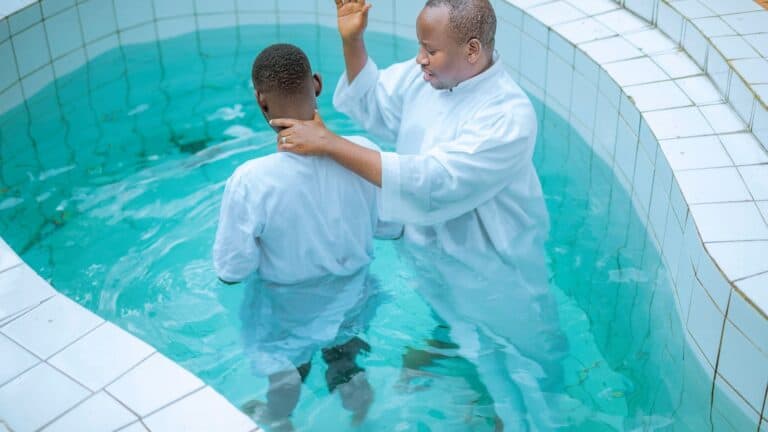
Consider baptism. Some Christians point to New Testament accounts of people believing and then being baptized and conclude that baptism should follow an individual’s profession of faith. Others emphasize household baptisms and connections between baptism and covenant theology to support baptizing infants.
The same problem appears with Communion. Christians can read Jesus saying, “This is my body” and reach very different conclusions about what those words mean.
Church government creates another divide. Should a church be led by bishops? Elders? Independent congregations? A hierarchical institution? Different Christians find biblical arguments for different systems.
Then there’s an even deeper disagreement: Is the Bible the sole infallible authority for Christian doctrine, or should scripture be interpreted within an authoritative church tradition?
Catholic and Orthodox Christians do not approach that question in precisely the same way many Protestants do.
Christians therefore aren’t merely disagreeing about what individual Bible verses mean. They can disagree about the rules for deciding what they mean.
Politics and Culture Have Divided Christians Too
Not every denomination exists because somebody discovered a new interpretation of scripture.
History matters.
Christian churches have divided over nationalism, ethnicity, language, colonialism, slavery, segregation, political authority, and regional identity. Some divisions that eventually looked theological began partly because Christians lived in different political and cultural worlds.
American Christianity provides especially striking examples. Several major denominations divided in the 19th century over slavery. Churches were also shaped by racial segregation, immigration, regional differences, and changing attitudes toward social issues.
In other words, Christians didn’t build their churches outside history.
They built them inside it.
The same forces that divide nations, communities, and families have sometimes divided churches as well.
Even “Nondenominational” Churches Usually Come From Somewhere
The rise of nondenominational Christianity can make the denominational picture even more confusing.
A church may have no denominational name on the sign and no formal connection to a traditional denomination. That doesn’t mean it has no theological tradition.
Many nondenominational churches hold beliefs historically associated with particular forms of evangelical Protestantism. Their positions on baptism, biblical authority, salvation, Communion, spiritual gifts, or church leadership often resemble traditions that already existed.
The label “nondenominational” usually describes institutional independence more than an absence of theological inheritance.
Even a church that says, “We just follow the Bible,” still has to interpret the Bible.
And interpretation inevitably raises the same questions Christians have been arguing about for centuries.
Are There Really Tens of Thousands of Christian Denominations?
You’ve probably seen claims that Christianity has 30,000, 40,000, or even more denominations.
Those numbers need context.
Large statistical counts often classify separate church organizations in different countries as distinct denominations, even when they belong to closely related traditions. Depending on the methodology, the number can therefore sound as though Christianity contains tens of thousands of completely different belief systems.
It doesn’t.
Christianity is better understood as a huge family tree containing several major traditions, many denominational families, national churches, independent organizations, and countless smaller branches.
The fragmentation is real.
But the raw number can exaggerate just how theologically different all those groups actually are.
One Bible, Many Christianities
So why are there so many Christian denominations? Because Christianity has had nearly 2,000 years to argue.
Christians have disagreed about theology, authority, worship, sacraments, politics, leadership, biblical interpretation, and social questions. Empires have risen and fallen around them. Languages and cultures have separated communities. Reform movements have challenged established churches, only to develop disagreements of their own.
And every time a disagreement becomes serious enough, one possible solution is to start another church. Yet the divisions tell only part of the story.
Despite enormous differences, most major Christian traditions continue to share a recognizable core centered on Jesus, the Bible, baptism, prayer, worship, and beliefs inherited from the earliest centuries of Christianity.
Perhaps that’s the strangest part of Christianity’s family tree. Its branches have been growing apart for almost 2,000 years. They can still trace themselves back to the same roots.
Reader question: If Christians have disagreed for nearly 2,000 years, which disagreement do you think has had the biggest impact on Christianity as we know it today?
You may want to read:
- New ICE Facility for Migrant Children Raises Alarm Over Trafficking Risks
- 10 Questions About the Bible Scholars Still Don’t Have Clear Answers To
- 10 Things Early Christians Believed That Might Surprise Christians Today