12 “girl code” rules women disagree on in shared living
Shared living has a way of exposing beliefs people didn’t even know they held. Girl code isn’t a fixed set of rules but a collection of assumptions shaped by upbringing, financial independence, personality, and sometimes quiet power struggles over space and control.
The idea suggests an unspoken agreement: that women, by default, will align on boundaries, cleanliness, emotional labor, and respect. But in practice, those expectations rarely match.
SmartAsset reports that sharing an apartment in major U.S. cities saves renters about $541 per month, making roommates less of a choice and more of a financial necessity. When living together is driven by cost rather than compatibility, the pressure to get along increases, even as the definitions of respect and responsibility quietly diverge.
Disagreements happen because there was never a single version of it to begin with. That’s where shared living becomes less about rules and more about negotiation: not just over chores or guests, but over whose standards shape the space, whose boundaries hold, and whose version of normal wins when they don’t match.
Always ask before inviting someone over

The majority of roommates consider unannounced guests the primary catalyst for lease-breaking arguments. While one camp views the home as a sanctuary where every external entry requires a clearance text, another sees the permission-seeking model as an infantile regression that strips away adult autonomy.
Humans use territorial markers (such as bedroom doors or specific seats at a table) to regulate social interactions and maintain a sense of psychological security. For many women, an unasked guest is a literal breach of that safety.
Conversely, sociologists often point to low-density social styles where the open-door policy is a hallmark of community building rather than a lack of respect. The friction arises when a sanctuary seeker cohabitates with a social connector, as the latter may find a 24-hour notice rule for a coffee guest to be an exhausting bureaucratic hurdle.
Sharing food vs. strict ownership

People feel a psychological ownership over goods they have personally selected, which explains why a roommate eating your specific brand of Greek yogurt feels like a personal violation.
In contrast, “Help Yourself” cultures often stem from large-family dynamics in which food is a shared resource, viewed through the lens of what Lewis Hyde calls The Gift: a cycle of giving that sustains relationships.
However, when the 15% average increase in grocery costs seen in recent years hits a household, the gift economy often collapses into resentment.
Only a tiny fraction of roommates (8%) care if they share the same diet (Vegan, Halal, etc.), which reinforces the strict ownership. Becuse 92% of roommates don’t share a diet, the fridge becomes a collection of individual private properties rather than a communal pantry.
How clean is “clean enough”
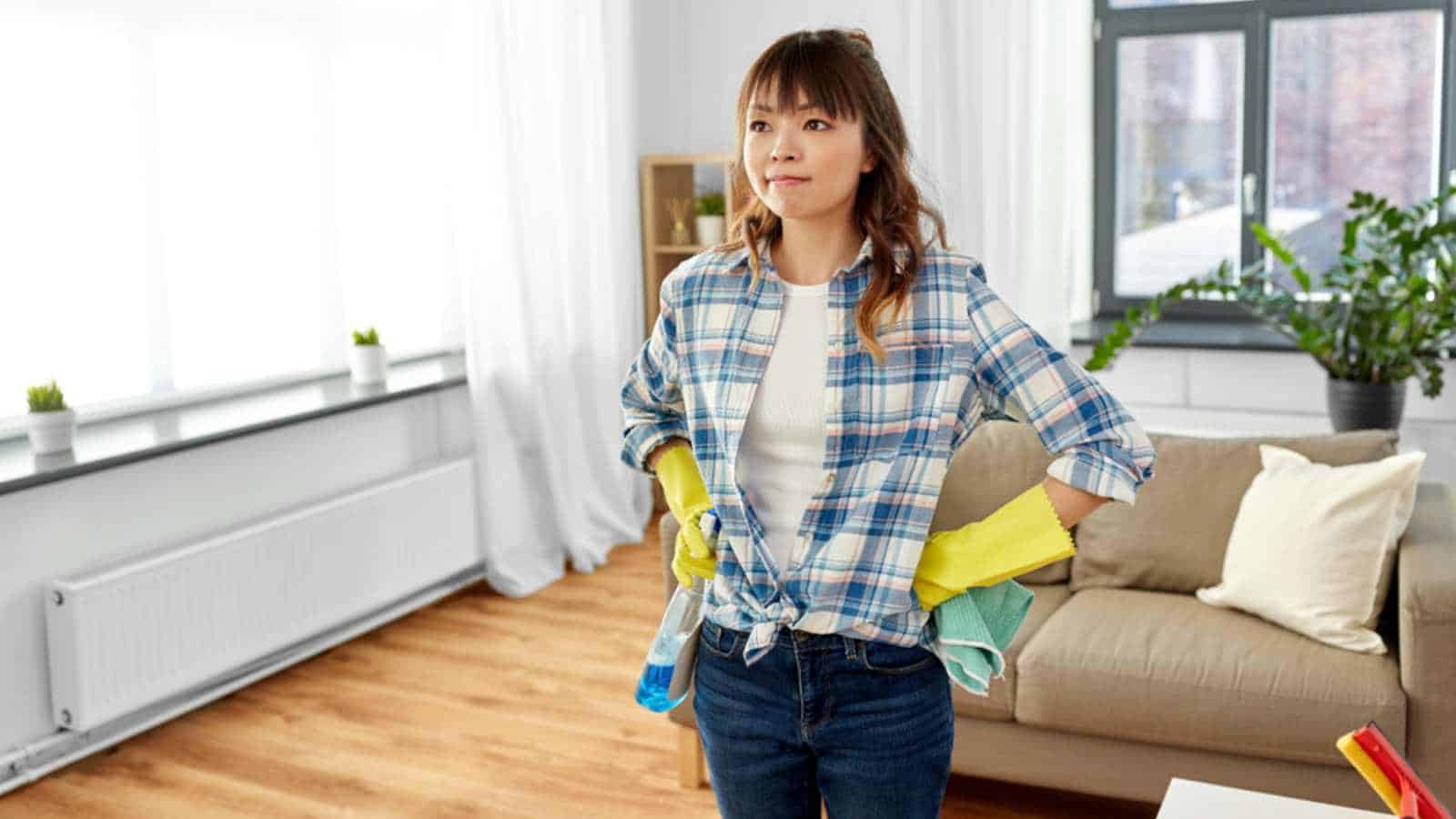
Differences in disgust sensitivity, a psychological trait studied by Dr. Val Curtis, dictate whether a dish in the sink is a minor detail or a biological hazard.
For the roommate who prefers daily maintenance, cleanliness is a moral imperative that reflects mental clarity; for the weekly reset group, cleaning is a functional task best batched for efficiency. The clutter threshold varies widely between individuals, leading to situations in which one roommate feels they are doing all the work, while the other literally does not see the mess.
Women spend roughly 2.8 hours a week on unpaid labor globally, and it’s usually domestic work. But when perceptions of cleanliness differ, that time investment rarely leads to mutual satisfaction, often resulting in chore wars where both parties feel victimized by the other’s standards.
Boyfriends/partners staying over

A partner staying over more than 3 nights a week increases utility consumption, since the average person uses 80-100 gallons of water per day. A guest staying three nights a week, taking long showers, and using the toilet adds approximately 240–300 gallons of water per week to the household.
The New York Times recently highlighted the rise of cohabitation agreements among platonic roommates to cap guest nights, as the presence of a partner shifts the domestic power dynamic and reduces the primary tenant’s comfort level with bra-offs.
A partner might be viewed as an extension of their personal life and should be welcomed freely, but legal experts often warn that squatters’ rights can inadvertently kick in if a guest receives mail or stays for 14 consecutive days. This conflict is less about the person and more about the invisible depletion of space and resources without financial compensation.
Splitting bills evenly vs. proportionally

While 50.5% of roommates prefer a straight 50/50 split for simplicity, a growing movement toward usage-based fairness is complicating the math. The argument for proportional splitting often surfaces when one roommate works from home, utilizing 40 hours of high-speed internet and climate control that a commuter does not.
Even splits generate the least conflict unless there is a significant income disparity or usage gap. For example, a roommate with a master bedroom and ensuite might pay 20% more, a calculation supported by the Square Footage Method used in professional property management.
Tension builds when people who prefer splitting everything evenly feel like calculating every little expense takes the warmth out of living together, while those who want things divided based on use feel like they’re quietly paying for someone else’s way of life.
Decorating shared spaces

The clash between a less-is-more look and a room full of personality is actually a struggle for mental comfort. Our physical surroundings directly impact our mood and productivity.
If one roommate takes over the living room with their own style, like a stark, minimal vibe, the other might feel like a guest in their own home, unable to hang photos or add items that make them feel settled.
This often turns into a battle of who cares more or who spent more; the roommate who drops $2,000 on a sofa often feels they’ve bought the right to veto any art they don’t like.
However, visual balance is essential for peace. It might result in a mismatched, crowded mess that isn’t perfect for anyone, but it ensures no one feels pushed out of their own four walls.
Borrowing clothes without asking

The average woman owns approximately 90-100 pieces of clothing, but wears only about 10–12% of them regularly. In The Psychology of Fashion, Karen Pine discusses how clothing is an extension of the self; thus, unauthorized borrowing is identity theft.
This is particularly sensitive with high-value items; Gen Z and Millennial women are increasingly investing in investment pieces meant for resale on platforms like Depop. A single wine stain or a stretched hem doesn’t just ruin a night out; it devalues a financial asset.
Conversely, it maximizes the utility of a wardrobe and fosters a shared identity bond. The conflict is often generational or class-based, with those who view clothes as disposable fast fashion unable to understand the protective instincts of those who save for months for a single designer blazer.
Noise levels and quiet hours

When one roommate’s winding down (watching Netflix at 11 PM) coincides with another’s REM cycle, the result is more than just annoyance; it is a health issue.
Soundproofing in modern apartments is notoriously poor, often failing to meet the STC (Sound Transmission Class) rating of 50 required for true privacy. Statistics from the World Health Organization suggest that environmental noise above 45 decibels at night can increase cortisol levels. Moreover, too much noise in a child’s early years can disrupt how they learn and grow, and the effects can follow them for life, shaping both their education and overall health.
This creates a rift: the social roommate feels policed in their own home, while the working roommate feels their professional performance is being sabotaged by a lack of basic silence.
Emotional support expectations

There is a sharp divide between those who seek a family-like environment and those who want a functional co-tenant.
SpareRoom found that 40% of people want to be friends with their roommates, but the remaining 60% prioritize quiet and clean over cocktails and venting.
Sociologist Arlie Hochschild defined emotional labor as the effort to maintain others’ well-being, and in a shared house, one roommate may feel drained by the one who expects 2-hour debriefs after every bad date.
Those on the privacy side see the home as a place to recharge alone, while connection seekers view a roommate’s silence as coldness or passive-aggression.
Addressing issues directly vs. avoiding tension

Communication styles usually fall into two camps: those who say exactly what they mean and those who drop hints to be polite.
People who prioritize logic often prefer a blunt text about taking out the trash, while those who are more sensitive might find that same message cold or aggressive. This is how sticky note wars begin.
Studies have shown that being passive-aggressive is the fastest way to burn out an intimate connection, yet many women are taught from a young age to avoid direct conflict just to keep things pleasant.
The person who likes to be direct views a face-to-face talk as the quickest way to fix a problem, while the person who avoids tension sees it as an attack. They’d rather use subtle cues that the other person usually misses entirely, letting frustration build until someone snaps.
Guests using shared resources

Being a good host has its limits, especially when a guest drinks the last of the expensive milk or hogs the only shower for 40 minutes during the morning rush.
Some people believe that being a good friend means giving guests total freedom of the house, while others believe that the resources should be reserved for the people actually paying the bills.
In crowded cities like New York or London, where space is tight, the physical presence of an extra person is felt much more deeply.
If a guest is using the kitchen to cook a big meal, they are effectively blocking the roommate who pays $1,200 a month for that access.
It’s a conflict between wanting to be socially generous and the harsh reality of living on a budget where every square foot and every grocery item is accounted for.
Chore systems vs. “just do it when needed”

Assigning chores is a polarizing move. For some, a list on the fridge is the only way to make sure the workload is split fairly so no one gets stuck doing everything. For others, a chart feels like living in a college dorm or a strict barracks.
Even in all-female households, the mental load, the stress of tracking when to buy toilet paper or when the trash goes out, usually falls on just one person. The roommate who prefers to be flexible thinks “just do it when it’s dirty” is a fine plan, but that only works if everyone notices the mess at the same time.
Usually, the person who is more bothered by dirt ends up doing most of the work. This creates a loop of quiet resentment that a simple, structured system could have prevented before it even started.
Key Takeaways

- There’s no universal girl code in shared living. What people assume is standard is often just personal preference shaped by upbringing and lifestyle.
- Most conflicts stem from unspoken expectations colliding, especially around cleanliness, guests, money, and shared space.
- Financial pressure has made roommates a necessity rather than a choice, raising the stakes of everyday disagreements.
- Many so-called rules (like sharing food, emotional closeness, or quiet hours) are interpreted differently, leading to friction even among otherwise compatible people.
- Successful shared living depends less on assumed alignment and more on clear communication, negotiated boundaries, and mutual flexibility.
Disclaimer – This list is solely the author’s opinion based on research and publicly available information. It is not intended to be professional advice.
Like our content? Be sure to follow us