The Unequal Divide of Household Labor
According to the American Time Use Survey, from 2003 to 2023, the gap in unpaid domestic labor has narrowed, albeit slowly and unevenly. Women’s total housework time decreased by about an hour per week, while men’s increased by about two hours per week, largely in traditionally “feminine” areas such as cooking, cleaning, and laundry.
Shopping is near gender parity, and fathers are spending more time on childcare than at any point in the past 60 years. Yet, women continue to shoulder the majority of core routine tasks, from cooking and cleaning to laundry, while men do more flexible, occasional chores. The bottom line: A gender revolution in housework has upended norms, but true balance at home remains elusive.
Why Household Equality Is Strong in the Nordic Countries

Official Nordic Co-operation, the Nordic region’s intergovernmental agency, puts it plainly: these nations score the highest on the Global Gender Gap Index. Legislation such as shared parental leave and “use-it-or-lose-it” paternity leave (in many countries, fathers are allocated several weeks that they can claim) demonstrates that housework is not a woman’s job. Representation at the top is also better: Nordic women occupy nearly half of all seats on corporate boards, higher than the EU average (Norden.org).
However, even in this so-called ideal system, some problems persist. The gender pay gap has not been eliminated, and women are underrepresented among CEOs. Surveys indicate that in Nordic homes, women perform more daily tasks than men, even if the imbalance is less pronounced than in other countries. As the Nordic Co-operation itself points out, the region is at the forefront of progress; however, even in these countries, policy has not yet been able to undo old habits or ways of thinking completely.
From Homemaker to Double Shift: A Century of Change
Using India as a case study, due to its deep cultural roots in gender roles and its reflection of wider global struggles, we can see how women’s domestic responsibilities persist even as education and employment opportunities expand. Despite progress in workforce participation, Indian women continue to bear the bulk of household labor.
The 2019 Time Use Survey found that women spend over 5 hours per day on unpaid care and domestic work, compared to just 1.5 hours for men. This imbalance means that when women take on paid employment, they rarely escape the home workload — instead, they inherit a “double shift.” India’s story illustrates how economic gains and cultural norms don’t always evolve together, and why household labor remains one of the hardest barriers to equality worldwide.
Why Women Still Do More — Even When They Earn More

Pew Research data finds that even in couples with near-equal earnings, the share of caregiving and housework still tilts heavily toward women. Marriages where wives are the primary earners often result in women doing more domestic chores and having less leisure time than their spouses.
This suggests that a shift in economic power does not necessarily translate to a corresponding shift in domestic responsibility. The cultural expectations, social norms, and underlying gender assumptions can continue to be powerful drivers of action.
It also highlights a subtle yet important “leisure gap,” in which husbands in egalitarian arrangements spend more hours on leisure activities, while wives, even when earning equally, often end up absorbing a greater share of the “invisible” burden at home.
Pay Gap Follows Women Into The Kitchen
The problem begins with the fact that most women never even get the highest-paying jobs to begin with, in part because of stereotypes and structural sexism. Male-dominated industries continue to gatekeep positions of power, while “women’s work” in fields like caregiving, education, and administration is devalued and underpaid.
The cycle is vicious: women get paid less because they are prevented from having the same career opportunities, and then they are expected to do more housework as a result of those lower wages.
The Price Tag for Free Domestic Labor
Domestic work sustains families and households worldwide. Cooking, cleaning, childcare, and the myriad “invisible” tasks of daily life take a form of labor that rarely registers as a paycheck or in GDP tallies. However, the bill for that free work is comparable to entire economies, according to economists.
According to UN Women, the value of unpaid care work could be equivalent to 10% to 40% of a country’s GDP if it were to be priced. In the United States, that value would exceed $1.5 trillion a year.
Read Further: 12 Energy and Time Saving Kitchen Hacks for Effortless Cooking
Gender Conditioning Begins in Childhood
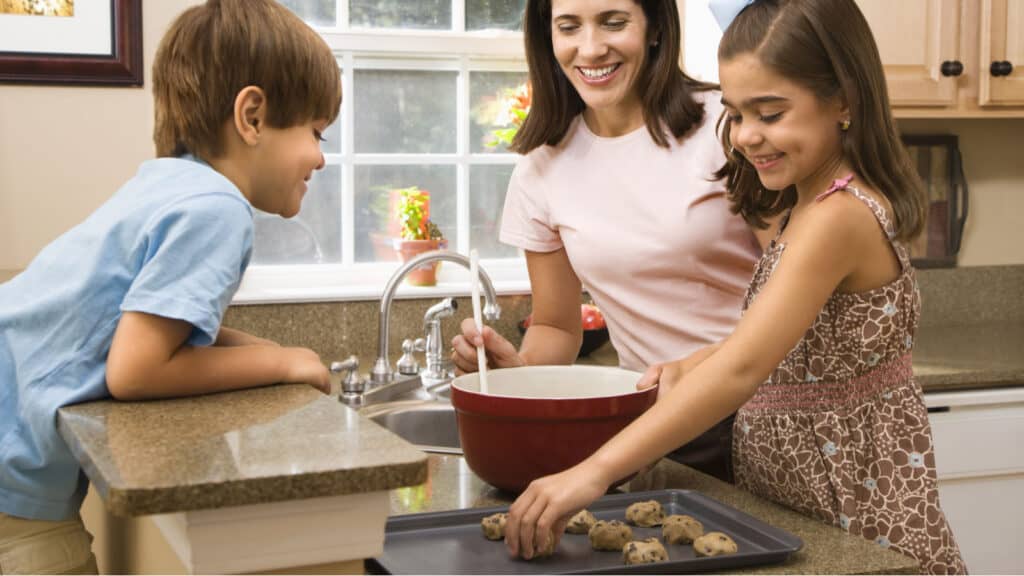
The origins of domestic inequality are sown well before adulthood. Developmental studies (Martin & Ruble, “Patterns of Gender Development”) have found that children as young as 18 to 24 months old can identify themselves as “boy” or “girl,” and they begin to make crude associations (such as tools being for boys and dolls for girls).
Children’s toy preferences and choice of playmates around the ages of 2–3 often already reflect these primordial associations, before they even fully grasp the concept of gender roles.
Why Robots Won’t Save Women from Housework Yet
Ads for new cleaning technology often promise that robot vacuums, dishwashers, or “smart” kitchen appliances will soon save families from the drudgery of housework. As with so much of “technology,” it can only take us so far. Robots can vacuum floors, but they can’t sort laundry, or notice when we’re running low on toilet paper, or rock the baby back to sleep at 3 AM. Most of what we think of as “housework” involves mental or emotional labor, such as organizing, planning, remembering, and anticipating.
Automation often creates new burdens, as machines also require setup, maintenance, and management—and studies suggest that women continue to disproportionately bear this “second shift” of technical labor. Robotic appliances are also still prohibitively expensive for many families, especially more advanced domestic robots.
Housework as a Measure of Relationship Equity
Who does the chores says a lot about how equal a relationship really is. When both partners share cooking, cleaning, and daily responsibilities, couples tend to feel more satisfied and connected. But when one person feels they’re doing most of the work, resentment often builds—sometimes quietly, sometimes openly.
Even intimacy can suffer when the balance feels unfair. A large study of over 10,000 couples confirmed this: people who felt overburdened by housework reported lower relationship satisfaction and less frequent sex.
Imagining a Truly Equal Household
The idea of a perfectly equal household is more aspiration than reality. Even in societies with strong equality laws, most homes still reflect old habits: women take on more of the invisible work, while men are often praised for doing the basics. Equality at home is challenging because it involves unlearning generations of conditioning and redefining what “fairness” means on a daily basis.
But imagining an equal household is still useful. It forces us to question why the burden continues to fall unevenly and what small steps can shift the balance. Research indicates that couples who share responsibilities more evenly tend to argue less and feel more satisfied in their relationships. That doesn’t mean equality will ever look perfect or symmetrical, but it does mean progress is possible. A truly equal household may never exist in its entirety, but moving closer to it matters—for fairness, intimacy, and freedom.
Why investing for retirement is so important for women (and how to do it)

Why investing for retirement is so important for women (and how to do it)
Retirement planning can be challenging, especially for women who face unique obstacles such as the wage gap, caregiving responsibilities, and a longer life expectancy. It’s essential for women to educate themselves on financial literacy and overcome the investing gap to achieve a comfortable and secure retirement. So, let’s talk about why investing for retirement is important for women and how to start on this journey towards financial freedom.
Science Tells Us What To Expect As We Age: Strategies for Thriving in Later Life

Science Tells Us What To Expect As We Age: Strategies for Thriving in Later Life
How does aging affect our bodies and minds, and how can we adapt to those differences? These are questions that pertain to us all. Aging gradually alters people over decades, a long period shaped by individuals’ economic and social circumstances, their behaviors, their neighborhoods, and other factors. Also, while people experience common physiological issues in later life, they don’t follow a well-charted, developmentally predetermined path. Let’s take a look at what science has told us to expect.