12 reasons Christians and Muslims view the Virgin Mary differently
Most of us think we know who the Virgin Mary is, but it depends a lot on whether you grew up hearing her story in a church or a mosque.
The Virgin Mary stands as a bridge between two of the world’s largest faiths, yet the paths diverge sharply when you look at the details of her life and purpose. While both traditions revere her as a holy woman chosen by the Divine, the theological implications of her role create a fascinating study in contrast that shapes how billions of believers pray and live. Christians generally see her as the Mother of God, instrumental in salvation history, while Muslims honor her as a righteous, devout woman who gave birth to a great prophet.
Getting into these differences reveals much more than just doctrinal disagreements; it highlights how history, culture, and scripture have painted two distinct portraits of the same woman. For an American reader, understanding these nuances offers a fresh perspective on neighbors and global communities alike, moving beyond simple assumptions to real understanding.
The Title Mother Of God Versus Mother Of Jesus
Christians often bestow the title Theotokos or “God-bearer” upon Mary, emphasizing that she carried the divine person of Jesus Christ in her womb. This title was ratified early in church history to protect the belief that Jesus was fully God and fully man from the very moment of his conception. For many believers, this title is the highest honor a human could ever receive and places her above all other saints.
Islam explicitly rejects this title because the concept of God having a mother implies a physical lineage or divinity that contradicts the strict oneness of Allah. Muslims view Jesus as a mighty prophet created by God’s word, but not as God incarnate, which fundamentally changes how they address his mother. Consequently, while she is the most respected woman in Islam, calling her the “Mother of God” would be considered a serious theological error known as shirk.
The Story Of The Virgin Birth
The Bible describes the birth of Jesus taking place in a stable or cave in Bethlehem, surrounded by animals and visited by shepherds. Joseph is a central figure in this narrative, acting as the protector and provider who frantically seeks a place for his expectant wife in a crowded town. This familiar nativity scene is reenacted in millions of homes and churches every Christmas as a symbol of humility.
The Quranic account offers a starkly different setting, describing Mary withdrawing to a remote eastern place to give birth alone beneath a date palm tree. In her pain and solitude, God provides a stream of water and fresh dates to comfort her, underscoring her personal reliance on the Divine in the absence of Joseph’s presence. Mary is mentioned by name 34 times in the Quran, which is actually more often than she appears in the New Testament.
Her Marriage To Joseph
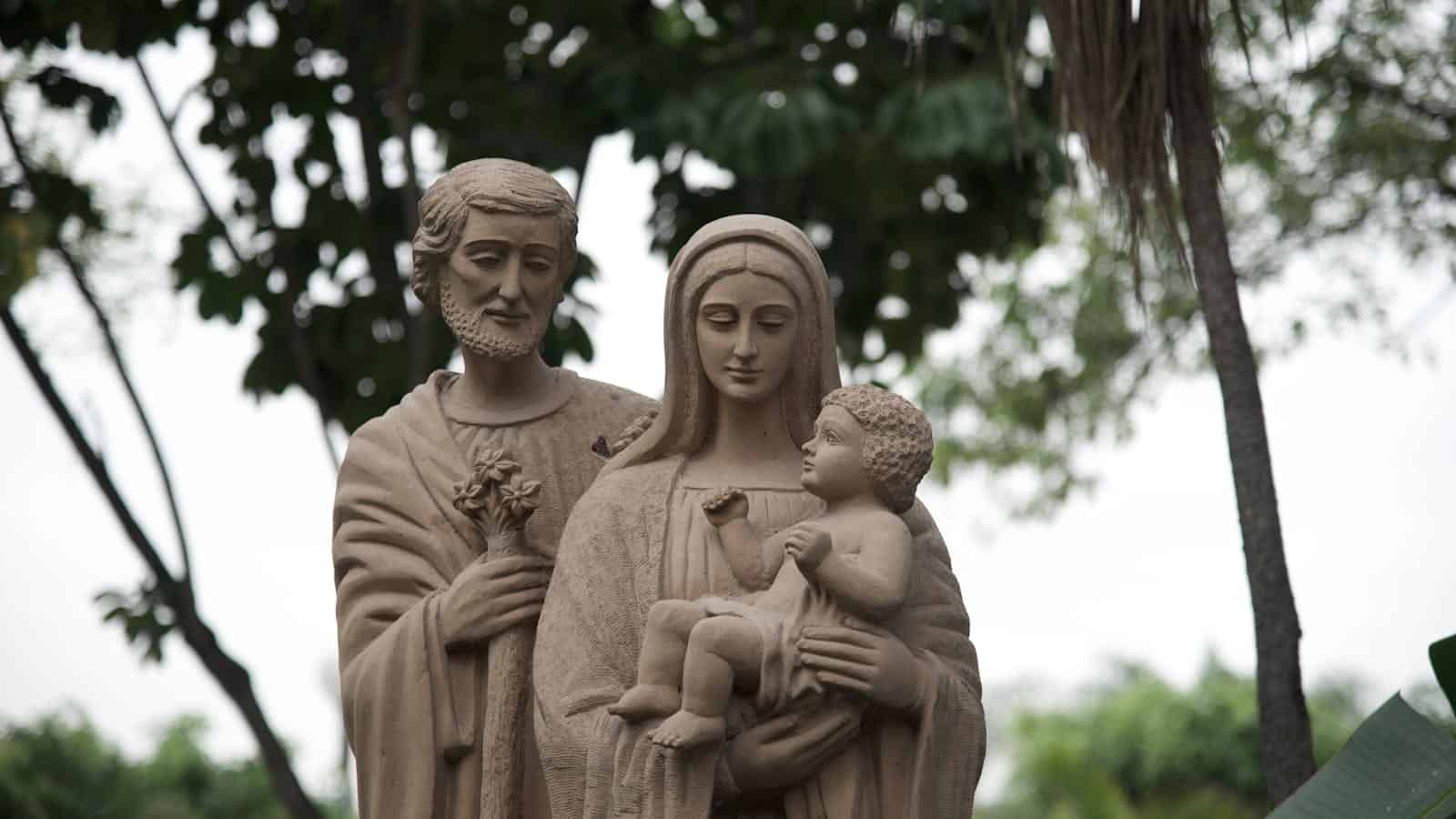
For most Christians, the marriage between Mary and Joseph is a vital part of the story, providing a legal lineage for Jesus through the house of David. Joseph is venerated as a saint who played a crucial fatherly role, guiding the Holy Family to Egypt and raising Jesus with quiet strength. Their union is seen as a model for holy family life and the sanctity of marriage.
Islamic tradition generally holds that Mary was not married to Joseph or anyone else, as she had been dedicated to the temple service from a young age. The idea of her being betrothed or married confuses the narrative of her total consecration to God and her status as a chaste woman who had no man touch her. Because of this, Joseph barely features in Islamic retellings of the birth of Jesus, keeping the focus entirely on Mary and the miracle.
The Nature Of Her Son
The Christian view of Mary is inextricably including her role as the ark that carried the Savior of the World. Her importance flows directly from the divinity of her son; she is honored because she said “yes” to bringing God into the physical world. This connection means that in Christian theology, you cannot fully understand Jesus without appreciating the woman who gave him his human nature.
Muslims revere Jesus, or Isa, as a prophet of the highest order, but they strictly deny his divinity and sonship to God. This shifts Mary’s role from being the mother of a deity to being the mother of a great messenger, similar to the mother of Moses, but with a miraculous conception. With about 2 billion Muslims globally, this perspective represents a massive portion of the world that honors her specifically as a model of faith rather than a divine vessel.
Role In Salvation
In many Christian denominations, especially Catholicism and Orthodoxy, Mary plays an active role in the story of redemption as the “New Eve” who undoes the disobedience of the first Eve. Her cooperation with God’s plan is seen as essential, leading some to call her a co-worker in salvation, though Christ remains the sole redeemer. This theology leads to deep devotion, with millions asking for her help in their spiritual struggles.
Islam views salvation as a direct matter between the individual and Allah, based on faith and good deeds, without the need for an intermediary like Mary. She is a sign of God’s power and a paragon of virtue, but she does not save anyone or mediate forgiveness. She serves as a powerful inspiration for submission to God’s will, yet holds no authority to alter a person’s eternal fate.
The Crucifixion Experience

Christian art often depicts the Stabat Mater, the sorrowful mother standing at the foot of the cross watching her son die. This moment is crucial for Christian empathy, as it shows Mary sharing in the intense suffering of Jesus, piercing her own soul as prophesied. Her presence at the crucifixion makes her a comforting figure for mothers who have lost children.
Since Islam teaches that Jesus was not crucified but was raised to heaven by Allah before death, Mary would not have watched her son die on a cross. This fundamental difference in the narrative removes the “sorrowful mother” aspect that is so central to Catholic piety and iconography. Instead, the Islamic narrative focuses on her triumph over the social stigma of her miraculous pregnancy.
You may want to read more here: Why Muslims believe Jesus was not crucified
Original Sin And The Immaculate Conception
The Catholic Church teaches the dogma of the Immaculate Conception, which states that Mary was conceived without original sin to be a fitting vessel for Christ. This grace kept her free from the stain of sin that affects all other humans from the moment of their existence. Pew Research statistics indicate that about 47% of U.S. adults have a personal connection to Catholicism, making this doctrine a familiar concept to many Americans.
Muslims do not believe in the concept of original sin; they believe every child is born pure and sinless upon their fitra or natural disposition. Therefore, there is no need for a special doctrine like the Immaculate Conception to protect Mary from a sin she wouldn’t have inherited anyway. However, Islamic tradition does record a hadith stating that Mary and Jesus were the only two humans not touched by Satan at birth.
Intercession And Prayer
For Catholics and Orthodox Christians, praying to Mary is a daily practice, asking her to intercede with her son on their behalf. The “Hail Mary” is one of the most repeated prayers in history, reflecting a belief that she has a special hearing ear with Jesus. A recent Zenit report noted that a record 12.8 million pilgrims visited the Basilica of Our Lady of Guadalupe in December 2025, highlighting the scale of this devotion.
Muslims may greet Mary with peace, but they strictly forbid praying to her or asking her for favors, as prayer is reserved solely for Allah. Asking a deceased human, no matter how holy, for help is seen as crossing a line into polytheism or idol worship. They show their love for her by following her example of modesty and prayerfulness rather than by petitioning her.
Statues And Visual Depictions
Visit a Catholic or Orthodox church, and you will likely see statues, icons, and paintings of the Virgin Mary holding the infant Jesus. These images serve as focal points for devotion, teaching tools, and reminders of her loving presence in the church. Processions carrying her statue are common in many cultures, serving as a vibrant public declaration of faith.
Islam is generally aniconic, meaning it avoids visual depictions of holy figures to prevent idolatry. You will not find statues or paintings of Maryam in a mosque, nor will you see Muslims wearing medals with her likeness. The absence of imagery is meant to keep the believer’s heart focused on the invisible Creator rather than the created form.
Liturgical Feasts And Celebrations
The Christian calendar is dotted with feast days dedicated to Mary, such as the Annunciation, the Assumption, and her Birthday. These days are often holy days of obligation for Catholics, requiring attendance at Mass and special celebrations. These rhythms of the year help believers keep her example at the forefront of their spiritual lives.
While Islam honors Mary, there are no specific feast days or festivals on the calendar dedicated to her worship or remembrance. Her story is recited from the Quran, and she is mentioned with reverence in sermons, but there is no “Feast of Maryam.” Interestingly, she is the only woman mentioned by name in the Quran, and the 19th chapter, Surah Maryam, is named entirely after her.
Her Final Destiny
Catholicism teaches the Assumption, the belief that Mary was taken up body and soul into heaven at the end of her earthly life. This dogma asserts that her body did not suffer decay, mirroring the resurrection of her son. This belief reinforces the hope that all believers will one day be resurrected and glorified.
Islam has no unified consensus or dogmatic teaching on the end of Mary’s life, though most scholars assume she died a natural death. Her body is believed to be buried on earth, awaiting the general resurrection on the Day of Judgment, like all other humans. The focus remains on her earthly life of obedience rather than a miraculous departure from the world.
The Concept Of Validated Apparitions
Many Christians, particularly Catholics, believe that Mary continues to visit the earth through apparitions at places like Lourdes, Fatima, and Guadalupe. The Church investigates these events and often approves them as worthy of belief, leading to massive shrines and healing miracles. These sites become major centers of tourism and spiritual renewal for millions of people annually.
Islam does not typically recognize these Marian apparitions and views them with skepticism or as potential deceptions. While Muslims believe in the unseen world of jinn and angels, the idea of Mary returning to deliver messages does not fit standard Islamic theology. Consequently, a Muslim would likely respect the devotion of pilgrims but would not attribute the vision to the actual Maryam.
You may be interested in reading:
- What we often get wrong about Muslim American women
- 12 fascinating facts about Mary, the mother of Jesus
- 10 similarities between Islam and Christianity