12 ways America’s bottom 60% are being shut out of a decent life
America keeps telling people the economy is strong, but a lot of households are living inside a very different story. The stock market can rise, GDP can look respectable, and unemployment numbers can sound tidy on the evening news, yet millions of people still look at their rent, groceries, medical bills, car insurance, and student loans and think, “Strong for who?”
That question sits at the heart of the bottom 60% crisis. These are not people refusing to work, dream, plan, save, or “do better.” Many are working, caregiving, raising children, helping parents, juggling debt, delaying healthcare, skipping rest, and quietly shrinking their lives to fit a paycheck that no longer covers the basics.
For women, especially Black women, Latina women, single mothers, disabled women, caregivers, and low-wage workers, the squeeze can feel even tighter because the economy still leans heavily on their unpaid labor while paying too little for their paid labor.
They cannot afford a basic quality of life

The Ludwig Institute for Shared Economic Prosperity found that the bottom 60% of U.S. households earned about $38,000 a year on average in 2023, yet needed roughly $67,000 to afford what the institute defines as a minimal quality of life. That gap is not a little inconvenience. It is the distance between paying bills and living with some measure of dignity.
That is why the “good economy” message can feel so insulting to people living close to the edge. Standard numbers like GDP, unemployment, and stock performance can make the country look healthy on paper while hiding the fact that most households cannot comfortably cover essentials.
A family does not eat GDP. A mother cannot pay rent with a strong stock index. A caregiver cannot fill a prescription with a headline about economic growth.
Wealth keeps rising, but not for them
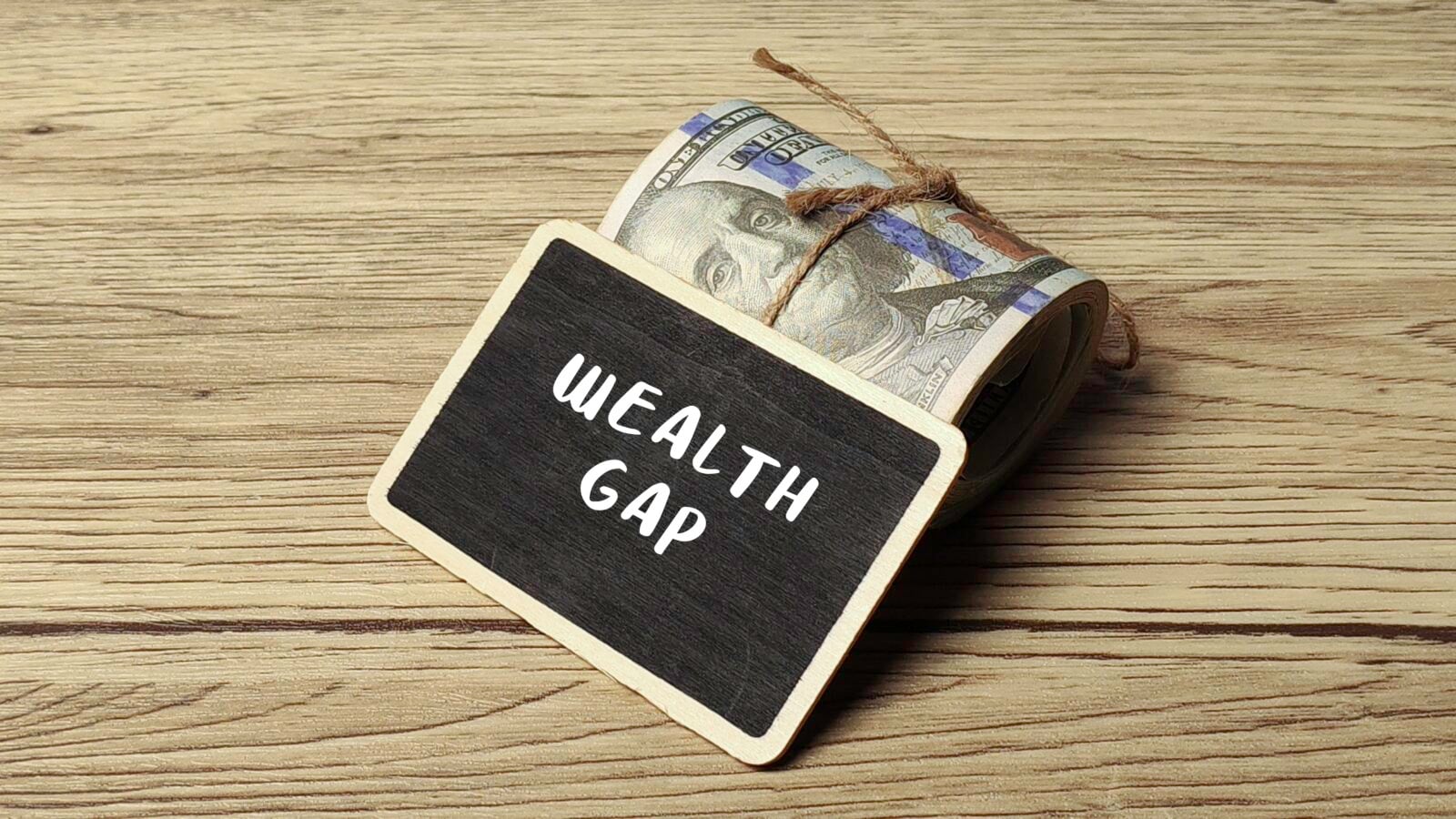
The United States is an extremely wealthy country, but the wealth is stacked like a tower with most people standing far below the balcony. Federal Reserve and inequality researchers show that the richest households control a huge share of national wealth, while the bottom half owns only a sliver of what the country produces.
The Congressional Budget Office found that from 1989 to 2022, families in the bottom half of the wealth distribution stayed stuck at just 6% of total family wealth. That means decades of growth, innovation, corporate profits, rising asset values, and political speeches about opportunity barely moved the needle for millions of households.
The bottom 60% are living in a rich country without owning much of the richness.
Their wages are not keeping up with real life

A paycheck can technically rise and still lose the race against life. Rent climbs. Groceries climb. Insurance climbs. Childcare climbs. A family earns a little more, then watches the entire increase disappear into bills that arrive with the emotional timing of bad news.
LISEP found that median earnings for the bottom 60% fell by about 4% after adjusting for cost of living from 2021 to 2023, even as the cost of basic economic security nearly doubled. That is the quiet cruelty of this economy.
People can work hard and still move backward. They can take extra shifts, delay dentist visits, pack lunch, cancel subscriptions, and still feel the floor tilting under them.
Their wealth is often fragile, illiquid, or buried under debt
When wealthy families talk about assets, they often mean stocks, businesses, trusts, investment accounts, and property that grows in value. For lower-wealth households, “wealth” often means a car that needs repairs, a small amount of home equity, future Social Security, or whatever remains after debt takes its bite.
Federal Reserve data show that the bottom half of households hold much of their wealth in real estate, while the ultra-rich hold far more in equities, the asset class that has grown dramatically during market booms. That difference matters because wealth is not only about how much someone has. It is also about whether that wealth can move, grow, protect, and be passed down.
A family cannot easily use future Social Security to cover an emergency today, and home equity does not buy groceries when the mortgage, taxes, and repairs keep rising.
Housing is swallowing the paycheck first

Housing used to be the thing that gave families stability. Now, for too many households, it is the bill that eats everything else alive. Rent, mortgage payments, insurance, utilities, repairs, and moving costs can turn every month into a countdown.
LISEP identifies housing as one of the major drivers pushing the cost of a basic life higher for the bottom 60%. That tracks with what many families already know from their own kitchen-table math. When housing takes too much of the paycheck, everything else gets squeezed: food, savings, childcare, medical care, transportation, education, and even joy.
For women trying to leave unsafe relationships, raise children alone, care for relatives, or rebuild after divorce, housing insecurity can become a locked door disguised as a bill.
Education is getting priced out of reach

Education is supposed to be the ladder. The problem is that the ladder now comes with fees, debt, interest, application costs, unpaid internships, transportation costs, childcare needs, and the risk that one unfinished degree can leave someone worse off than when they started.
LISEP reported that the savings required for in-state public university education for the bottom 60% rose sharply from 2021 to 2023. That means the very thing families are told to pursue for a better future is becoming harder to afford at the exact moment they need it most. Degrees, certifications, and training programs can still change lives, but the entrance fee keeps rising.
For low-income students, first-generation students, and students supporting family members, “just go back to school” can sound less like advice and more like someone tossing a rope from too far away.
Safety nets shrink when families need them most

America has already seen what stronger public support can do. During the pandemic, temporary expansions such as the Child Tax Credit helped reduce child poverty dramatically. After those supports expired, child poverty rose again, showing that hardship is not some mysterious natural disaster. Policy choices can soften it or sharpen it.
The Census Bureau reported that the child supplemental poverty rate fell to a record low in 2021, then rose after the expanded Child Tax Credit expired. That should have changed the national conversation. Instead, families were pushed back into the old bargain: work more, need less, stretch further, and pretend the system is not choosing which children get breathing room.
When social protections weaken, the bottom 60% face every job loss, illness, childcare crisis, and rent hike with fewer buffers.
Poor health steals years, wages, and peace

Poverty does not only empty wallets. It gets into the body. It shows up as chronic stress, untreated illness, skipped prescriptions, delayed checkups, poor sleep, high blood pressure, depression, exhaustion, and the kind of constant vigilance that makes rest feel almost suspicious.
Healthy People 2030 summarizes research showing that people in impoverished communities face higher risks of chronic disease, mental illness, higher mortality, and lower life expectancy. One major finding is especially stark: men in the top 1% of income live about 14.6 years longer than men in the bottom 1%, while women in the top 1% live about 10.1 years longer than women in the bottom 1%.
That is not just inequality. That is time being unevenly distributed.
Race and place make the squeeze even worse

The bottom 60% is not one neat group with one shared experience. Race, geography, gender, disability, immigration status, and family structure all shape how hard the economy hits. The National Equity Atlas has documented how poverty falls more heavily on people of color, especially Black, Native American, and Latino communities, because today’s hardship sits on top of older systems of exclusion.
That matters because the economy is not only built from wages and prices. It is built from neighborhoods, schools, transit routes, hospitals, job networks, banks, discrimination, segregation, and inherited wealth. A woman in a disinvested rural county or a Black mother in a historically underfunded neighborhood may face a very different climb than someone with family assets, stable housing, and access to high-paying networks.
The bottom 60% are being shut out, but some are being pushed further from the door than others.
They missed the biggest gains from stocks and asset booms

A lot of recent American wealth was created through assets, especially stocks and real estate. That sounds promising until you remember who owns most of those assets. The St. Louis Fed found that by late 2023, the top 0.1% held about $6.5 trillion in assets, more than double the roughly $3.1 trillion held by the entire bottom 50%.
That is why the stock market can hit new highs while many households feel nothing but pressure. If a family has little or no money invested, market gains do not pay their heating bill. If they rent, housing-price growth may enrich someone else while making their own life more expensive.
The boom worked like a private members’ club. The people already inside watched their wealth grow. The people outside got higher prices and another lecture about budgeting.
The American dream is becoming something people inherit

America still loves the story of the self-made climb. Start with little, work hard, make wise choices, and rise. It is a beautiful story, but it gets harder to believe when wealth increasingly moves through inheritance, home equity, family help, debt-free education, and networks that start long before a young adult sends out their first résumé.
CBO data show that families in the bottom half have remained stuck with 6% of total family wealth across decades. That matters for the next generation. Wealth helps parents pay for tutoring, stable housing, college, medical care, unpaid internships, first apartments, business starts, and emergency rescues.
Without it, children inherit stress instead of security. The American dream has not vanished, but for too many families, it now arrives with a cover charge.
Americans can feel that the system is tilted

People do not need an economics degree to know when the math is not working. They feel it at the grocery store. They feel it when a car repair becomes a financial emergency. They feel it when one illness can ruin a budget, when rent eats the raise, when childcare costs more than the job pays, and when every “smart choice” still leaves them one step behind.
Gallup reported in 2026 that a record 55% of Americans said their financial situation was getting worse. That kind of pessimism does not appear out of nowhere. It grows when people keep hearing that the economy is fine while their own lives feel tighter, smaller, and more fragile.
The bottom 60% are not imagining the shutout. They are living it, month by month, bill by bill, sacrifice by sacrifice.
The takeaway

The bottom 60% are not failing America. America is failing to build an economy where hard work still gives ordinary people a fair shot at stability, health, education, housing, and a future they can plan for. The data show a country where wealth rises upward, costs press downward, and millions of households are left in the middle trying to hold the roof up with tired hands.
Economic inequality is not abstract when women are the ones stretching food budgets, delaying care, managing unpaid labor, raising children through instability, and trying to build safety in a system that keeps moving the price of safety higher. A decent life should not be a luxury product. It should be the floor.
Disclaimer – This list is solely the author’s opinion based on research and publicly available information. It is not intended to be professional advice.
Like our content? Be sure to follow us