Refusing to Pay Federal Taxes as Protest: What the Law Actually Allows, and What It Does Not
In moments of deep political division, some Americans turn to their tax bill as a form of protest. Calls to withhold federal taxes, often framed as moral resistance to government policies, periodically resurface during wars, social movements, and election cycles.
The idea is not new. Tax resistance has been used for centuries as a symbolic challenge to state power. What has changed is the enforcement environment. Today’s federal tax system is highly automated, tightly enforced, and legally unforgiving. While refusing to pay taxes may feel like a powerful statement, it carries consequences that are both predictable and severe.
Here is what actually happens when federal taxes go unpaid, how tax resistance has played out historically, and what alternatives exist for people who want to make a financial statement without putting themselves at serious legal risk.
The Legal Reality of Not Paying Federal Taxes
Penalties and Interest Add Up Quickly
Under federal law, unpaid income taxes immediately begin accruing penalties and interest. The failure to pay penalty is generally assessed at 0.5 percent per month, capped at 25 percent of the unpaid balance, unless reduced through specific agreements with the government.
Interest is charged on top of penalties and compounds daily. The interest rate is set quarterly and tied to federal short term rates. In recent years it has ranged between 7 and 8 percent annually, depending on the quarter. That means a relatively modest tax bill can grow significantly in a short period of time.
A $10,000 unpaid balance can easily generate hundreds of dollars in interest within a year, even before penalties are fully assessed.
How Enforcement Actually Works
The Internal Revenue Service uses a tiered enforcement process that relies heavily on automation.
Most cases begin with mailed notices generated by the Automated Collection System. If no response is received, the agency can escalate to:
- Federal tax liens, which attach to property and damage credit
- Bank levies, freezing funds in checking or savings accounts
- Wage garnishment, requiring employers to send part of a paycheck directly to the government
- Seizure of assets, including vehicles or real estate in extreme cases
Tax refunds are automatically intercepted and applied to outstanding balances, even when the taxpayer is on a payment plan.
Criminal prosecution is relatively rare and usually reserved for cases involving fraud, false filings, or intentional evasion rather than simple nonpayment. Still, courts have consistently upheld convictions when refusal crosses into willful avoidance. Actor Wesley Snipes’ prison sentence for failure to file federal returns remains one of the most cited modern examples.
A Brief History of Tax Resistance in the United States

Early American Rebellions
Tax disputes played a central role in early American political unrest.
The Whiskey Rebellion of the 1790s erupted after an excise tax on distilled spirits disproportionately affected small farmers. President George Washington ultimately sent federal troops to suppress the uprising, establishing a precedent for federal enforcement authority.
A few years earlier, Shays’ Rebellion in Massachusetts saw indebted farmers protesting property seizures and tax collection practices, tensions that helped shape debates leading to the U.S. Constitution.
Civil Disobedience and Moral Protest
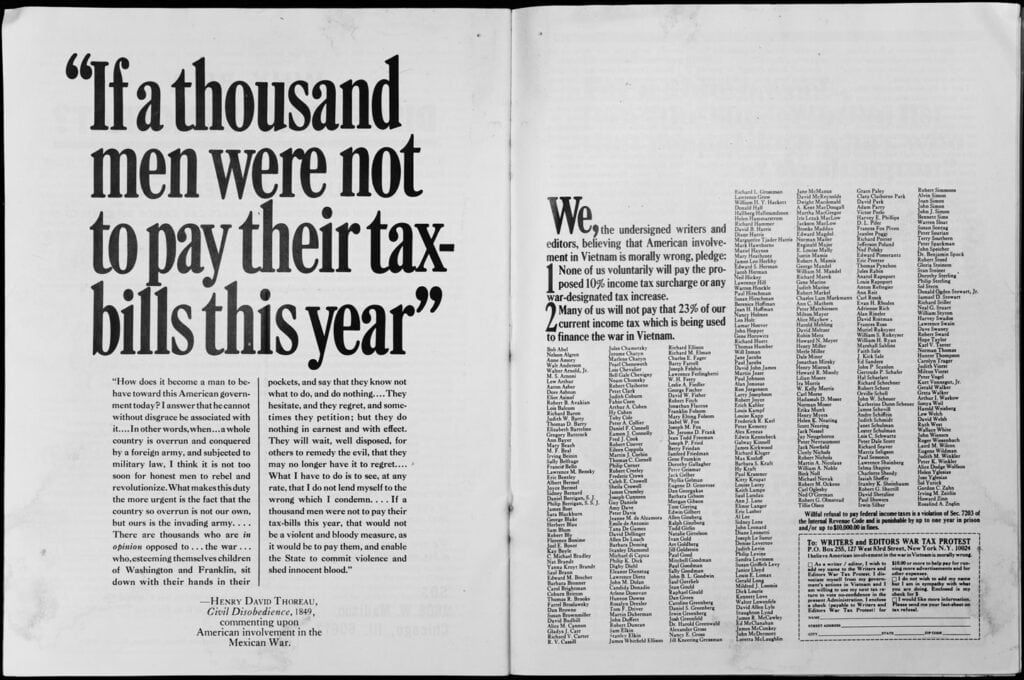
In 1846, Henry David Thoreau refused to pay a poll tax in protest of slavery and the Mexican American War. His essay Civil Disobedience later became foundational to nonviolent protest movements worldwide.
Thoreau argued that moral opposition sometimes required personal sacrifice, including imprisonment. His ideas influenced figures such as Mahatma Gandhi and Martin Luther King Jr., though neither advocated tax resistance as a mass legal strategy in the United States.
Vietnam Era Tax Protests
During the Vietnam War, hundreds of thousands of Americans participated in some form of war tax protest. Some withheld a portion of their taxes corresponding to military spending, while others refused payment entirely.
Artists such as Joan Baez publicly redirected withheld funds to charitable causes. Many participants faced liens, wage garnishment, or long term financial consequences, even as the protests attracted national attention.
Modern Tax Resistance and Its Limits
Organized Guidance, Limited Protection
Groups like the National War Tax Resistance Coordinating Committee provide information about historical protest tactics. These include symbolic underpayment or percentage based withholding tied to military budgets.
Importantly, such organizations do not claim that these actions are legal. Their materials typically emphasize that participants should expect enforcement and plan accordingly.
Sovereign Citizen Claims Are Not Legal
Courts have repeatedly rejected arguments promoted by sovereign citizen groups asserting that individuals are exempt from federal taxation. Claims based on so called “strawman” theories or misreadings of constitutional law have failed uniformly in federal courts.
Judges have frequently warned that these arguments not only lose cases but can increase penalties when raised frivolously.
Alternatives to Tax Refusal That Carry Less Risk

Pay Under Protest and Legal Challenges
Some states allow taxes to be paid under formal protest while challenging an assessment through legal channels. These mechanisms are typically limited to valuation or procedural disputes, not ideological objections to federal spending.
At the federal level, targeted litigation can raise constitutional or statutory questions, though success rates are low.
Consumer and Investment Pressure
Many modern movements focus on financial leverage rather than tax refusal:
- Boycotts targeting corporations over labor, climate, or human rights concerns
- Divestment campaigns urging institutions to withdraw investments from fossil fuels or other contested industries
- Shareholder activism using proxy votes and resolutions to influence corporate behavior
These strategies avoid direct conflict with tax law while still exerting economic pressure.
Political and Charitable Channels
Donating to advocacy organizations, funding legal challenges, or supporting policy campaigns allows individuals to direct resources toward change without triggering penalties or enforcement actions.
Weighing Symbolism Against Consequences
Refusing to pay federal taxes remains one of the most legally risky forms of protest available to individuals. History shows that while tax resistance can be symbolically powerful, it rarely produces direct policy change and almost always results in personal financial harm.
Thoreau famously wrote that under unjust governments, prison may be the proper place for the just. In the modern tax system, the consequences are more likely to involve liens, garnishment, and long term financial damage than moral transformation.
For many activists today, reshaping systems through lawful financial pressure, political engagement, and strategic advocacy offers a more sustainable path than challenging the IRS directly.
Related reading: This Is How the IRS Knows When You Are Cheating on Your Taxes